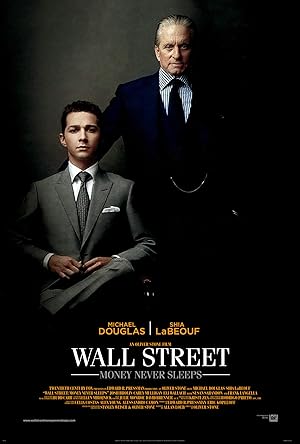
Wall Street: Money Never Sleeps
As the global economy teeters on the brink of disaster, a young Wall Street trader partners with disgraced former Wall Street corporate raider Gordon Gekko on a two-tiered mission: To alert the financial community to the coming doom, and to find out who was responsible for the death of the young trader's mentor.
Working with a respectable budget of $70.0M, the film achieved a steady performer with $134.7M in global revenue (+92% profit margin).
1 win & 4 nominations


Plot Structure
Story beats plotted across runtime


Narrative Arc
Emotional journey through the story's key moments
Story Circle
Blueprint 15-beat structure
Arcplot Score Breakdown
Weighted: Precision (70%) + Arc (15%) + Theme (15%)
Wall Street: Money Never Sleeps (2010) exemplifies precise plot construction, characteristic of Oliver Stone's storytelling approach. This structural analysis examines how the film's 15-point plot structure maps to proven narrative frameworks across 2 hours and 13 minutes. With an Arcplot score of 7.1, the film balances conventional beats with creative variation.
Structural Analysis
The Status Quo at 2 minutes (2% through the runtime) establishes Gordon Gekko is released from prison in 2001, collecting his brick cell phone and few belongings. The world has moved on without him - he is alone and forgotten, establishing the film's meditation on legacy and redemption.. Notably, this early placement immediately immerses viewers in the story world.
The inciting incident occurs at 16 minutes when Keller Zabel's stock collapses due to rumors spread by Bretton James. The Federal Reserve refuses to bail them out. Jake's mentor Louis Zabel and the firm are destroyed in a single day, pulling the rug out from Jake's secure world and setting revenge in motion.. At 12% through the film, this Disruption aligns precisely with traditional story structure. This beat shifts the emotional landscape, launching the protagonist into the central conflict.
The First Threshold at 34 minutes marks the transition into Act II, occurring at 25% of the runtime. This illustrates the protagonist's commitment to Jake makes a deal with Gordon Gekko: he'll help Gordon reconnect with Winnie in exchange for Gordon's help in taking down Bretton James. Jake actively chooses to enter the world of manipulation and revenge, partnering with the legendary corporate raider despite Winnie's objections., moving from reaction to action.
At 66 minutes, the Midpoint arrives at 50% of the runtime—precisely centered, creating perfect narrative symmetry. Significantly, this crucial beat False victory: Jake and Winnie get engaged/married, Gordon appears to be genuinely reforming and bonding with both of them, and Jake's revenge plot against Bretton James is taking shape. Everything seems to be working - but the stakes are raised when Winnie reveals she's pregnant and has a $100M trust fund from her mother., fundamentally raising what's at risk. The emotional intensity shifts, dividing the narrative into clear before-and-after phases.
The Collapse moment at 99 minutes (75% through) represents the emotional nadir. Here, Jake discovers Gordon has betrayed him - taking Winnie's $100M to rebuild his own empire, not for charity. Winnie learns Jake was complicit in reuniting her with her father for ulterior motives. She leaves Jake, pregnant and heartbroken. Jake has lost everything: his love, his integrity, his mentor's legacy, and enabled the very greed he fought against., reveals the protagonist at their lowest point. This beat's placement in the final quarter sets up the climactic reversal.
The Second Threshold at 106 minutes initiates the final act resolution at 80% of the runtime. Jake realizes what truly matters isn't revenge or money - it's family and doing the right thing. He gets crucial information about Bretton James' vulnerability and makes a final play, but this time not for revenge - for justice and to reclaim his integrity. He chooses people over profit., demonstrating the transformation achieved throughout the journey.
Emotional Journey
Wall Street: Money Never Sleeps's emotional architecture traces a deliberate progression across 15 carefully calibrated beats.
Narrative Framework
This structural analysis employs structural analysis methodology used to understand storytelling architecture. By mapping Wall Street: Money Never Sleeps against these established plot points, we can identify how Oliver Stone utilizes or subverts traditional narrative conventions. The plot point approach reveals not only adherence to structural principles but also creative choices that distinguish Wall Street: Money Never Sleeps within the drama genre.
Oliver Stone's Structural Approach
Among the 15 Oliver Stone films analyzed on Arcplot, the average structural score is 7.1, reflecting strong command of classical structure. Wall Street: Money Never Sleeps takes a more unconventional approach compared to the director's typical style. For comparative analysis, explore the complete Oliver Stone filmography.
Comparative Analysis
Additional drama films include After Thomas, South Pacific and Dirty Dancing: Havana Nights. For more Oliver Stone analyses, see Nixon, Any Given Sunday and Alexander.
Plot Points by Act
Act I
SetupStatus Quo
Gordon Gekko is released from prison in 2001, collecting his brick cell phone and few belongings. The world has moved on without him - he is alone and forgotten, establishing the film's meditation on legacy and redemption.
Theme
At Gekko's book lecture "Is Greed Good?", he warns the audience: "Someone reminded me the other day that greed is still good. But now it seems it's legal." This states the thematic question: has anything really changed, or is greed still destroying lives?
Worldbuilding
Establishing 2008 financial world: Jake Moore as successful young trader at Keller Zabel, his relationship with Winnie Gekko (Gordon's estranged daughter), his mentor Louis Zabel running the firm, and rival Bretton James. The world of high finance, green energy investments, and personal relationships is set up.
Disruption
Keller Zabel's stock collapses due to rumors spread by Bretton James. The Federal Reserve refuses to bail them out. Jake's mentor Louis Zabel and the firm are destroyed in a single day, pulling the rug out from Jake's secure world and setting revenge in motion.
Resistance
Louis Zabel commits suicide by jumping in front of a subway train. Jake is devastated and debates what to do. He attends Gekko's lecture and approaches him, learning that Gordon wants to reconcile with his daughter Winnie. Jake sees an opportunity: use Gordon's Wall Street knowledge to take down Bretton James.
Act II
ConfrontationFirst Threshold
Jake makes a deal with Gordon Gekko: he'll help Gordon reconnect with Winnie in exchange for Gordon's help in taking down Bretton James. Jake actively chooses to enter the world of manipulation and revenge, partnering with the legendary corporate raider despite Winnie's objections.
Mirror World
Jake secretly facilitates a meeting between Gordon and Winnie at a restaurant. Their awkward reunion - Gordon trying to reconnect, Winnie resistant but curious - represents the emotional/relational storyline that will carry the theme of whether people can change and relationships can be repaired.
Premise
Jake navigates multiple worlds: working at a new firm, continuing his green energy fusion project, developing his relationship with Gordon (learning Wall Street tactics), scheming against Bretton James, and managing his engagement to Winnie. The "fun and games" of financial warfare and mentorship play out.
Midpoint
False victory: Jake and Winnie get engaged/married, Gordon appears to be genuinely reforming and bonding with both of them, and Jake's revenge plot against Bretton James is taking shape. Everything seems to be working - but the stakes are raised when Winnie reveals she's pregnant and has a $100M trust fund from her mother.
Opposition
Gordon manipulates Jake into convincing Winnie to give him the $100M inheritance (supposedly for her foundation and to repay his debts). Jake's green energy deal collapses. Bretton James counters Jake's moves. The financial crisis of 2008 intensifies. Jake is caught between multiple loyalties and schemes unraveling.
Collapse
Jake discovers Gordon has betrayed him - taking Winnie's $100M to rebuild his own empire, not for charity. Winnie learns Jake was complicit in reuniting her with her father for ulterior motives. She leaves Jake, pregnant and heartbroken. Jake has lost everything: his love, his integrity, his mentor's legacy, and enabled the very greed he fought against.
Crisis
Jake sits alone in darkness, processing the complete destruction of his life. He's become what he hated - another player in the greed game. He must confront whether revenge and ambition were worth the cost, and what really matters to him.
Act III
ResolutionSecond Threshold
Jake realizes what truly matters isn't revenge or money - it's family and doing the right thing. He gets crucial information about Bretton James' vulnerability and makes a final play, but this time not for revenge - for justice and to reclaim his integrity. He chooses people over profit.
Synthesis
Jake executes his final move against Bretton James, forcing him into a corner using the same tactics used against Zabel. Meanwhile, Gordon - having his own realization about family after learning about his grandchild - attempts to make amends, returning the money. The moral and financial debts are resolved.
Transformation
Gordon arrives at Winnie and Jake's home with the returned $100M as a gift for his grandchild. The family - Jake, Winnie, Gordon, and the baby - come together. In contrast to Gordon's lonely prison release at the film's start, he's now surrounded by family. The cycle of greed is broken by choosing redemption and relationship.