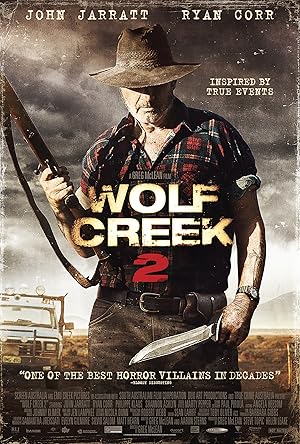
Wolf Creek 2
The outback once more becomes a place of horror as another unwitting tourist becomes the prey for crazed, serial-killing pig-hunter Mick Taylor.
Working with a modest budget of $8.0M, the film achieved a steady performer with $9.6M in global revenue (+20% profit margin).
4 wins & 4 nominations


Plot Structure
Story beats plotted across runtime


Narrative Arc
Emotional journey through the story's key moments
Story Circle
Blueprint 15-beat structure
Arcplot Score Breakdown
Weighted: Precision (70%) + Arc (15%) + Theme (15%)
Wolf Creek 2 (2013) showcases strategically placed narrative architecture, characteristic of Greg McLean's storytelling approach. This structural analysis examines how the film's 15-point plot structure maps to proven narrative frameworks across 1 hour and 46 minutes. With an Arcplot score of 7.2, the film balances conventional beats with creative variation.
Structural Analysis
The Status Quo at 1 minutes (1% through the runtime) establishes Two Australian highway patrol officers sit bored in their car on a desolate outback road, establishing the vast, empty, and dangerous landscape where tourists disappear.. Significantly, this early placement immediately immerses viewers in the story world.
The inciting incident occurs at 13 minutes when Mick Taylor appears at the German tourists' campsite, his friendly demeanor masking lethal intent. The ordinary backpacking trip transforms into a nightmare when his true nature emerges.. At 12% through the film, this Disruption aligns precisely with traditional story structure. This beat shifts the emotional landscape, launching the protagonist into the central conflict.
The First Threshold at 27 minutes marks the transition into Act II, occurring at 25% of the runtime. This indicates the protagonist's commitment to Paul, a British backpacker driving through the outback, witnesses Mick pursuing Katarina on the highway. He makes the fateful choice to intervene, picking her up and accelerating away from Mick's truck., moving from reaction to action.
At 53 minutes, the Midpoint arrives at 50% of the runtime—precisely centered, creating perfect narrative symmetry. Significantly, this crucial beat Katarina dies during the chase, eliminating Paul's companion and leaving him utterly alone against Mick. This false defeat strips away any hope of shared survival and raises the stakes to pure individual survival., fundamentally raising what's at risk. The emotional intensity shifts, dividing the narrative into clear before-and-after phases.
The Collapse moment at 80 minutes (75% through) represents the emotional nadir. Here, Bound in Mick's torture chamber, Paul is forced to play a sadistic Australian history trivia game where wrong answers mean mutilation. Paul loses a finger, experiencing the full horror of Mick's psychopathic games., demonstrates the protagonist at their lowest point. This beat's placement in the final quarter sets up the climactic reversal.
The Second Threshold at 85 minutes initiates the final act resolution at 80% of the runtime. Paul finds an opportunity when Mick is momentarily distracted. Drawing on his will to survive, he fights back, managing to wound Mick and escape the underground lair into the tunnels., demonstrating the transformation achieved throughout the journey.
Emotional Journey
Wolf Creek 2's emotional architecture traces a deliberate progression across 15 carefully calibrated beats.
Narrative Framework
This structural analysis employs structural analysis methodology used to understand storytelling architecture. By mapping Wolf Creek 2 against these established plot points, we can identify how Greg McLean utilizes or subverts traditional narrative conventions. The plot point approach reveals not only adherence to structural principles but also creative choices that distinguish Wolf Creek 2 within the horror genre.
Greg McLean's Structural Approach
Among the 5 Greg McLean films analyzed on Arcplot, the average structural score is 7.4, reflecting strong command of classical structure. Wolf Creek 2 takes a more unconventional approach compared to the director's typical style. For comparative analysis, explore the complete Greg McLean filmography.
Comparative Analysis
Additional horror films include Thinner, A Nightmare on Elm Street and Mary Reilly. For more Greg McLean analyses, see The Darkness, The Belko Experiment and Rogue.
Plot Points by Act
Act I
SetupStatus Quo
Two Australian highway patrol officers sit bored in their car on a desolate outback road, establishing the vast, empty, and dangerous landscape where tourists disappear.
Theme
Mick Taylor casually tells the officers that tourists don't understand the outback—foreshadowing the theme that outsiders are prey in this hostile land where the rules of civilization don't apply.
Worldbuilding
The outback's brutal nature is established as Mick murders both cops, then shifts to German backpackers Rutger and Katarina enjoying their carefree tourist experience, unaware of the danger lurking in the beautiful landscape.
Disruption
Mick Taylor appears at the German tourists' campsite, his friendly demeanor masking lethal intent. The ordinary backpacking trip transforms into a nightmare when his true nature emerges.
Resistance
Rutger attempts to protect Katarina from Mick but is brutally killed. Katarina flees through the outback as Mick pursues her, demonstrating the futility of fighting back against this predator on his home turf.
Act II
ConfrontationFirst Threshold
Paul, a British backpacker driving through the outback, witnesses Mick pursuing Katarina on the highway. He makes the fateful choice to intervene, picking her up and accelerating away from Mick's truck.
Mirror World
Paul and Katarina share a brief connection as fellow travelers trying to survive, but this hope is shattered when Mick rams their vehicle. Katarina represents what Paul could lose—his own life and humanity.
Premise
A relentless vehicular chase unfolds across the outback as Paul desperately tries to escape Mick's massive truck. The pursuit delivers intense survival horror action, with Paul using every resource to stay alive.
Midpoint
Katarina dies during the chase, eliminating Paul's companion and leaving him utterly alone against Mick. This false defeat strips away any hope of shared survival and raises the stakes to pure individual survival.
Opposition
Paul's escape attempts grow increasingly desperate. He crashes, runs through the bush, and is eventually captured by Mick, who takes him to his underground lair filled with trophies from previous victims.
Collapse
Bound in Mick's torture chamber, Paul is forced to play a sadistic Australian history trivia game where wrong answers mean mutilation. Paul loses a finger, experiencing the full horror of Mick's psychopathic games.
Crisis
Paul endures psychological and physical torture, his spirit nearly broken. He witnesses evidence of countless victims and realizes he's just another trophy for Mick's collection, facing the abyss of hopelessness.
Act III
ResolutionSecond Threshold
Paul finds an opportunity when Mick is momentarily distracted. Drawing on his will to survive, he fights back, managing to wound Mick and escape the underground lair into the tunnels.
Synthesis
Paul navigates the labyrinthine tunnels and emerges into the outback. He stumbles toward civilization as Mick pursues. Paul finally reaches a road and is discovered by authorities, having survived the nightmare.
Transformation
Paul sits catatonic in a psychiatric facility, physically alive but psychologically destroyed. The closing image shows a man who escaped with his life but lost his mind—survival came at the cost of his humanity.