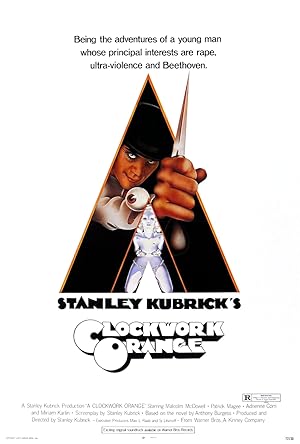
A Clockwork Orange
Protagonist Alex DeLarge is an "ultraviolent" youth in futuristic Britain. As with all luck, his eventually runs out and he's arrested and convicted of murder. While in prison, Alex learns of an experimental program in which convicts are programmed to detest violence. If he goes through the program, his sentence will be reduced and he will be back on the streets sooner than expected. But Alex's ordeals are far from over once he hits the streets of Britain..
Despite its tight budget of $2.2M, A Clockwork Orange became a runaway success, earning $27.0M worldwide—a remarkable 1129% return. The film's distinctive approach attracted moviegoers, demonstrating that strong storytelling can transcend budget limitations.
Nominated for 4 Oscars. 12 wins & 26 nominations
Roger Ebert
"Kubrick has created a world more real than the world we live in, and using his world he has destroyed ours."Read Full Review


Plot Structure
Story beats plotted across runtime


Narrative Arc
Emotional journey through the story's key moments
Story Circle
Blueprint 15-beat structure
Arcplot Score Breakdown
Weighted: Precision (70%) + Arc (15%) + Theme (15%)
A Clockwork Orange (1971) exhibits deliberately positioned narrative design, characteristic of Stanley Kubrick's storytelling approach. This structural analysis examines how the film's 15-point plot structure maps to proven narrative frameworks across 2 hours and 16 minutes. With an Arcplot score of 4.3, the film takes an unconventional approach to traditional narrative frameworks.
Characters
Cast & narrative archetypes

Alex DeLarge
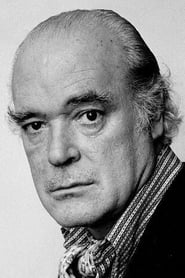
Mr. Alexander

Prison Chaplain
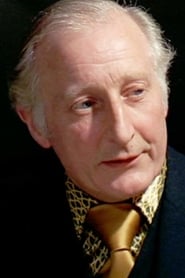
Minister of the Interior
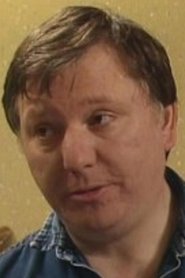
Georgie

Dim

Pete
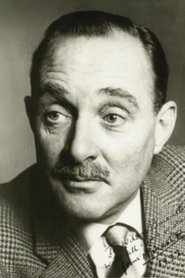
Chief Guard Barnes
Main Cast & Characters
Alex DeLarge
Played by Malcolm McDowell
A charismatic sociopath and gang leader who leads his "droogs" in ultra-violence, undergoing experimental aversion therapy that strips him of free will.
Mr. Alexander
Played by Patrick Magee
A liberal writer whose wife is killed by Alex's gang, later becoming an instrument of revenge when he recognizes Alex.
Prison Chaplain
Played by Godfrey Quigley
A compassionate priest who questions the morality of removing choice from criminals, warning that goodness must come from within.
Minister of the Interior
Played by Anthony Sharp
A pragmatic politician who champions the Ludovico Technique as a solution to prison overcrowding and crime.
Georgie
Played by James Marcus
Alex's ambitious droog who challenges his leadership, later becoming a police officer who brutalizes his former leader.
Dim
Played by Warren Clarke
Alex's dim-witted but physically strong droog, who also becomes a police officer and participates in beating Alex.
Pete
Played by Michael Tarn
The most passive member of Alex's gang who participates in their crimes but shows less enthusiasm than the others.
Chief Guard Barnes
Played by Michael Bates
A brutal prison guard who oversees Alex and represents the sadistic authority within the correctional system.
Structural Analysis
The Status Quo at 1 minutes (1% through the runtime) establishes Alex sits in the Korova Milk Bar with his droogs, dressed in codpieces and bowler hats, contemplating ultra-violence. This opening establishes Alex's world of nihilistic brutality and complete moral freedom.. Notably, this early placement immediately immerses viewers in the story world.
The inciting incident occurs at 14 minutes when Alex's droogs challenge his leadership, demanding more equality and bigger takings. Dim directly defies Alex, forcing a confrontation that shatters the group's unity and sets up Alex's downfall.. At 11% through the film, this Disruption aligns precisely with traditional story structure. This beat shifts the emotional landscape, launching the protagonist into the central conflict.
The First Threshold at 30 minutes marks the transition into Act II, occurring at 22% of the runtime. This illustrates the protagonist's commitment to Alex is arrested and charged with murder after killing the Cat Lady. He chooses to assert his identity, declaring "I'm a victim of the modern age" - entering the world of institutional control and punishment., moving from reaction to action.
At 61 minutes, the Midpoint arrives at 45% of the runtime—arriving early, accelerating into Act IIb complications. The analysis reveals that this crucial beat Alex is publicly demonstrated as "cured" before government officials and press. He cannot defend himself from humiliation or react to a naked woman. The Minister declares the experiment a success, but the chaplain protests it's a false victory - Alex appears reformed but has lost his humanity and free will., fundamentally raising what's at risk. The emotional intensity shifts, dividing the narrative into clear before-and-after phases.
The Collapse moment at 92 minutes (68% through) represents the emotional nadir. Here, Mr. Alexander recognizes Alex as the one who attacked him and killed his wife. Seeking political revenge against the government, Alexander drives Alex to attempt suicide by playing Beethoven. Alex jumps from the window - a literal death moment., shows the protagonist at their lowest point. This beat's placement in the final quarter sets up the climactic reversal.
The Second Threshold at 98 minutes initiates the final act resolution at 72% of the runtime. The Minister visits Alex and offers a deal: in exchange for cooperation and public forgiveness, they'll take care of him. Alex realizes he has leverage and accepts, understanding he can manipulate the system that tried to destroy him., demonstrating the transformation achieved throughout the journey.
Emotional Journey
A Clockwork Orange's emotional architecture traces a deliberate progression across 15 carefully calibrated beats.
Narrative Framework
This structural analysis employs structural analysis methodology used to understand storytelling architecture. By mapping A Clockwork Orange against these established plot points, we can identify how Stanley Kubrick utilizes or subverts traditional narrative conventions. The plot point approach reveals not only adherence to structural principles but also creative choices that distinguish A Clockwork Orange within the crime genre.
Stanley Kubrick's Structural Approach
Among the 10 Stanley Kubrick films analyzed on Arcplot, the average structural score is 5.3, showcasing experimental approaches to narrative form. A Clockwork Orange takes a more unconventional approach compared to the director's typical style. For comparative analysis, explore the complete Stanley Kubrick filmography.
Comparative Analysis
Additional crime films include The Bad Guys, Rustom and The Whole Ten Yards. For more Stanley Kubrick analyses, see Eyes Wide Shut, Barry Lyndon and Lolita.
Plot Points by Act
Act I
SetupStatus Quo
Alex sits in the Korova Milk Bar with his droogs, dressed in codpieces and bowler hats, contemplating ultra-violence. This opening establishes Alex's world of nihilistic brutality and complete moral freedom.
Theme
The writer Mr. Alexander discusses his manuscript "A Clockwork Orange" about the importance of moral choice. He states that forcing goodness is as inhuman as forcing evil - the central thematic question of the film.
Worldbuilding
Alex and his droogs engage in ultra-violence: beating a homeless man, fighting a rival gang, the home invasion and assault of Mr. Alexander and his wife. We see Alex's complete world: his leadership, his love of Beethoven, his dysfunctional home life, and society's inability to control youth crime.
Disruption
Alex's droogs challenge his leadership, demanding more equality and bigger takings. Dim directly defies Alex, forcing a confrontation that shatters the group's unity and sets up Alex's downfall.
Resistance
Alex reasserts dominance by violently attacking Dim and Georgie, then leads them on the "Cat Lady" robbery to prove his authority. His arrogance and brutality escalate, but his droogs betray him during the escape, leaving him for the police.
Act II
ConfrontationFirst Threshold
Alex is arrested and charged with murder after killing the Cat Lady. He chooses to assert his identity, declaring "I'm a victim of the modern age" - entering the world of institutional control and punishment.
Mirror World
The prison chaplain warns Alex about the Ludovico Technique, questioning whether it truly reforms or merely conditions. He represents the moral voice asking whether removing choice removes humanity - the film's thematic mirror.
Premise
Alex serves time in prison, manipulating the chaplain and volunteering for the Ludovico Technique to gain early release. He undergoes the experimental aversion therapy, forced to watch violence while injected with nausea-inducing drugs, ultimately becoming physically incapable of violence or listening to Beethoven.
Midpoint
Alex is publicly demonstrated as "cured" before government officials and press. He cannot defend himself from humiliation or react to a naked woman. The Minister declares the experiment a success, but the chaplain protests it's a false victory - Alex appears reformed but has lost his humanity and free will.
Opposition
Released into society, Alex discovers he's homeless (parents rented his room), helpless (cannot defend himself), and despised (the world remembers his crimes). His former victims take revenge: the homeless man and his fellows beat him, his former droogs (now police) brutalize him, and he collapses at Mr. Alexander's doorstep.
Collapse
Mr. Alexander recognizes Alex as the one who attacked him and killed his wife. Seeking political revenge against the government, Alexander drives Alex to attempt suicide by playing Beethoven. Alex jumps from the window - a literal death moment.
Crisis
Alex lies in hospital, broken and in a full body cast. The government faces scandal as the Ludovico Technique is exposed as torture. Alex exists in darkness, physically and psychologically shattered, the complete victim of opposing forces.
Act III
ResolutionSecond Threshold
The Minister visits Alex and offers a deal: in exchange for cooperation and public forgiveness, they'll take care of him. Alex realizes he has leverage and accepts, understanding he can manipulate the system that tried to destroy him.
Synthesis
Alex is celebrated by the press, given a stereo and promised a job. Doctors reveal the Ludovico Technique has been reversed. Alex listens to Beethoven again and experiences violent fantasies, discovering he is "cured" of his cure - his capacity for choice and evil has returned.
Transformation
Alex fantasizes about having sex with a woman while an audience of Victorian-era aristocrats applauds. He declares "I was cured, all right" - he has returned to his old self, perhaps worse, now with institutional protection. The image mirrors the opening but shows Alex has learned nothing except how to game the system.