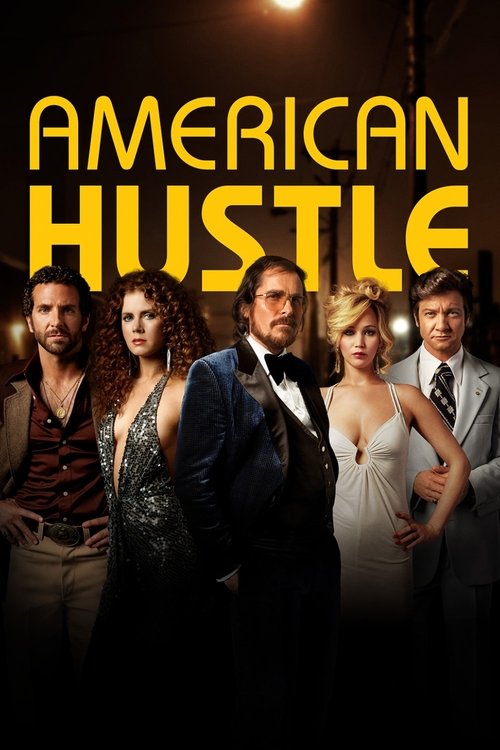
American Hustle
A conman and his seductive partner are forced to work for a wild FBI agent, who pushes them into a world of Jersey power-brokers and the Mafia.
Despite a respectable budget of $40.0M, American Hustle became a runaway success, earning $251.2M worldwide—a remarkable 528% return.
Nominated for 10 Oscars. 70 wins & 228 nominations


Plot Structure
Story beats plotted across runtime


Narrative Arc
Emotional journey through the story's key moments
Story Circle
Blueprint 15-beat structure
Arcplot Score Breakdown
Weighted: Precision (70%) + Arc (15%) + Theme (15%)
American Hustle (2013) exemplifies meticulously timed narrative design, characteristic of David O. Russell's storytelling approach. This structural analysis examines how the film's 15-point plot structure maps to proven narrative frameworks across 2 hours and 18 minutes. With an Arcplot score of 6.7, the film balances conventional beats with creative variation.
Characters
Cast & narrative archetypes

Irving Rosenfeld
Sydney Prosser
Richie DiMaso
Rosalyn Rosenfeld
Mayor Carmine Polito
Main Cast & Characters
Irving Rosenfeld
Played by Christian Bale
A skilled con artist forced to work with the FBI, torn between survival and love. Master manipulator struggling to protect those he cares about.
Sydney Prosser
Played by Amy Adams
Irving's partner in crime and love interest who reinvents herself as British aristocrat "Lady Edith Greensly". Smart, ambitious, and adaptable survivor.
Richie DiMaso
Played by Bradley Cooper
Ambitious FBI agent who forces Irving and Sydney to help him entrap powerful targets. Reckless, driven by dreams of glory and recognition.
Rosalyn Rosenfeld
Played by Jennifer Lawrence
Irving's unstable, unpredictable wife who threatens to derail the entire operation. Volatile yet vulnerable, refuses to grant Irving a divorce.
Mayor Carmine Polito
Played by Jeremy Renner
Well-meaning New Jersey mayor who becomes the FBI's primary target. Genuinely wants to help his community but gets caught in corruption.
Structural Analysis
The Status Quo at 2 minutes (1% through the runtime) establishes Irving meticulously constructs his elaborate combover in a hotel mirror - a visual metaphor for the carefully constructed facades that define his life as a con artist. This opening image establishes the film's central tension between appearance and reality.. Structural examination shows that this early placement immediately immerses viewers in the story world.
The inciting incident occurs at 20 minutes when FBI agent Richie DiMaso catches Irving and Sydney in a sting operation. They're arrested, and their carefully constructed world of controlled cons collapses. DiMaso offers a deal: help catch four bigger criminals or go to prison.. At 15% through the film, this Disruption is delayed, allowing extended setup of the story world. This beat shifts the emotional landscape, launching the protagonist into the central conflict.
The First Threshold at 35 minutes marks the transition into Act II, occurring at 25% of the runtime. This indicates the protagonist's commitment to Irving makes the active choice to fully commit to DiMaso's operation, agreeing to help entrap New Jersey Mayor Carmine Polito. This decision launches them into the dangerous world of political corruption and mob connections - a mirror world far more treacherous than their small-time cons., moving from reaction to action.
At 70 minutes, the Midpoint arrives at 50% of the runtime—precisely centered, creating perfect narrative symmetry. The analysis reveals that this crucial beat The operation connects with the mafia through Carmine. Victor Tellegio (representing mob boss Meyer Lansky) enters the picture, raising stakes to life-or-death. What seemed like a controlled con has spiraled into genuinely dangerous territory. DiMaso's ambition has pulled them into a world where mistakes mean death, not just prison., fundamentally raising what's at risk. The emotional intensity shifts, dividing the narrative into clear before-and-after phases.
The Collapse moment at 104 minutes (76% through) represents the emotional nadir. Here, Carmine Polito is arrested in a public, humiliating FBI operation. Irving watches as a genuinely good man - perhaps the only authentic person in his life - is destroyed by Irving's deception. The "whiff of death" is the death of Irving's ability to rationalize his life of cons., shows the protagonist at their lowest point. This beat's placement in the final quarter sets up the climactic reversal.
The Second Threshold at 110 minutes initiates the final act resolution at 80% of the runtime. Irving realizes he can turn the con back on DiMaso himself. He synthesizes everything he's learned: his con artistry skills, Sydney's partnership, understanding of how the FBI works, and his genuine desire to help Carmine. He devises a plan to con the con artist., demonstrating the transformation achieved throughout the journey.
Emotional Journey
American Hustle's emotional architecture traces a deliberate progression across 15 carefully calibrated beats.
Narrative Framework
This structural analysis employs a 15-point narrative structure framework that maps key story moments. By mapping American Hustle against these established plot points, we can identify how David O. Russell utilizes or subverts traditional narrative conventions. The plot point approach reveals not only adherence to structural principles but also creative choices that distinguish American Hustle within the drama genre.
David O. Russell's Structural Approach
Among the 8 David O. Russell films analyzed on Arcplot, the average structural score is 7.0, demonstrating varied approaches to story architecture. American Hustle takes a more unconventional approach compared to the director's typical style. For comparative analysis, explore the complete David O. Russell filmography.
Comparative Analysis
Additional drama films include After Thomas, South Pacific and Dirty Dancing: Havana Nights. For more David O. Russell analyses, see Silver Linings Playbook, Three Kings and Amsterdam.
Plot Points by Act
Act I
SetupStatus Quo
Irving meticulously constructs his elaborate combover in a hotel mirror - a visual metaphor for the carefully constructed facades that define his life as a con artist. This opening image establishes the film's central tension between appearance and reality.
Theme
Sydney tells Irving: "You're nothing to me until you're everything." This line encapsulates the film's thematic exploration of authenticity versus performance, survival versus connection, and the impossibility of half-measures in both love and cons.
Worldbuilding
Flashbacks establish Irving's world: his dry-cleaning business fronting for loan scams, his toxic marriage to Rosalyn, and the electric connection when he meets Sydney. We see their partnership bloom as she becomes "Lady Edith Greensley" with a fake British accent, creating their most successful con operation yet.
Disruption
FBI agent Richie DiMaso catches Irving and Sydney in a sting operation. They're arrested, and their carefully constructed world of controlled cons collapses. DiMaso offers a deal: help catch four bigger criminals or go to prison.
Resistance
Irving resists cooperating with DiMaso, trying to protect Sydney and find a way out. DiMaso's ambition and recklessness become clear - he wants to expand beyond four arrests to politicians and mob figures. Irving debates whether to commit fully or find an escape route, while navigating Rosalyn's manipulation and his growing fear.
Act II
ConfrontationFirst Threshold
Irving makes the active choice to fully commit to DiMaso's operation, agreeing to help entrap New Jersey Mayor Carmine Polito. This decision launches them into the dangerous world of political corruption and mob connections - a mirror world far more treacherous than their small-time cons.
Mirror World
Irving meets Mayor Carmine Polito, a genuinely good man trying to rebuild Atlantic City and help his constituents. Carmine represents everything Irving could be but isn't - authentic, honest, committed to something larger than himself. This relationship will force Irving to confront his own morality.
Premise
The ABSCAM operation unfolds in all its elaborate glory: fake sheikhs, briefcases of money, hotel suites, and increasingly complex layers of deception. Irving and Sydney navigate between DiMaso's reckless ambition, mob threats, Rosalyn's chaos, and their growing guilt about destroying Carmine. The premise delivers: watching expert con artists work their magic.
Midpoint
The operation connects with the mafia through Carmine. Victor Tellegio (representing mob boss Meyer Lansky) enters the picture, raising stakes to life-or-death. What seemed like a controlled con has spiraled into genuinely dangerous territory. DiMaso's ambition has pulled them into a world where mistakes mean death, not just prison.
Opposition
Everything tightens: the mob grows suspicious, Rosalyn nearly destroys everything by revealing details to a mobster, DiMaso's superiors threaten to shut down the operation, and Irving's feelings for Carmine make the betrayal increasingly unbearable. Sydney's true identity becomes uncertain even to herself. The pressure intensifies from all sides.
Collapse
Carmine Polito is arrested in a public, humiliating FBI operation. Irving watches as a genuinely good man - perhaps the only authentic person in his life - is destroyed by Irving's deception. The "whiff of death" is the death of Irving's ability to rationalize his life of cons.
Crisis
Irving confronts the darkness of what he's done. He's destroyed a good man, endangered Sydney, and let DiMaso's ambition control everything. The emotional weight of all the lies and performances crushes down. He must find a way to salvage something authentic from the wreckage.
Act III
ResolutionSecond Threshold
Irving realizes he can turn the con back on DiMaso himself. He synthesizes everything he's learned: his con artistry skills, Sydney's partnership, understanding of how the FBI works, and his genuine desire to help Carmine. He devises a plan to con the con artist.
Synthesis
Irving and Sydney execute their counter-con: using a fake sheikh bribe to entrap DiMaso himself into evidence tampering. They manipulate DiMaso's ambition and recklessness against him. The plan works - DiMaso is discredited, the case falls apart, and they negotiate light sentences. Irving also helps ensure Carmine serves minimal time.
Transformation
Irving and Sydney, now together authentically, run a legitimate art gallery. The closing image mirrors the opening: Irving is still constructing his appearance, but now there's honesty in his life. He's found a way to survive while being real - "You're nothing to me until you're everything" finally fulfilled.