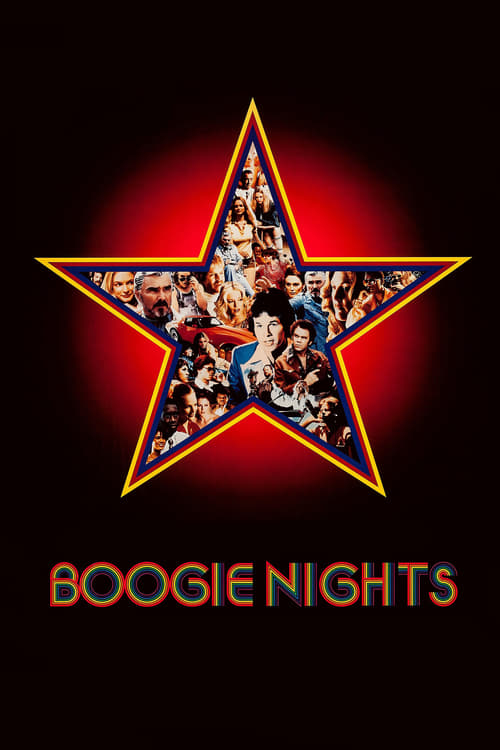
Boogie Nights
Set in 1977, back when sex was safe, pleasure was a business and business was booming, idealistic porn producer Jack Horner aspires to elevate his craft to an art form. Horner discovers Eddie Adams, a hot young talent working as a busboy in a nightclub, and welcomes him into the extended family of movie-makers, misfits and hangers-on that are always around. Adams' rise from nobody to a celebrity adult entertainer is meteoric, and soon the whole world seems to know his porn alter ego, "Dirk Diggler". Now, when disco and drugs are in vogue, fashion is in flux and the party never seems to stop, Adams' dreams of turning sex into stardom are about to collide with cold, hard reality.
Despite a mid-range budget of $15.0M, Boogie Nights became a box office success, earning $43.1M worldwide—a 187% return.
Nominated for 3 Oscars. 36 wins & 64 nominations


Plot Structure
Story beats plotted across runtime


Narrative Arc
Emotional journey through the story's key moments
Story Circle
Blueprint 15-beat structure
Arcplot Score Breakdown
Weighted: Precision (70%) + Arc (15%) + Theme (15%)
Boogie Nights (1997) showcases carefully calibrated narrative architecture, characteristic of Paul Thomas Anderson's storytelling approach. This structural analysis examines how the film's 15-point plot structure maps to proven narrative frameworks across 2 hours and 36 minutes. With an Arcplot score of 7.3, the film balances conventional beats with creative variation.
Characters
Cast & narrative archetypes

Eddie Adams / Dirk Diggler
Jack Horner
Amber Waves
Rollergirl
Reed Rothchild
Buck Swope
Maurice Rodriguez / Maurice T. Rodriguez
Little Bill Thompson
Colonel James
Scotty J.
Main Cast & Characters
Eddie Adams / Dirk Diggler
Played by Mark Wahlberg
A young busboy discovered by Jack Horner and transformed into porn star Dirk Diggler, whose rise and fall mirrors the industry's golden age.
Jack Horner
Played by Burt Reynolds
A visionary pornographic filmmaker who treats his craft as art and his cast as family, driven to create meaningful adult cinema.
Amber Waves
Played by Julianne Moore
A warm-hearted porn actress and mother figure to the family, fighting for custody of her son while finding purpose in her chosen family.
Rollergirl
Played by Heather Graham
A teenage high school dropout who skates everywhere and never takes off her skates, finding acceptance in the porn world.
Reed Rothchild
Played by John C. Reilly
Dirk's best friend and collaborator, a magician-turned-porn-star who dreams of opening a stereo equipment store.
Buck Swope
Played by Don Cheadle
A good-natured porn actor who dreams of opening his own stereo store and struggles with racism while pursuing his entrepreneurial ambitions.
Maurice Rodriguez / Maurice T. Rodriguez
Played by Luis Guzmán
Jack's loyal assistant and aspiring filmmaker who documents the family and later becomes a successful music producer.
Little Bill Thompson
Played by William H. Macy
Jack's cuckolded assistant director whose wife's public infidelities drive him to a breaking point.
Colonel James
Played by Robert Ridgely
A wealthy investor in Jack's films who harbors feelings for Dirk and represents old Hollywood money.
Scotty J.
Played by Philip Seymour Hoffman
The awkward boom operator who develops an unrequited crush on Dirk, representing outsider loneliness.
Structural Analysis
The Status Quo at 2 minutes (1% through the runtime) establishes Eddie Adams works as a busboy at a nightclub, living an unremarkable life in the San Fernando Valley, unseen and directionless.. Of particular interest, this early placement immediately immerses viewers in the story world.
The inciting incident occurs at 18 minutes when Jack Horner approaches Eddie with an offer to be in his films, recognizing his "special thing" - disrupting Eddie's mundane existence with the promise of stardom.. At 12% through the film, this Disruption aligns precisely with traditional story structure. This beat shifts the emotional landscape, launching the protagonist into the central conflict.
The First Threshold at 37 minutes marks the transition into Act II, occurring at 24% of the runtime. This shows the protagonist's commitment to Eddie actively chooses to perform in his first adult film, taking the name Dirk Diggler and fully committing to this new world and identity., moving from reaction to action.
At 78 minutes, the Midpoint arrives at 50% of the runtime—precisely centered, creating perfect narrative symmetry. The analysis reveals that this crucial beat New Year's Eve 1980 - the transition into the 80s marks a shift as video begins replacing film, cocaine use increases, and the golden age starts to fade., fundamentally raising what's at risk. The emotional intensity shifts, dividing the narrative into clear before-and-after phases.
The Collapse moment at 117 minutes (75% through) represents the emotional nadir. Here, Dirk, Reed, and Todd's drug deal gone catastrophically wrong - gunfire, death (Todd killed), and Dirk beaten and robbed - the literal "whiff of death" destroying his delusions of invincibility., demonstrates the protagonist at their lowest point. This beat's placement in the final quarter sets up the climactic reversal.
The Second Threshold at 125 minutes initiates the final act resolution at 80% of the runtime. Dirk returns to Jack's house, swallowing his pride to ask for forgiveness and his place back in the family - synthesizing humility with his talent., demonstrating the transformation achieved throughout the journey.
Emotional Journey
Boogie Nights's emotional architecture traces a deliberate progression across 15 carefully calibrated beats.
Narrative Framework
This structural analysis employs proven narrative structure principles that track dramatic progression. By mapping Boogie Nights against these established plot points, we can identify how Paul Thomas Anderson utilizes or subverts traditional narrative conventions. The plot point approach reveals not only adherence to structural principles but also creative choices that distinguish Boogie Nights within the drama genre.
Paul Thomas Anderson's Structural Approach
Among the 8 Paul Thomas Anderson films analyzed on Arcplot, the average structural score is 6.6, demonstrating varied approaches to story architecture. Boogie Nights represents one of the director's most structurally precise works. For comparative analysis, explore the complete Paul Thomas Anderson filmography.
Comparative Analysis
Additional drama films include After Thomas, South Pacific and Dirty Dancing: Havana Nights. For more Paul Thomas Anderson analyses, see Magnolia, Phantom Thread and Licorice Pizza.
Plot Points by Act
Act I
SetupStatus Quo
Eddie Adams works as a busboy at a nightclub, living an unremarkable life in the San Fernando Valley, unseen and directionless.
Theme
Jack Horner tells Eddie: "Everyone is blessed with one special thing" - establishing the theme of finding identity, family, and purpose through one's unique gifts.
Worldbuilding
Introduction to Jack Horner's porn film family: the crew, actors, and their world of parties, shoots, and camaraderie in the late 1970s adult film industry.
Disruption
Jack Horner approaches Eddie with an offer to be in his films, recognizing his "special thing" - disrupting Eddie's mundane existence with the promise of stardom.
Resistance
Eddie hesitates, debates with himself, gets encouragement from Rollergirl and others, and prepares for his first film shoot while learning the ropes of the industry.
Act II
ConfrontationFirst Threshold
Eddie actively chooses to perform in his first adult film, taking the name Dirk Diggler and fully committing to this new world and identity.
Mirror World
Dirk forms deep bonds with his new "family" - Jack as father figure, Amber as mother figure, Reed as best friend - finding the love and acceptance missing from his real family.
Premise
Dirk's meteoric rise to porn stardom through the late 70s: award shows, fame, money, parties, artistic collaboration with Jack, and the golden age of adult film.
Midpoint
New Year's Eve 1980 - the transition into the 80s marks a shift as video begins replacing film, cocaine use increases, and the golden age starts to fade.
Opposition
Dirk's ego inflates with drug addiction; he fights with Jack over creative control, leaves the family to pursue a music career, and descends into cocaine-fueled delusion as video cheapens the industry.
Collapse
Dirk, Reed, and Todd's drug deal gone catastrophically wrong - gunfire, death (Todd killed), and Dirk beaten and robbed - the literal "whiff of death" destroying his delusions of invincibility.
Crisis
Dirk hits rock bottom: broke, beaten, alone, his dreams shattered, forced to confront the consequences of his pride and what he's lost.
Act III
ResolutionSecond Threshold
Dirk returns to Jack's house, swallowing his pride to ask for forgiveness and his place back in the family - synthesizing humility with his talent.
Synthesis
Dirk is welcomed back into the fold; the family reunites; he prepares for a new film shoot with renewed humility and appreciation for what he has.
Transformation
Dirk stands before the mirror in his dressing room, looks at himself with quiet confidence, and recites "I'm a star" - but now grounded in family, humility, and genuine self-worth rather than ego.