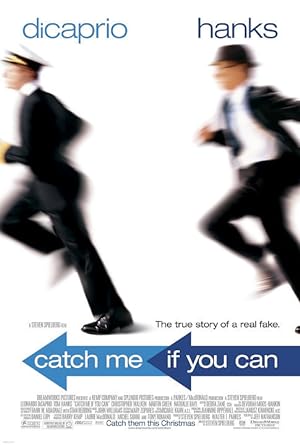
Catch Me If You Can
A true story about Frank Abagnale Jr. who, before his 19th birthday, successfully conned millions of dollars worth of checks as a Pan Am pilot, doctor, and legal prosecutor. An FBI agent makes it his mission to put him behind bars. But Frank not only eludes capture, he revels in the pursuit.
Despite a respectable budget of $52.0M, Catch Me If You Can became a commercial juggernaut, earning $352.1M worldwide—a remarkable 577% return.
Nominated for 2 Oscars. 16 wins & 46 nominations


Plot Structure
Story beats plotted across runtime


Narrative Arc
Emotional journey through the story's key moments
Story Circle
Blueprint 15-beat structure
Arcplot Score Breakdown
Weighted: Precision (70%) + Arc (15%) + Theme (15%)
Catch Me If You Can (2002) demonstrates strategically placed plot construction, characteristic of Steven Spielberg's storytelling approach. This structural analysis examines how the film's 15-point plot structure maps to proven narrative frameworks across 2 hours and 21 minutes. With an Arcplot score of 5.0, the film takes an unconventional approach to traditional narrative frameworks.
Characters
Cast & narrative archetypes

Frank Abagnale Jr.
Carl Hanratty
Frank Abagnale Sr.
Paula Abagnale
Brenda Strong
Roger Strong
Main Cast & Characters
Frank Abagnale Jr.
Played by Leonardo DiCaprio
A teenage con artist who successfully impersonates a pilot, doctor, and lawyer while forging millions in checks.
Carl Hanratty
Played by Tom Hanks
An FBI bank fraud agent obsessed with catching Frank, eventually becoming a mentor figure.
Frank Abagnale Sr.
Played by Christopher Walken
Frank's charming but struggling father whose failures and advice shape his son's trajectory.
Paula Abagnale
Played by Nathalie Baye
Frank's French mother whose affair and divorce devastate young Frank.
Brenda Strong
Played by Amy Adams
A naive hospital nurse who falls in love with Frank when he poses as a doctor.
Roger Strong
Played by Martin Sheen
Brenda's father, a stern prosecutor who nearly exposes Frank during a family dinner.
Structural Analysis
The Status Quo at 1 minutes (1% through the runtime) establishes Young Frank Abagnale Jr. Watches his father receive a community award, establishing the image of Frank Sr. As a beloved, successful figure and the family's apparent prosperity and happiness.. The analysis reveals that this early placement immediately immerses viewers in the story world.
The inciting incident occurs at 15 minutes when Frank's parents announce their divorce. His mother asks him to choose which parent to live with - a devastating moment that shatters his world and sense of family stability.. At 10% through the film, this Disruption aligns precisely with traditional story structure. This beat shifts the emotional landscape, launching the protagonist into the central conflict.
The First Threshold at 31 minutes marks the transition into Act II, occurring at 22% of the runtime. This indicates the protagonist's commitment to Frank makes the active choice to fully commit to the pilot con, obtaining a Pan Am uniform and ID. He crosses into the world of professional fraud, embracing the false identity that will define Act 2., moving from reaction to action.
At 63 minutes, the Midpoint arrives at 45% of the runtime—arriving early, accelerating into Act IIb complications. Significantly, this crucial beat False victory: Frank successfully impersonates a doctor at a hospital and deepens his relationship with Brenda. He seems invincible, but the stakes raise - Carl is closing in and Frank's lies are becoming harder to maintain., fundamentally raising what's at risk. The emotional intensity shifts, dividing the narrative into clear before-and-after phases.
The Collapse moment at 95 minutes (67% through) represents the emotional nadir. Here, Frank visits his mother and discovers she has remarried and has a new daughter - a "whiff of death" of his old family and any hope of reuniting his parents. His entire motivation for running crumbles., indicates the protagonist at their lowest point. This beat's placement in the final quarter sets up the climactic reversal.
The Second Threshold at 100 minutes initiates the final act resolution at 71% of the runtime. Frank is captured in France. He realizes he cannot run forever. In prison, he learns his father has died - the final death that forces him to accept reality and stop performing for an audience that no longer exists., demonstrating the transformation achieved throughout the journey.
Emotional Journey
Catch Me If You Can's emotional architecture traces a deliberate progression across 15 carefully calibrated beats.
Narrative Framework
This structural analysis employs systematic plot point analysis that identifies crucial turning points. By mapping Catch Me If You Can against these established plot points, we can identify how Steven Spielberg utilizes or subverts traditional narrative conventions. The plot point approach reveals not only adherence to structural principles but also creative choices that distinguish Catch Me If You Can within the biography genre.
Steven Spielberg's Structural Approach
Among the 33 Steven Spielberg films analyzed on Arcplot, the average structural score is 5.8, showcasing experimental approaches to narrative form. Catch Me If You Can takes a more unconventional approach compared to the director's typical style. For comparative analysis, explore the complete Steven Spielberg filmography.
Comparative Analysis
Additional biography films include After Thomas, Taking Woodstock and The Fire Inside. For more Steven Spielberg analyses, see The Adventures of Tintin, Close Encounters of the Third Kind and War Horse.
Plot Points by Act
Act I
SetupStatus Quo
Young Frank Abagnale Jr. watches his father receive a community award, establishing the image of Frank Sr. as a beloved, successful figure and the family's apparent prosperity and happiness.
Theme
Frank Sr. tells young Frank: "Two little mice fell in a bucket of cream. One gave up and drowned. The other fought so hard he churned that cream into butter and crawled out." Theme of persistence, deception, and survival through performance.
Worldbuilding
Establishment of Frank's world: his parents' troubled marriage, father's tax problems with the IRS, the family's financial facade, and Frank's admiration for his con-man father. Shows Frank using charm to get out of trouble at school.
Disruption
Frank's parents announce their divorce. His mother asks him to choose which parent to live with - a devastating moment that shatters his world and sense of family stability.
Resistance
Frank runs away and begins surviving on his own. He debates how to make money, experiments with small cons, discovers he can pass as older, and learns to forge checks. Includes his first successful pilot impersonation.
Act II
ConfrontationFirst Threshold
Frank makes the active choice to fully commit to the pilot con, obtaining a Pan Am uniform and ID. He crosses into the world of professional fraud, embracing the false identity that will define Act 2.
Mirror World
Frank meets Brenda, a young woman who represents genuine connection and the normal life he cannot have. She embodies the theme: the cost of living a lie and the desire for authentic identity.
Premise
The "fun and games" of Frank's cons: flying around the world as a fake pilot, cashing fraudulent checks, living in luxury, the cat-and-mouse game with Carl Hanratty. Frank is winning and enjoying the life of deception.
Midpoint
False victory: Frank successfully impersonates a doctor at a hospital and deepens his relationship with Brenda. He seems invincible, but the stakes raise - Carl is closing in and Frank's lies are becoming harder to maintain.
Opposition
Carl gets closer to catching Frank. Frank passes the Louisiana bar exam as a lawyer. The engagement to Brenda intensifies the pressure. Carl crashes the engagement party. Frank's world of lies becomes increasingly unsustainable.
Collapse
Frank visits his mother and discovers she has remarried and has a new daughter - a "whiff of death" of his old family and any hope of reuniting his parents. His entire motivation for running crumbles.
Crisis
Frank spirals into darkness, continuing to run but with less purpose. He contacts Carl on Christmas Eve, revealing his loneliness. The emotional low point before clarity emerges.
Act III
ResolutionSecond Threshold
Frank is captured in France. He realizes he cannot run forever. In prison, he learns his father has died - the final death that forces him to accept reality and stop performing for an audience that no longer exists.
Synthesis
Frank is extradited, serves partial sentence, then recruited by Carl to work for the FBI. He uses his con-artist skills legitimately to catch other forgers. The finale shows Frank helping the FBI while Carl mentors him.
Transformation
Frank works legitimately at the FBI, has reunited with Carl as a father figure, and visits his mother's house to see his half-sister. He no longer needs to run or pretend - he has found authentic identity through honest work.