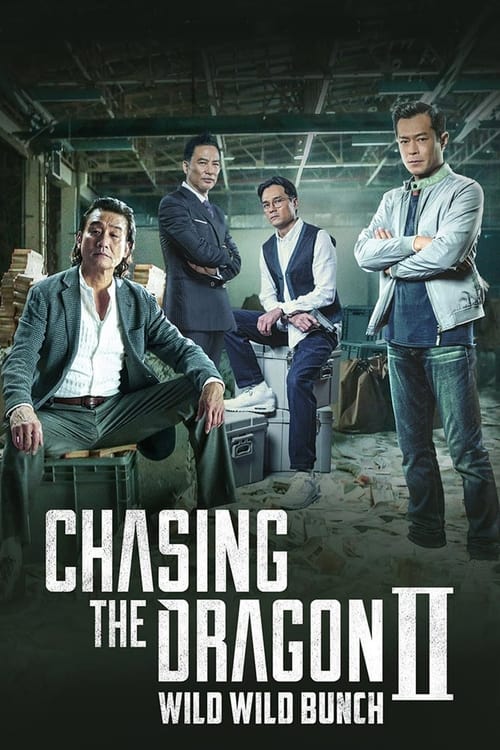
Chasing the Dragon II: Wild Wild Bunch
Based on real-life crimes that terrorized Hong Kong in the 1990s, Logan (Tony Leung Ka-Fai) is the head of leading a notorious human trafficking gang, abducting the children of Hong Kong's elite. Police forces decide to send in Sky (Louis Koo), a Hong Kong undercover agent whose mission is to infiltrate and save the hostages, all while bringing the gang and their leader to justice.
The film earned $45.7M at the global box office.


Plot Structure
Story beats plotted across runtime


Narrative Arc
Emotional journey through the story's key moments
Story Circle
Blueprint 15-beat structure
Arcplot Score Breakdown
Weighted: Precision (70%) + Arc (15%) + Theme (15%)
Chasing the Dragon II: Wild Wild Bunch (2019) exhibits strategically placed dramatic framework, characteristic of Wong Jing's storytelling approach. This structural analysis examines how the film's 15-point plot structure maps to proven narrative frameworks across 1 hour and 43 minutes. With an Arcplot score of 7.6, the film showcases strong structural fundamentals.
Characters
Cast & narrative archetypes

Logan
Choi Cheuk-man
Yuen Man-lung
Yuen Tin-ching
Big Brother
Sister 13
Main Cast & Characters
Logan
Played by Tony Leung Ka-fai
A dedicated Hong Kong police inspector investigating a high-profile kidnapping case involving a wealthy businessman's son.
Choi Cheuk-man
Played by Louis Koo
A cunning and ruthless criminal mastermind who orchestrates a daring kidnapping scheme in Hong Kong.
Yuen Man-lung
Played by Simon Yam
A Hong Kong tycoon and billionaire whose son is kidnapped, forcing him into a desperate situation.
Yuen Tin-ching
Played by Wun Ka-yi
The kidnapped son of the wealthy businessman, whose abduction sets the entire plot in motion.
Big Brother
Played by Lam Ka-tung
A violent and unpredictable member of the kidnapping gang who serves as muscle for the operation.
Sister 13
Played by Rachel Leung
A cold and calculating female member of the criminal gang involved in the kidnapping scheme.
Structural Analysis
The Status Quo at 1 minutes (1% through the runtime) establishes Introduction to 1990s Hong Kong criminal underworld. The protagonist's world before the central conflict begins.. The analysis reveals that this early placement immediately immerses viewers in the story world.
The inciting incident occurs at 12 minutes when The inciting incident that disrupts the status quo - likely the first major crime or kidnapping that sets the plot in motion.. At 12% through the film, this Disruption aligns precisely with traditional story structure. This beat shifts the emotional landscape, launching the protagonist into the central conflict.
The First Threshold at 26 minutes marks the transition into Act II, occurring at 25% of the runtime. This illustrates the protagonist's commitment to Active choice to fully engage with the criminal case or conflict, committing to the dangerous path ahead., moving from reaction to action.
At 52 minutes, the Midpoint arrives at 50% of the runtime—precisely centered, creating perfect narrative symmetry. Structural examination shows that this crucial beat Major revelation or false victory/defeat that raises stakes significantly - likely a major confrontation or discovery., fundamentally raising what's at risk. The emotional intensity shifts, dividing the narrative into clear before-and-after phases.
The Collapse moment at 77 minutes (75% through) represents the emotional nadir. Here, Darkest moment - major loss, death, or failure that represents the lowest point in the protagonist's journey., indicates the protagonist at their lowest point. This beat's placement in the final quarter sets up the climactic reversal.
The Second Threshold at 82 minutes initiates the final act resolution at 80% of the runtime. New information or synthesis provides clarity and resolve - breakthrough that enables the final confrontation., demonstrating the transformation achieved throughout the journey.
Emotional Journey
Chasing the Dragon II: Wild Wild Bunch's emotional architecture traces a deliberate progression across 15 carefully calibrated beats.
Narrative Framework
This structural analysis employs a 15-point narrative structure framework that maps key story moments. By mapping Chasing the Dragon II: Wild Wild Bunch against these established plot points, we can identify how Wong Jing utilizes or subverts traditional narrative conventions. The plot point approach reveals not only adherence to structural principles but also creative choices that distinguish Chasing the Dragon II: Wild Wild Bunch within the crime genre.
Wong Jing's Structural Approach
Among the 3 Wong Jing films analyzed on Arcplot, the average structural score is 7.2, reflecting strong command of classical structure. Chasing the Dragon II: Wild Wild Bunch represents one of the director's most structurally precise works. For comparative analysis, explore the complete Wong Jing filmography.
Comparative Analysis
Additional crime films include The Bad Guys, Rustom and The Whole Ten Yards. For more Wong Jing analyses, see Chasing the Dragon, God of Gamblers.
Plot Points by Act
Act I
SetupStatus Quo
Introduction to 1990s Hong Kong criminal underworld. The protagonist's world before the central conflict begins.
Theme
Thematic statement about greed, power, and the consequences of crossing moral boundaries in pursuit of wealth.
Worldbuilding
Establishment of characters, criminal networks, law enforcement dynamics, and the socio-political landscape of 1990s Hong Kong.
Disruption
The inciting incident that disrupts the status quo - likely the first major crime or kidnapping that sets the plot in motion.
Resistance
Investigation begins, resistance and debate about how to respond to the threat, gathering of resources and information.
Act II
ConfrontationFirst Threshold
Active choice to fully engage with the criminal case or conflict, committing to the dangerous path ahead.
Mirror World
Introduction of key relationship or subplot that carries thematic weight - partnership, rivalry, or personal connection.
Premise
The investigation/pursuit intensifies, cat-and-mouse games between criminals and law enforcement, exploring the promise of the premise.
Midpoint
Major revelation or false victory/defeat that raises stakes significantly - likely a major confrontation or discovery.
Opposition
Antagonists gain ground, pressure intensifies, complications mount as the criminal enterprise becomes more dangerous.
Collapse
Darkest moment - major loss, death, or failure that represents the lowest point in the protagonist's journey.
Crisis
Emotional processing of the collapse, wrestling with the cost of the pursuit, questioning whether to continue.
Act III
ResolutionSecond Threshold
New information or synthesis provides clarity and resolve - breakthrough that enables the final confrontation.
Synthesis
Final confrontation and resolution - execution of plan, climactic action sequence, bringing criminals to justice.
Transformation
Closing image showing transformation - how the world and characters have changed, reflection on the cost of justice.