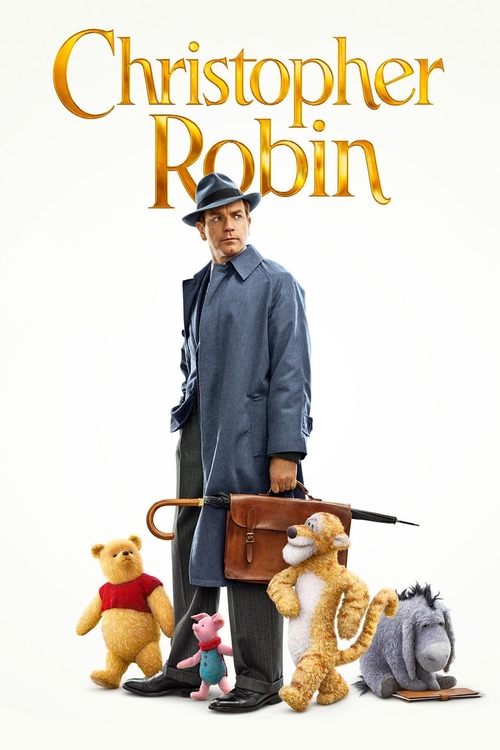
Christopher Robin
A working-class family man, Christopher Robin, encounters his childhood friend Winnie-the-Pooh, who helps him to rediscover the joys of life.
Despite a substantial budget of $75.0M, Christopher Robin became a box office success, earning $197.7M worldwide—a 164% return.
Nominated for 1 Oscar. 2 wins & 13 nominations


Plot Structure
Story beats plotted across runtime


Narrative Arc
Emotional journey through the story's key moments
Story Circle
Blueprint 15-beat structure
Characters
Cast & narrative archetypes

Christopher Robin
Winnie the Pooh
Evelyn Robin
Madeline Robin
Tigger
Eeyore
Piglet
Rabbit
Main Cast & Characters
Christopher Robin
Played by Ewan McGregor
An overworked efficiency manager who has lost touch with his imagination and childhood friends from the Hundred Acre Wood.
Winnie the Pooh
Played by Jim Cummings
Christopher's loyal childhood friend, a bear of very little brain who helps Christopher rediscover joy and wonder.
Evelyn Robin
Played by Hayley Atwell
Christopher's patient and understanding wife who wants her husband to reconnect with their daughter and find balance.
Madeline Robin
Played by Bronte Carmichael
Christopher's imaginative young daughter who yearns for her father's attention and shares his childhood sense of wonder.
Tigger
Played by Jim Cummings
An enthusiastic and bouncy tiger who maintains his optimistic spirit and encourages Christopher to embrace life.
Eeyore
Played by Brad Garrett
A gloomy but loyal donkey who provides pessimistic commentary yet remains a faithful friend.
Piglet
Played by Nick Mohammed
A timid and anxious pig who overcomes his fears to support his friends.
Rabbit
Played by Peter Capaldi
An organized and somewhat fussy rabbit who values order and practicality.
Structural Analysis
The Status Quo at 1 minutes (1% through the runtime) establishes Young Christopher Robin plays joyfully with Pooh and friends in the Hundred Acre Wood, representing childhood innocence and imagination before he must leave for boarding school.. Structural examination shows that this early placement immediately immerses viewers in the story world.
The inciting incident occurs at 12 minutes when Christopher's boss Winslow Jr. Cancels his family's countryside weekend, demanding he find 20% cost reductions by Monday or face massive layoffs. Christopher must stay in London and work.. At 12% through the film, this Disruption aligns precisely with traditional story structure. This beat shifts the emotional landscape, launching the protagonist into the central conflict.
The First Threshold at 23 minutes marks the transition into Act II, occurring at 22% of the runtime. This indicates the protagonist's commitment to Pooh emerges through Christopher's old door in London. Christopher, shocked but unable to ignore his old friend, actively chooses to help Pooh return to the Hundred Acre Wood to find the others., moving from reaction to action.
At 52 minutes, the Midpoint arrives at 50% of the runtime—precisely centered, creating perfect narrative symmetry. Significantly, this crucial beat Christopher realizes his briefcase with the critical work documents is missing. Pooh took it back to London. Stakes raise: Christopher must return to London immediately or lose everything at work., fundamentally raising what's at risk. The emotional intensity shifts, dividing the narrative into clear before-and-after phases.
The Collapse moment at 76 minutes (73% through) represents the emotional nadir. Here, Christopher explodes at Pooh, shouting "I don't have time for this anymore!" and rejecting his old friend completely. Pooh and the animals leave heartbroken. Christopher has chosen work over love, becoming the hollow adult he feared., shows the protagonist at their lowest point. This beat's placement in the final quarter sets up the climactic reversal.
The Second Threshold at 81 minutes initiates the final act resolution at 78% of the runtime. Madeline shows Christopher his old drawings from the Hundred Acre Wood. He remembers Pooh's wisdom: "People say nothing is impossible, but I do nothing every day." Christopher realizes the answer isn't efficiency but imagination - he can save jobs AND the company., demonstrating the transformation achieved throughout the journey.
Emotional Journey
Christopher Robin's emotional architecture traces a deliberate progression across 15 carefully calibrated beats.
Narrative Framework
This structural analysis employs proven narrative structure principles that track dramatic progression. By mapping Christopher Robin against these established plot points, we can identify how Marc Forster utilizes or subverts traditional narrative conventions. The plot point approach reveals not only adherence to structural principles but also creative choices that distinguish Christopher Robin within the adventure genre.
Marc Forster's Structural Approach
Among the 10 Marc Forster films analyzed on Arcplot, the average structural score is 7.3, reflecting strong command of classical structure. Christopher Robin exemplifies the director's characteristic narrative technique. For comparative analysis, explore the complete Marc Forster filmography.
Comparative Analysis
Additional adventure films include The Black Stallion, The Bad Guys and Puss in Boots. For more Marc Forster analyses, see Finding Neverland, Stranger Than Fiction and The Kite Runner.
Plot Points by Act
Act I
SetupStatus Quo
Young Christopher Robin plays joyfully with Pooh and friends in the Hundred Acre Wood, representing childhood innocence and imagination before he must leave for boarding school.
Theme
Pooh tells young Christopher: "Doing nothing often leads to the very best of something." This encapsulates the film's theme about the value of presence and play over constant productivity.
Worldbuilding
Montage showing Christopher's life: boarding school, war service, marriage to Evelyn, birth of daughter Madeline, and settling into a joyless job at Winslow Luggage. He has become efficient, serious, and disconnected from his family.
Disruption
Christopher's boss Winslow Jr. cancels his family's countryside weekend, demanding he find 20% cost reductions by Monday or face massive layoffs. Christopher must stay in London and work.
Resistance
Christopher debates his priorities, disappoints his family by sending them away without him. Meanwhile, in the Hundred Acre Wood, Pooh wakes up unable to find his friends and searches for Christopher Robin.
Act II
ConfrontationFirst Threshold
Pooh emerges through Christopher's old door in London. Christopher, shocked but unable to ignore his old friend, actively chooses to help Pooh return to the Hundred Acre Wood to find the others.
Mirror World
Christopher and Pooh travel to Sussex and enter the Hundred Acre Wood together. The Wood represents everything Christopher has lost: wonder, play, and emotional presence.
Premise
Christopher searches for Pooh's friends with increasing frustration, trying to apply adult efficiency to the illogical world. He reunites with Tigger, Eeyore, Piglet, Rabbit, Kanga, and Roo, who help him remember how to play.
Midpoint
Christopher realizes his briefcase with the critical work documents is missing. Pooh took it back to London. Stakes raise: Christopher must return to London immediately or lose everything at work.
Opposition
Pooh and friends cause chaos in London searching for Christopher. Christopher tries to capture them while hiding them from the public. Evelyn and Madeline discover the animals. Christopher's two worlds collide messily.
Collapse
Christopher explodes at Pooh, shouting "I don't have time for this anymore!" and rejecting his old friend completely. Pooh and the animals leave heartbroken. Christopher has chosen work over love, becoming the hollow adult he feared.
Crisis
Christopher presents his efficiency plan at work - firing workers - feeling empty. Evelyn confronts him, saying "Your daughter is growing up and you're missing it." Christopher sits alone, realizing he's lost what matters most.
Act III
ResolutionSecond Threshold
Madeline shows Christopher his old drawings from the Hundred Acre Wood. He remembers Pooh's wisdom: "People say nothing is impossible, but I do nothing every day." Christopher realizes the answer isn't efficiency but imagination - he can save jobs AND the company.
Synthesis
Christopher, Evelyn, and Madeline race to find Pooh and friends. Christopher apologizes and shares his new plan: reduce costs through innovation (new luggage line) rather than layoffs. He pitches it to Winslow Jr. with his family's help, combining work skill with imagination.
Transformation
Christopher plays with Madeline and Pooh in the Hundred Acre Wood, having achieved work-life balance. He's rediscovered doing "nothing" - presence, play, and love. The closing image mirrors the opening but now he shares the magic with his daughter.