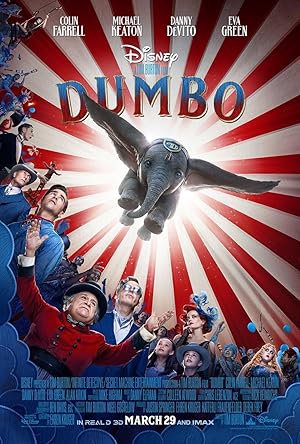
Dumbo
Holt was once a circus star until he went off to war and returned terribly altered. Circus owner Max Medici hires him to take care of Dumbo, a newborn elephant whose oversized ears make him the laughingstock of the struggling circus troupe. But when Holt's children discover that Dumbo can fly, silver-tongued entrepreneur V.A. Vandevere and aerial artist Colette Marchant swoop in to make the little elephant a star.
Despite a blockbuster budget of $170.0M, Dumbo became a financial success, earning $353.3M worldwide—a 108% return. This commercial performance validated the ambitious narrative scope, proving that audiences embrace compelling narrative even at blockbuster scale.
4 wins & 13 nominations


Plot Structure
Story beats plotted across runtime


Narrative Arc
Emotional journey through the story's key moments
Story Circle
Blueprint 15-beat structure
Arcplot Score Breakdown
Weighted: Precision (70%) + Arc (15%) + Theme (15%)
Dumbo (2019) showcases strategically placed narrative architecture, characteristic of Tim Burton's storytelling approach. This structural analysis examines how the film's 15-point plot structure maps to proven narrative frameworks across 1 hour and 52 minutes. With an Arcplot score of 7.2, the film balances conventional beats with creative variation.
Characters
Cast & narrative archetypes

Holt Farrier
Milly Farrier
Joe Farrier
Max Medici
V. A. Vandevere
Colette Marchant
Mrs. Jumbo
Dumbo
Main Cast & Characters
Holt Farrier
Played by Colin Farrell
A former circus star and war veteran who returns home to care for his children and becomes Dumbo's handler.
Milly Farrier
Played by Nico Parker
Holt's intelligent and science-minded daughter who befriends Dumbo and discovers his ability to fly.
Joe Farrier
Played by Finley Hobbins
Holt's younger son who helps his sister care for Dumbo and supports the flying elephant.
Max Medici
Played by Danny DeVito
The struggling owner of the Medici Brothers circus who sees Dumbo as his ticket to financial salvation.
V. A. Vandevere
Played by Michael Keaton
A ruthless entertainment mogul who acquires the circus and exploits Dumbo for profit at his Dreamland theme park.
Colette Marchant
Played by Eva Green
A French trapeze artist and aerialist at Dreamland who is paired with Dumbo for spectacular performances.
Mrs. Jumbo
Played by Animal performer
Dumbo's mother, a circus elephant separated from her son and used as leverage by Vandevere.
Dumbo
Played by Animal performer
A young elephant born with oversized ears who discovers he can fly and becomes a circus sensation.
Structural Analysis
The Status Quo at 1 minutes (1% through the runtime) establishes The Medici Brothers' Circus performs to a modest crowd in 1919 Joplin, Missouri. Holt Farrier returns from WWI, missing an arm, to his children Milly and Joe and his former life as a circus star.. Of particular interest, this early placement immediately immerses viewers in the story world.
The inciting incident occurs at 13 minutes when Mrs. Jumbo gives birth to a baby elephant with extraordinarily large ears. The circus performers are initially charmed, but the unusual calf represents both a problem and potential opportunity for the struggling show.. At 11% through the film, this Disruption aligns precisely with traditional story structure. This beat shifts the emotional landscape, launching the protagonist into the central conflict.
The First Threshold at 28 minutes marks the transition into Act II, occurring at 25% of the runtime. This reveals the protagonist's commitment to Dumbo flies publicly for the first time in the circus ring, amazing the audience and saving the show. The Medici circus chooses to embrace Dumbo as their star attraction, entering a new world of possibility., moving from reaction to action.
At 57 minutes, the Midpoint arrives at 50% of the runtime—precisely centered, creating perfect narrative symmetry. Of particular interest, this crucial beat During a performance, Dumbo sees his mother Mrs. Jumbo imprisoned in the "Nightmare Island" section of the park. He breaks from the act to try to reach her, causing chaos. Vandevere's true nature is revealed—false victory turns to defeat., fundamentally raising what's at risk. The emotional intensity shifts, dividing the narrative into clear before-and-after phases.
The Collapse moment at 84 minutes (75% through) represents the emotional nadir. Here, Vandevere orders Mrs. Jumbo killed and plans to eliminate Dumbo after a final show. The family hits their lowest point, seemingly powerless against Vandevere's control. Hope appears lost for reuniting mother and child., demonstrates the protagonist at their lowest point. This beat's placement in the final quarter sets up the climactic reversal.
The Second Threshold at 90 minutes initiates the final act resolution at 80% of the runtime. The circus troupe unites on a plan to rescue both elephants during the final show. Holt synthesizes his protective instincts with action. Colette chooses conscience over celebrity. The family operates as one to outsmart Vandevere., demonstrating the transformation achieved throughout the journey.
Emotional Journey
Dumbo's emotional architecture traces a deliberate progression across 15 carefully calibrated beats.
Narrative Framework
This structural analysis employs structural analysis methodology used to understand storytelling architecture. By mapping Dumbo against these established plot points, we can identify how Tim Burton utilizes or subverts traditional narrative conventions. The plot point approach reveals not only adherence to structural principles but also creative choices that distinguish Dumbo within the adventure genre.
Tim Burton's Structural Approach
Among the 19 Tim Burton films analyzed on Arcplot, the average structural score is 6.9, demonstrating varied approaches to story architecture. Dumbo represents one of the director's most structurally precise works. For comparative analysis, explore the complete Tim Burton filmography.
Comparative Analysis
Additional adventure films include The Black Stallion, The Bad Guys and Puss in Boots. For more Tim Burton analyses, see Beetlejuice, Dark Shadows and Pee-wee's Big Adventure.
Plot Points by Act
Act I
SetupStatus Quo
The Medici Brothers' Circus performs to a modest crowd in 1919 Joplin, Missouri. Holt Farrier returns from WWI, missing an arm, to his children Milly and Joe and his former life as a circus star.
Theme
Max Medici tells Holt, "You don't need glory. You just need to be a part of something." The theme of finding value beyond spectacle and embracing one's place is introduced.
Worldbuilding
The struggling circus troupe is introduced: Max Medici, the performers, and the familial bond despite financial hardship. Holt is assigned to care for the pregnant elephant Mrs. Jumbo. His children Milly (science-minded) and Joe (imaginative) explore the circus world.
Disruption
Mrs. Jumbo gives birth to a baby elephant with extraordinarily large ears. The circus performers are initially charmed, but the unusual calf represents both a problem and potential opportunity for the struggling show.
Resistance
Dumbo is mocked in his public debut and separated from his mother after she defends him. Max sells Mrs. Jumbo. Milly and Joe bond with Dumbo and discover he can fly when given a feather. Holt is reluctant but begins to see possibilities.
Act II
ConfrontationFirst Threshold
Dumbo flies publicly for the first time in the circus ring, amazing the audience and saving the show. The Medici circus chooses to embrace Dumbo as their star attraction, entering a new world of possibility.
Mirror World
V.A. Vandevere, wealthy owner of the spectacular Dreamland amusement park, arrives with star aerialist Colette Marchant. They represent the seductive but hollow world of commercialized spectacle—the thematic counterpoint to genuine family connection.
Premise
The Medici troupe is absorbed into Dreamland. Dumbo becomes a sensation performing with Colette. The promise of the premise: a flying elephant in a grand spectacle. The family enjoys temporary success and luxury, but cracks appear in Vandevere's promises.
Midpoint
During a performance, Dumbo sees his mother Mrs. Jumbo imprisoned in the "Nightmare Island" section of the park. He breaks from the act to try to reach her, causing chaos. Vandevere's true nature is revealed—false victory turns to defeat.
Opposition
Vandevere becomes overtly villainous, planning to kill Dumbo. The family realizes they're trapped in a gilded cage. Holt and the performers are fired. Milly discovers Mrs. Jumbo is to be killed. Pressure intensifies as Vandevere tightens control.
Collapse
Vandevere orders Mrs. Jumbo killed and plans to eliminate Dumbo after a final show. The family hits their lowest point, seemingly powerless against Vandevere's control. Hope appears lost for reuniting mother and child.
Crisis
Holt and the circus family process their desperation. They realize they must work together, using their unique talents not for spectacle but for genuine purpose—saving Dumbo and Mrs. Jumbo.
Act III
ResolutionSecond Threshold
The circus troupe unites on a plan to rescue both elephants during the final show. Holt synthesizes his protective instincts with action. Colette chooses conscience over celebrity. The family operates as one to outsmart Vandevere.
Synthesis
During the finale performance, the troupe executes their rescue plan. Spectacular chaos as Dumbo and Mrs. Jumbo are freed, Dreamland catches fire, and Vandevere's empire crumbles. The family escapes together, defeating the antagonist through cooperation and love rather than spectacle.
Transformation
Dumbo and Mrs. Jumbo are released into the wild in their natural home. The Medici circus is rebuilt as an animal-free show celebrating human talent. Holt and his children watch Dumbo fly free, transformed from seeking glory to finding purpose in family and freedom.