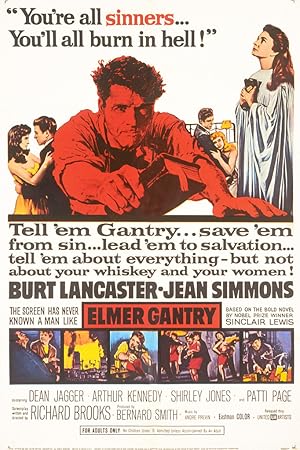
Elmer Gantry
Elmer Gantry is a fast-talking, hard-drinking traveling salesman who always has a risqué story and a hip flask to entertain cronies and customers alike. He is immediately taken with Sister Sharon Falconer, a lay preacher whose hellfire-and-damnation revivalism has attracted quite a following. Gantry uses his own quick wit and Bible knowledge to become an indispensable part of Sister Sharon's roadshow, but his past soon catches up with him in the form of Lulu Bains, now a prostitute. While Gantry seeks and eventually gets forgiveness from Sharon, tragedy strikes when she finally manages to get out of her revivalist tent and opens a permanent church.
Despite its modest budget of $3.0M, Elmer Gantry became a financial success, earning $10.4M worldwide—a 247% return. The film's unique voice found its audience, showing that strong storytelling can transcend budget limitations.


Plot Structure
Story beats plotted across runtime


Narrative Arc
Emotional journey through the story's key moments
Story Circle
Blueprint 15-beat structure
Arcplot Score Breakdown
Weighted: Precision (70%) + Arc (15%) + Theme (15%)
Elmer Gantry (1960) reveals carefully calibrated narrative design, characteristic of Richard Brooks's storytelling approach. This structural analysis examines how the film's 15-point plot structure maps to proven narrative frameworks across 2 hours and 26 minutes. With an Arcplot score of 6.8, the film balances conventional beats with creative variation.
Characters
Cast & narrative archetypes

Elmer Gantry
Sister Sharon Falconer
Lulu Bains
Jim Lefferts
William L. Morgan
Main Cast & Characters
Elmer Gantry
Played by Burt Lancaster
A charismatic, manipulative traveling salesman who becomes a revivalist preacher driven by ambition and lust rather than genuine faith.
Sister Sharon Falconer
Played by Jean Simmons
A sincere, passionate evangelist who leads a traveling revival ministry and becomes romantically involved with Gantry despite her dedication to God.
Lulu Bains
Played by Shirley Jones
A former lover of Gantry who becomes a prostitute and seeks revenge by attempting to expose his hypocritical past.
Jim Lefferts
Played by Arthur Kennedy
A cynical, atheistic newspaper reporter who sees through Gantry's charlatan act and attempts to expose religious hypocrisy.
William L. Morgan
Played by Dean Jagger
A wealthy businessman and promoter who manages Sister Sharon's revival campaigns and helps expand her ministry.
Structural Analysis
The Status Quo at 2 minutes (1% through the runtime) establishes Elmer Gantry, a charismatic traveling salesman, drinks and carouses on a train, demonstrating his gift for persuasive talk and love of women and whiskey. He's a charming rogue living by his wits in 1920s America.. Notably, this early placement immediately immerses viewers in the story world.
The inciting incident occurs at 17 minutes when Gantry encounters Sister Sharon Falconer's revival meeting in a tent. He's captivated by her fervor and charisma, and sees an opportunity to combine his talents with her ministry. This chance meeting disrupts his aimless drifting.. At 12% through the film, this Disruption aligns precisely with traditional story structure. This beat shifts the emotional landscape, launching the protagonist into the central conflict.
The First Threshold at 36 minutes marks the transition into Act II, occurring at 24% of the runtime. This demonstrates the protagonist's commitment to Sharon agrees to let Gantry join her revival ministry as a featured preacher. Gantry makes the active choice to commit to this new life, leaving his salesman existence behind and entering the world of evangelical preaching., moving from reaction to action.
At 74 minutes, the Midpoint arrives at 50% of the runtime—precisely centered, creating perfect narrative symmetry. Of particular interest, this crucial beat False victory: The ministry reaches its peak success, building a grand tabernacle. Gantry and Sharon's relationship intensifies. They seem unstoppable, but this success attracts greater scrutiny. The stakes raise as their prominence increases vulnerability to exposure., fundamentally raising what's at risk. The emotional intensity shifts, dividing the narrative into clear before-and-after phases.
The Collapse moment at 108 minutes (74% through) represents the emotional nadir. Here, Lulu Bains is convinced to participate in exposing Gantry in court. The scandal breaks publicly, threatening to destroy everything. Gantry's past sins are laid bare, his reputation crumbles. This is his darkest moment - the whiff of death for his career and relationship., illustrates the protagonist at their lowest point. This beat's placement in the final quarter sets up the climactic reversal.
The Second Threshold at 115 minutes initiates the final act resolution at 79% of the runtime. Lulu recants her testimony, admitting she was coerced. The immediate legal threat passes, but the deeper moral questions remain. Gantry gains temporary reprieve but must now face the ultimate test of the ministry's - and his own - authenticity., demonstrating the transformation achieved throughout the journey.
Emotional Journey
Elmer Gantry's emotional architecture traces a deliberate progression across 15 carefully calibrated beats.
Narrative Framework
This structural analysis employs systematic plot point analysis that identifies crucial turning points. By mapping Elmer Gantry against these established plot points, we can identify how Richard Brooks utilizes or subverts traditional narrative conventions. The plot point approach reveals not only adherence to structural principles but also creative choices that distinguish Elmer Gantry within the drama genre.
Richard Brooks's Structural Approach
Among the 4 Richard Brooks films analyzed on Arcplot, the average structural score is 6.6, demonstrating varied approaches to story architecture. Elmer Gantry represents one of the director's most structurally precise works. For comparative analysis, explore the complete Richard Brooks filmography.
Comparative Analysis
Additional drama films include After Thomas, South Pacific and Dirty Dancing: Havana Nights. For more Richard Brooks analyses, see Looking for Mr. Goodbar, In Cold Blood and Cat on a Hot Tin Roof.
Plot Points by Act
Act I
SetupStatus Quo
Elmer Gantry, a charismatic traveling salesman, drinks and carouses on a train, demonstrating his gift for persuasive talk and love of women and whiskey. He's a charming rogue living by his wits in 1920s America.
Theme
A character remarks on the conflict between genuine faith and religious showmanship, establishing the film's central question: can salvation be real when delivered by a charlatan?
Worldbuilding
Establishment of Gantry's world: his sales job, his drinking and womanizing, his knack for religious talk despite his sinful lifestyle. Introduction of the revival culture of 1920s America and Sister Sharon Falconer's traveling ministry.
Disruption
Gantry encounters Sister Sharon Falconer's revival meeting in a tent. He's captivated by her fervor and charisma, and sees an opportunity to combine his talents with her ministry. This chance meeting disrupts his aimless drifting.
Resistance
Gantry pursues Sharon, attempting to convince her to let him join her ministry. She's skeptical of his sincerity. He demonstrates his preaching abilities and persuasive power. The debate centers on whether he's genuine or just another opportunist.
Act II
ConfrontationFirst Threshold
Sharon agrees to let Gantry join her revival ministry as a featured preacher. Gantry makes the active choice to commit to this new life, leaving his salesman existence behind and entering the world of evangelical preaching.
Mirror World
Gantry and Sharon's relationship deepens beyond professional partnership. Their romantic connection develops, representing the thematic tension between spiritual devotion and earthly desire. Sharon embodies the genuine faith Gantry lacks.
Premise
The promise of the premise: Gantry in his element, electrifying crowds with his preaching, growing the ministry's success and wealth. The fun of watching a con man excel at religious showmanship while navigating his attraction to Sharon and the politics of the revival circuit.
Midpoint
False victory: The ministry reaches its peak success, building a grand tabernacle. Gantry and Sharon's relationship intensifies. They seem unstoppable, but this success attracts greater scrutiny. The stakes raise as their prominence increases vulnerability to exposure.
Opposition
Jim Lefferts, a cynical journalist, investigates Gantry's background. Lulu Bains, a prostitute and Gantry's former lover, resurfaces and threatens to expose his past. The forces opposing Gantry's hypocrisy close in. Sharon becomes more zealous and less rational.
Collapse
Lulu Bains is convinced to participate in exposing Gantry in court. The scandal breaks publicly, threatening to destroy everything. Gantry's past sins are laid bare, his reputation crumbles. This is his darkest moment - the whiff of death for his career and relationship.
Crisis
Gantry faces the consequences of his exposure. He must confront whether he's truly changed or remained the same charlatan. Sharon stands by him despite the scandal, her faith unshaken. The ministry's future hangs in balance.
Act III
ResolutionSecond Threshold
Lulu recants her testimony, admitting she was coerced. The immediate legal threat passes, but the deeper moral questions remain. Gantry gains temporary reprieve but must now face the ultimate test of the ministry's - and his own - authenticity.
Synthesis
The climactic tabernacle fire: During a packed revival service, the building catches fire. Sharon, in her zealous faith, refuses to leave, believing God will protect her. Gantry tries to save her but the fire consumes the tabernacle. Tragedy strikes as Sharon perishes. The finale resolves whether faith or fraud prevails.
Transformation
After the fire, Gantry addresses the crowd outside the ruins. Despite everything, he continues preaching, showing he remains fundamentally unchanged - still the persuasive showman. The transformation is society's, not his: the mirror held up reveals American culture's complicity in religious exploitation.