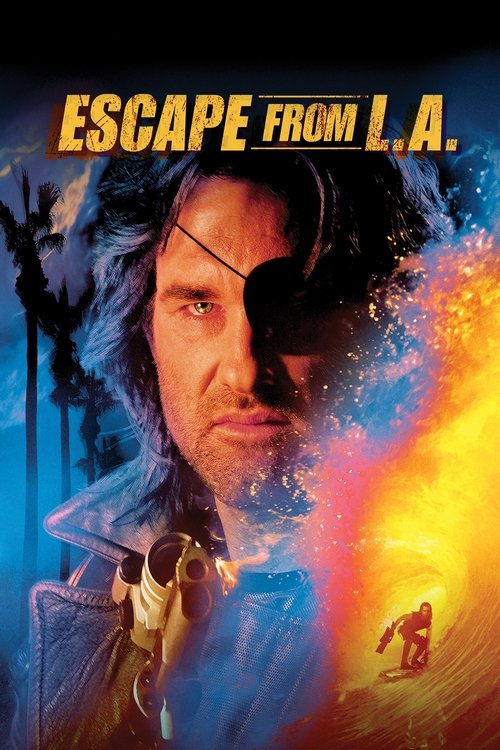
Escape from L.A.
Into the 9.6-quaked Los Angeles of 2013 comes Snake Plissken. His job: wade through L.A.'s ruined landmarks to retrieve a doomsday device.
The film underperformed commercially against its respectable budget of $50.0M, earning $42.3M globally (-15% loss).


Plot Structure
Story beats plotted across runtime


Narrative Arc
Emotional journey through the story's key moments
Story Circle
Blueprint 15-beat structure
Arcplot Score Breakdown
Weighted: Precision (70%) + Arc (15%) + Theme (15%)
Escape from L.A. (1996) exemplifies precise dramatic framework, characteristic of John Carpenter's storytelling approach. This structural analysis examines how the film's 15-point plot structure maps to proven narrative frameworks across 1 hour and 36 minutes. With an Arcplot score of 6.8, the film balances conventional beats with creative variation.
Characters
Cast & narrative archetypes

Snake Plissken
Utopia
Cuervo Jones
The President
Map to the Stars Eddie
Hershe Las Palmas
Malloy
Brazen
Main Cast & Characters
Snake Plissken
Played by Kurt Russell
A cynical anti-hero war veteran sent to retrieve a doomsday device from the fascist island of Los Angeles.
Utopia
Played by A.J. Langer
A revolutionary leader in L.A. who becomes Snake's unlikely ally and romantic interest.
Cuervo Jones
Played by Georges Corraface
A charismatic revolutionary warlord who has stolen the doomsday device and rules part of L.A.
The President
Played by Cliff Robertson
An authoritarian theocratic leader who sends Snake on the mission to recover the weapon.
Map to the Stars Eddie
Played by Steve Buscemi
A helpful but delusional guide in L.A. who aids Snake on his journey.
Hershe Las Palmas
Played by Pam Grier
A transgender woman and performer who helps Snake navigate the dangerous island.
Malloy
Played by Stacy Keach
The government official who briefs Snake on his mission and monitors his progress.
Brazen
Played by Valeria Golino
A member of the Surgeon General of Beverly Hills' gang who becomes involved in Snake's mission.
Structural Analysis
The Status Quo at 1 minutes (1% through the runtime) establishes Opening newsreel-style sequence depicts the massive earthquake that separated Los Angeles from the mainland, transforming it into a lawless island prison for America's undesirables under the theocratic President's moral authority.. Of particular interest, this early placement immediately immerses viewers in the story world.
The inciting incident occurs at 12 minutes when Snake is injected with the Plutoxin 7 virus and given a ten-hour deadline to retrieve the black box remote from Cuervo Jones before the virus kills him. His only chance at survival is to accept this suicide mission into Los Angeles.. At 13% through the film, this Disruption is delayed, allowing extended setup of the story world. This beat shifts the emotional landscape, launching the protagonist into the central conflict.
The First Threshold at 24 minutes marks the transition into Act II, occurring at 25% of the runtime. This indicates the protagonist's commitment to Snake launches his one-man submarine and crosses into the waters of Los Angeles Island, committing himself to the mission. He surfaces in the ruins of the submerged city, alone in hostile territory with the clock ticking on his life., moving from reaction to action.
At 48 minutes, the Midpoint arrives at 50% of the runtime—precisely centered, creating perfect narrative symmetry. The analysis reveals that this crucial beat Snake finally reaches Cuervo Jones's compound at Happy Kingdom, only to be captured and forced into a gladiatorial basketball game where he must score or die. This false defeat reveals the true danger of his enemy and raises the stakes dramatically., fundamentally raising what's at risk. The emotional intensity shifts, dividing the narrative into clear before-and-after phases.
The Collapse moment at 72 minutes (75% through) represents the emotional nadir. Here, Snake is captured by Cuervo's forces and scheduled for execution. His allies are scattered or dead, the black box is still in enemy hands, and the virus is nearing its lethal stage. Snake faces imminent death with his mission failed., reveals the protagonist at their lowest point. This beat's placement in the final quarter sets up the climactic reversal.
The Second Threshold at 77 minutes initiates the final act resolution at 80% of the runtime. Snake escapes execution using his holographic projector decoy device and pursues Cuervo to the mainland crossing point. He realizes he can stop both the invasion and reject the corrupt President's authority - he doesn't have to serve either master., demonstrating the transformation achieved throughout the journey.
Emotional Journey
Escape from L.A.'s emotional architecture traces a deliberate progression across 15 carefully calibrated beats.
Narrative Framework
This structural analysis employs systematic plot point analysis that identifies crucial turning points. By mapping Escape from L.A. against these established plot points, we can identify how John Carpenter utilizes or subverts traditional narrative conventions. The plot point approach reveals not only adherence to structural principles but also creative choices that distinguish Escape from L.A. within the action genre.
John Carpenter's Structural Approach
Among the 16 John Carpenter films analyzed on Arcplot, the average structural score is 6.9, demonstrating varied approaches to story architecture. Escape from L.A. takes a more unconventional approach compared to the director's typical style. For comparative analysis, explore the complete John Carpenter filmography.
Comparative Analysis
Additional action films include The Bad Guys, Puss in Boots and Venom: The Last Dance. For more John Carpenter analyses, see Halloween, In the Mouth of Madness and They Live.
Plot Points by Act
Act I
SetupStatus Quo
Opening newsreel-style sequence depicts the massive earthquake that separated Los Angeles from the mainland, transforming it into a lawless island prison for America's undesirables under the theocratic President's moral authority.
Theme
Commander Malloy states that those who don't conform to the new moral America are given a choice: "deportation or death." The theme of individual freedom versus authoritarian control is established through the government's absolute demand for conformity.
Worldbuilding
The dystopian world is established: America is now a theocratic police state, L.A. is an island prison, and Snake Plissken is captured attempting to enter the country illegally. The President's daughter Utopia has stolen the Sword of Damocles control device and fled to L.A. to join revolutionary Cuervo Jones.
Disruption
Snake is injected with the Plutoxin 7 virus and given a ten-hour deadline to retrieve the black box remote from Cuervo Jones before the virus kills him. His only chance at survival is to accept this suicide mission into Los Angeles.
Resistance
Snake is briefed on his mission parameters, outfitted with weapons and gadgets including a holographic projector, and given intel on Cuervo Jones's location. Malloy and the President's aide Brazen prepare him for insertion into the island prison, though Snake remains characteristically resistant and distrustful of authority.
Act II
ConfrontationFirst Threshold
Snake launches his one-man submarine and crosses into the waters of Los Angeles Island, committing himself to the mission. He surfaces in the ruins of the submerged city, alone in hostile territory with the clock ticking on his life.
Mirror World
Snake encounters "Map to the Stars" Eddie, a sleazy but helpful guide who knows the territory. Eddie represents the chaotic freedom of L.A. Island - a world without moral restrictions where everyone is a hustler, contrasting the oppressive order Snake fled.
Premise
Snake navigates the bizarre post-apocalyptic landscape of L.A.: he survives the Surgical Failures in Beverly Hills, encounters the plastic surgery-obsessed Surgeon General of Beverly Hills, escapes a deadly trap, and pursues leads on Cuervo Jones through the lawless territories while his deadline counts down.
Midpoint
Snake finally reaches Cuervo Jones's compound at Happy Kingdom, only to be captured and forced into a gladiatorial basketball game where he must score or die. This false defeat reveals the true danger of his enemy and raises the stakes dramatically.
Opposition
After surviving the basketball death match, Snake allies with Taslima and Pipeline, pursues Cuervo across the island, and engages in a surfing chase through a massive tsunami. Meanwhile, Cuervo prepares his invasion force and the virus continues its countdown in Snake's bloodstream.
Collapse
Snake is captured by Cuervo's forces and scheduled for execution. His allies are scattered or dead, the black box is still in enemy hands, and the virus is nearing its lethal stage. Snake faces imminent death with his mission failed.
Crisis
Snake waits for execution while Cuervo's army prepares to cross to the mainland. The world Snake knows is about to change forever, and he appears powerless to stop it. His time and options have run out.
Act III
ResolutionSecond Threshold
Snake escapes execution using his holographic projector decoy device and pursues Cuervo to the mainland crossing point. He realizes he can stop both the invasion and reject the corrupt President's authority - he doesn't have to serve either master.
Synthesis
Snake infiltrates the President's compound during Cuervo's attack, kills Cuervo, and retrieves the black box. Confronting the President, Snake exposes his hypocrisy and refuses to hand over the device. He uses his last moments to make a choice that will define his legacy.
Transformation
Snake activates the Sword of Damocles, shutting down all electrical technology on Earth. He walks away into the darkness, having rejected both authoritarian governments. His final line - "Welcome to the human race" - shows he's chosen freedom over any corrupt system.