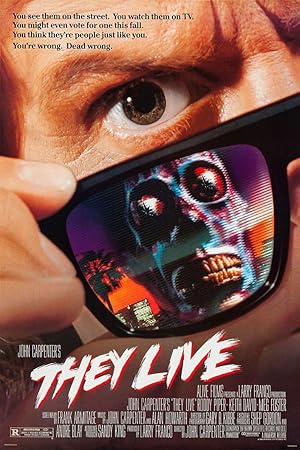
They Live
Nada, a down-on-his-luck construction worker, discovers a pair of special sunglasses. Wearing them, he is able to see the world as it really is: people being bombarded by media and government with messages like "Stay Asleep", "No Imagination", "Submit to Authority". Even scarier is that he is able to see that some usually normal-looking people are in fact ugly aliens in charge of the massive campaign to keep humans subdued.
Despite its small-scale budget of $4.0M, They Live became a commercial success, earning $13.0M worldwide—a 225% return. The film's innovative storytelling connected with viewers, illustrating how strong storytelling can transcend budget limitations.


Plot Structure
Story beats plotted across runtime


Narrative Arc
Emotional journey through the story's key moments
Story Circle
Blueprint 15-beat structure
Arcplot Score Breakdown
Weighted: Precision (70%) + Arc (15%) + Theme (15%)
They Live (1988) demonstrates meticulously timed dramatic framework, characteristic of John Carpenter's storytelling approach. This structural analysis examines how the film's 15-point plot structure maps to proven narrative frameworks across 1 hour and 33 minutes. With an Arcplot score of 6.7, the film balances conventional beats with creative variation.
Characters
Cast & narrative archetypes

John Nada
Frank Armitage
Holly Thompson
Gilbert
Main Cast & Characters
John Nada
Played by Roddy Piper
A homeless drifter who discovers sunglasses that reveal the true nature of reality and the alien occupation of Earth.
Frank Armitage
Played by Keith David
A construction worker and family man who reluctantly joins Nada's fight against the alien infiltrators.
Holly Thompson
Played by Meg Foster
A cable television executive who represents the complicit human collaborators with the alien regime.
Gilbert
Played by Peter Jason
A member of the underground resistance movement broadcasting pirate signals to wake up humanity.
Structural Analysis
The Status Quo at 1 minutes (1% through the runtime) establishes Nada arrives in Los Angeles by freight train, a homeless drifter with nothing but his backpack, seeking honest work in a city that seems indifferent to the working class.. Significantly, this early placement immediately immerses viewers in the story world.
The inciting incident occurs at 11 minutes when Nada notices strange activity at the church across from the camp - mysterious broadcasts interrupting TV signals warning that humanity is being controlled. His curiosity is triggered by the underground resistance's pirate transmissions.. At 12% through the film, this Disruption aligns precisely with traditional story structure. This beat shifts the emotional landscape, launching the protagonist into the central conflict.
The First Threshold at 23 minutes marks the transition into Act II, occurring at 24% of the runtime. This shows the protagonist's commitment to Nada puts on the special sunglasses and sees the horrifying truth: aliens disguised as humans control society through subliminal messages hidden in advertisements, money, and media. "OBEY," "CONSUME," "CONFORM" - the world will never look the same., moving from reaction to action.
At 47 minutes, the Midpoint arrives at 50% of the runtime—precisely centered, creating perfect narrative symmetry. Of particular interest, this crucial beat Frank finally puts on the glasses and sees the aliens for himself. The two men are now united in truth - a false victory as they have an ally but are now both hunted fugitives with no clear plan to fight back., fundamentally raising what's at risk. The emotional intensity shifts, dividing the narrative into clear before-and-after phases.
The Collapse moment at 70 minutes (76% through) represents the emotional nadir. Here, Holly betrays the resistance, leading police to massacre the underground meeting. Most of the resistance is killed in the brutal raid. Nada and Frank barely escape through the aliens' interdimensional portal system., shows the protagonist at their lowest point. This beat's placement in the final quarter sets up the climactic reversal.
The Second Threshold at 74 minutes initiates the final act resolution at 80% of the runtime. Nada and Frank realize the signal transmitter is on the roof of Cable 54. Despite being outnumbered and outgunned, they commit to a suicide mission to destroy the antenna and expose the aliens to the world., demonstrating the transformation achieved throughout the journey.
Emotional Journey
They Live's emotional architecture traces a deliberate progression across 15 carefully calibrated beats.
Narrative Framework
This structural analysis employs systematic plot point analysis that identifies crucial turning points. By mapping They Live against these established plot points, we can identify how John Carpenter utilizes or subverts traditional narrative conventions. The plot point approach reveals not only adherence to structural principles but also creative choices that distinguish They Live within the action genre.
John Carpenter's Structural Approach
Among the 16 John Carpenter films analyzed on Arcplot, the average structural score is 6.9, demonstrating varied approaches to story architecture. They Live takes a more unconventional approach compared to the director's typical style. For comparative analysis, explore the complete John Carpenter filmography.
Comparative Analysis
Additional action films include The Bad Guys, Puss in Boots and Venom: The Last Dance. For more John Carpenter analyses, see Halloween, In the Mouth of Madness and Escape from L.A..
Plot Points by Act
Act I
SetupStatus Quo
Nada arrives in Los Angeles by freight train, a homeless drifter with nothing but his backpack, seeking honest work in a city that seems indifferent to the working class.
Theme
The street preacher outside the church declares that the world is being controlled by forces that keep humanity asleep: "They got their own secret system... they are dismantling the sleeping middle class."
Worldbuilding
Nada finds work at a construction site, befriends Frank, and settles into the Justiceville shantytown. We see the economic disparity - homeless communities alongside a society obsessed with consumption and television.
Disruption
Nada notices strange activity at the church across from the camp - mysterious broadcasts interrupting TV signals warning that humanity is being controlled. His curiosity is triggered by the underground resistance's pirate transmissions.
Resistance
Nada investigates the church, finding it's a front for a resistance movement. Police brutally raid the camp and church, destroying Justiceville. Nada barely escapes but returns to find a hidden box of sunglasses in the church ruins.
Act II
ConfrontationFirst Threshold
Nada puts on the special sunglasses and sees the horrifying truth: aliens disguised as humans control society through subliminal messages hidden in advertisements, money, and media. "OBEY," "CONSUME," "CONFORM" - the world will never look the same.
Mirror World
Nada's violent confrontation with the aliens in a bank and subsequent killing spree forces him into the role of wanted fugitive. He takes Holly hostage, a cable TV employee who represents both potential ally and the system he's fighting against.
Premise
Nada navigates the alien-controlled world, seeing through their disguises. The iconic extended alley fight: Nada desperately tries to force Frank to wear the glasses and see the truth, an intense battle representing how hard it is to wake people from comfortable ignorance.
Midpoint
Frank finally puts on the glasses and sees the aliens for himself. The two men are now united in truth - a false victory as they have an ally but are now both hunted fugitives with no clear plan to fight back.
Opposition
Nada and Frank join the underground resistance and learn the scope of the alien operation. They discover human collaborators who've sold out for wealth and status. The resistance plans to destroy the alien signal broadcaster hidden at Cable 54.
Collapse
Holly betrays the resistance, leading police to massacre the underground meeting. Most of the resistance is killed in the brutal raid. Nada and Frank barely escape through the aliens' interdimensional portal system.
Crisis
Nada and Frank find themselves inside the alien facility, witnessing the collaboration between aliens and wealthy human elites at a banquet celebrating their partnership. The scope of human complicity in their own oppression is fully revealed.
Act III
ResolutionSecond Threshold
Nada and Frank realize the signal transmitter is on the roof of Cable 54. Despite being outnumbered and outgunned, they commit to a suicide mission to destroy the antenna and expose the aliens to the world.
Synthesis
Nada and Frank battle through the Cable 54 building toward the rooftop transmitter. Frank is killed. Holly appears seemingly to help but betrays Nada again. Nada shoots her and reaches the antenna despite being mortally wounded.
Transformation
Dying Nada destroys the transmitter with his final breath, giving the aliens a defiant middle finger. Across the world, the signal fails and humanity finally sees the aliens' true faces - the sleeper has awakened the world.