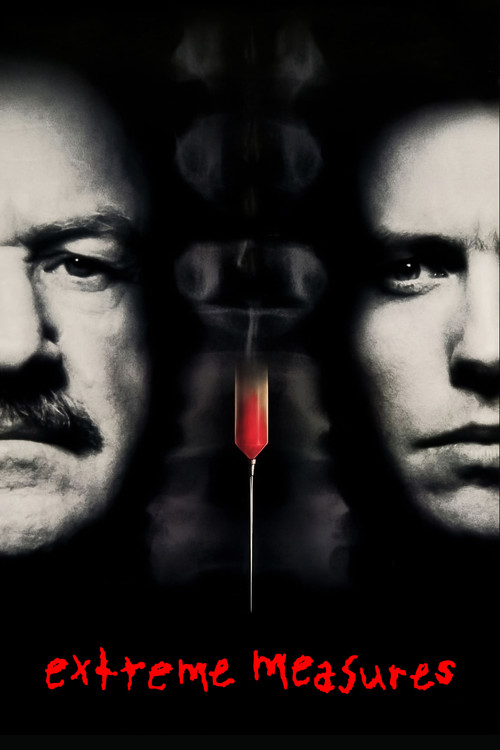
Extreme Measures
Guy Luthan, a British doctor working at a hospital in New York, starts making unwelcome enquiries when the body of a man who died in his emergency room disappears. After the trail leads Luthan to the door of an eminent surgeon at the hospital, Luthan soon finds himself in extreme danger people who want the hospital's secret to remain undiscovered.
The film financial setback against its mid-range budget of $38.0M, earning $17.4M globally (-54% loss). While initial box office returns were modest, the film has gained appreciation for its unique voice within the drama genre.


Plot Structure
Story beats plotted across runtime


Narrative Arc
Emotional journey through the story's key moments
Story Circle
Blueprint 15-beat structure
Arcplot Score Breakdown
Weighted: Precision (70%) + Arc (15%) + Theme (15%)
Extreme Measures (1996) demonstrates strategically placed narrative architecture, characteristic of Michael Apted's storytelling approach. This structural analysis examines how the film's 15-point plot structure maps to proven narrative frameworks across 1 hour and 58 minutes. With an Arcplot score of 7.4, the film balances conventional beats with creative variation.
Characters
Cast & narrative archetypes

Dr. Guy Luthan
Dr. Lawrence Myrick
Jodie Trammel
Claude Minkins
Dr. Jeffrey Manko
Detective Burke
Main Cast & Characters
Dr. Guy Luthan
Played by Hugh Grant
An idealistic ER doctor who uncovers a deadly conspiracy involving human experimentation while investigating a mysterious homeless patient.
Dr. Lawrence Myrick
Played by Gene Hackman
A brilliant but morally compromised neurosurgeon conducting illegal experiments on homeless people for the greater medical good.
Jodie Trammel
Played by Sarah Jessica Parker
A psychiatric nurse who becomes romantically involved with Guy and helps him uncover the truth despite the danger.
Claude Minkins
Played by Paul Guilfoyle
A homeless man and victim of Myrick's experiments who becomes paralyzed and seeks Guy's help to expose the conspiracy.
Dr. Jeffrey Manko
Played by Bill Nunn
Guy's colleague and friend at the hospital who initially doubts Guy's conspiracy theories but eventually supports him.
Detective Burke
Played by David Morse
A police detective investigating the suspicious deaths and disappearances connected to the conspiracy.
Structural Analysis
The Status Quo at 2 minutes (1% through the runtime) establishes Dr. Guy Luthan works confidently in the Gramercy Hospital ER, a skilled and dedicated young physician in his element, saving lives in the controlled chaos of New York emergency medicine.. Structural examination shows that this early placement immediately immerses viewers in the story world.
The inciting incident occurs at 12 minutes when A mysterious homeless man is brought into the ER with strange symptoms and track marks. Despite Guy's efforts, the man dies under suspicious circumstances, and his body disappears from the morgue.. At 10% through the film, this Disruption aligns precisely with traditional story structure. This beat shifts the emotional landscape, launching the protagonist into the central conflict.
The First Threshold at 28 minutes marks the transition into Act II, occurring at 23% of the runtime. This shows the protagonist's commitment to Guy actively chooses to defy hospital orders and continues investigating despite warnings. He breaks into medical records and crosses ethical lines, committing to uncovering the truth regardless of consequences., moving from reaction to action.
At 56 minutes, the Midpoint arrives at 48% of the runtime—precisely centered, creating perfect narrative symmetry. The analysis reveals that this crucial beat False defeat: Guy is framed for drug possession and prescription fraud. He's arrested and his medical license is suspended. The conspiracy reveals its power - they can destroy his life completely., fundamentally raising what's at risk. The emotional intensity shifts, dividing the narrative into clear before-and-after phases.
The Collapse moment at 86 minutes (73% through) represents the emotional nadir. Here, Guy is captured and taken to the secret research facility. He faces Dr. Myrick who justifies the experiments - sacrificing "worthless" lives to cure paralysis. Guy realizes the depth of the conspiracy and seems powerless to stop it., illustrates the protagonist at their lowest point. This beat's placement in the final quarter sets up the climactic reversal.
The Second Threshold at 92 minutes initiates the final act resolution at 78% of the runtime. Guy realizes he can't stop the research, but he can expose it and force it into ethical oversight. He gathers evidence and finds allies who will help him bring the truth to light., demonstrating the transformation achieved throughout the journey.
Emotional Journey
Extreme Measures's emotional architecture traces a deliberate progression across 15 carefully calibrated beats.
Narrative Framework
This structural analysis employs structural analysis methodology used to understand storytelling architecture. By mapping Extreme Measures against these established plot points, we can identify how Michael Apted utilizes or subverts traditional narrative conventions. The plot point approach reveals not only adherence to structural principles but also creative choices that distinguish Extreme Measures within the drama genre.
Michael Apted's Structural Approach
Among the 13 Michael Apted films analyzed on Arcplot, the average structural score is 7.1, reflecting strong command of classical structure. Extreme Measures represents one of the director's most structurally precise works. For comparative analysis, explore the complete Michael Apted filmography.
Comparative Analysis
Additional drama films include After Thomas, South Pacific and Dirty Dancing: Havana Nights. For more Michael Apted analyses, see Coal Miner's Daughter, Amazing Grace and Nell.
Plot Points by Act
Act I
SetupStatus Quo
Dr. Guy Luthan works confidently in the Gramercy Hospital ER, a skilled and dedicated young physician in his element, saving lives in the controlled chaos of New York emergency medicine.
Theme
A colleague or patient discusses medical ethics: "How far would you go to save a life?" - establishing the central moral question about ends justifying means in medical research.
Worldbuilding
Guy's world established: his dedication to patients, relationship with nurse Jodie, hospital politics, and his idealistic approach to medicine. He's good at his job but naive about the darker side of medical institutions.
Disruption
A mysterious homeless man is brought into the ER with strange symptoms and track marks. Despite Guy's efforts, the man dies under suspicious circumstances, and his body disappears from the morgue.
Resistance
Guy investigates the homeless man's death, facing resistance from hospital administration. He debates whether to pursue this or focus on his career. He discovers the dead man's identity and finds similar cases.
Act II
ConfrontationFirst Threshold
Guy actively chooses to defy hospital orders and continues investigating despite warnings. He breaks into medical records and crosses ethical lines, committing to uncovering the truth regardless of consequences.
Mirror World
Guy encounters another investigator or informant who represents an alternate path - someone who pursued the truth and paid the price. This relationship carries the thematic question about moral compromises.
Premise
Medical detective story unfolds: Guy follows clues, discovers a pattern of homeless victims, uncovers illegal human experimentation. He's targeted by powerful forces trying to stop his investigation.
Midpoint
False defeat: Guy is framed for drug possession and prescription fraud. He's arrested and his medical license is suspended. The conspiracy reveals its power - they can destroy his life completely.
Opposition
Guy is now a fugitive, hunted by both police and the conspiracy. He discovers the experiments are conducted by respected Dr. Myrick, using homeless people for spinal cord research. The stakes escalate as witnesses are eliminated.
Collapse
Guy is captured and taken to the secret research facility. He faces Dr. Myrick who justifies the experiments - sacrificing "worthless" lives to cure paralysis. Guy realizes the depth of the conspiracy and seems powerless to stop it.
Crisis
Guy's dark night: he's confronted with the moral complexity. Myrick shows him paralyzed patients who could be cured by this research. Guy must reconcile his idealism with brutal reality.
Act III
ResolutionSecond Threshold
Guy realizes he can't stop the research, but he can expose it and force it into ethical oversight. He gathers evidence and finds allies who will help him bring the truth to light.
Synthesis
Final confrontation: Guy escapes with evidence, confronts Myrick publicly, and exposes the conspiracy. The research is stopped but the ethical questions remain unresolved. Guy uses both his medical knowledge and newfound moral complexity.
Transformation
Guy returns to medicine, but transformed. He's no longer naive about medical ethics - he understands the gray areas. The final image shows him as a wiser, more morally complex physician.