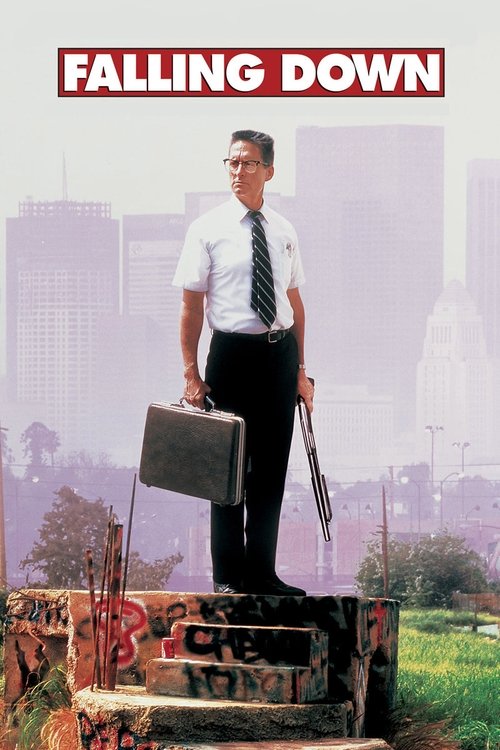
Falling Down
An ordinary man frustrated with the various flaws he sees in society begins to psychotically and violently lash out against them.
Working with a mid-range budget of $25.0M, the film achieved a modest success with $40.9M in global revenue (+64% profit margin).
1 win & 2 nominations


Plot Structure
Story beats plotted across runtime


Narrative Arc
Emotional journey through the story's key moments
Story Circle
Blueprint 15-beat structure
Arcplot Score Breakdown
Weighted: Precision (70%) + Arc (15%) + Theme (15%)
Falling Down (1993) exemplifies deliberately positioned plot construction, characteristic of Joel Schumacher's storytelling approach. This structural analysis examines how the film's 15-point plot structure maps to proven narrative frameworks across 1 hour and 53 minutes. With an Arcplot score of 7.4, the film balances conventional beats with creative variation.
Characters
Cast & narrative archetypes

William 'D-Fens' Foster
Sergeant Martin Prendergast
Beth Travino
Captain Sandra Torres
Mrs. Prendergast
Nick the Nazi Surplus Store Owner
Main Cast & Characters
William 'D-Fens' Foster
Played by Michael Douglas
Unemployed defense worker who snaps and goes on a violent rampage across Los Angeles on his way to his daughter's birthday party.
Sergeant Martin Prendergast
Played by Robert Duvall
Retiring LAPD detective on his last day who tracks D-Fens across the city while dealing with his overprotective wife.
Beth Travino
Played by Barbara Hershey
D-Fens' ex-wife who has a restraining order against him and fears for her and their daughter's safety.
Captain Sandra Torres
Played by Rachel Ticotin
Prendergast's dismissive police captain who doesn't take his investigation seriously.
Mrs. Prendergast
Played by Tuesday Weld
Martin's neurotic, overly protective wife who constantly calls him at work with irrational fears.
Nick the Nazi Surplus Store Owner
Played by Frederic Forrest
White supremacist Army surplus store owner who tries to befriend D-Fens, leading to a violent confrontation.
Structural Analysis
The Status Quo at 1 minutes (1% through the runtime) establishes William Foster (D-FENS) sits trapped in gridlock traffic on a sweltering LA morning, sweating profusely, surrounded by screaming children and honking cars. He snaps, abandons his car, and begins walking across Los Angeles.. Structural examination shows that this early placement immediately immerses viewers in the story world.
The inciting incident occurs at 13 minutes when D-FENS violently destroys the Korean convenience store with a baseball bat after being charged 85 cents for a Coke, declaring "I'm just standing up for my rights as a consumer." His frustration escalates from passive to active violence.. At 12% through the film, this Disruption aligns precisely with traditional story structure. This beat shifts the emotional landscape, launching the protagonist into the central conflict.
The First Threshold at 28 minutes marks the transition into Act II, occurring at 25% of the runtime. This illustrates the protagonist's commitment to D-FENS takes a bag full of weapons from the gang members after defending himself, actively choosing to arm himself and continue his violent path across LA. He's now committed to his mission to reach his daughter, no matter the cost., moving from reaction to action.
At 55 minutes, the Midpoint arrives at 49% of the runtime—precisely centered, creating perfect narrative symmetry. Structural examination shows that this crucial beat At the Whammy Burger, D-FENS holds the restaurant hostage with military weapons, delivering his manifesto about false advertising and broken promises. He's reached peak righteous indignation, but the encounter shows he's becoming the villain, not the hero., fundamentally raising what's at risk. The emotional intensity shifts, dividing the narrative into clear before-and-after phases.
The Collapse moment at 84 minutes (75% through) represents the emotional nadir. Here, D-FENS reaches his former home, now owned by another family, and sees children playing - a stark reminder that his family life is dead and he can never return to it. He realizes he's lost everything: job, home, wife, daughter. His dream is completely dead., reveals the protagonist at their lowest point. This beat's placement in the final quarter sets up the climactic reversal.
The Second Threshold at 90 minutes initiates the final act resolution at 80% of the runtime. Prendergast defies his captain and his wife, choosing to actively pursue D-FENS to the pier. D-FENS calls Beth and tells her he's coming. Both men commit fully to their final confrontation, synthesizing who they truly are., demonstrating the transformation achieved throughout the journey.
Emotional Journey
Falling Down's emotional architecture traces a deliberate progression across 15 carefully calibrated beats.
Narrative Framework
This structural analysis employs proven narrative structure principles that track dramatic progression. By mapping Falling Down against these established plot points, we can identify how Joel Schumacher utilizes or subverts traditional narrative conventions. The plot point approach reveals not only adherence to structural principles but also creative choices that distinguish Falling Down within the crime genre.
Joel Schumacher's Structural Approach
Among the 17 Joel Schumacher films analyzed on Arcplot, the average structural score is 7.0, reflecting strong command of classical structure. Falling Down represents one of the director's most structurally precise works. For comparative analysis, explore the complete Joel Schumacher filmography.
Comparative Analysis
Additional crime films include The Bad Guys, Rustom and The Whole Ten Yards. For more Joel Schumacher analyses, see Batman Forever, The Phantom of the Opera and Trespass.
Plot Points by Act
Act I
SetupStatus Quo
William Foster (D-FENS) sits trapped in gridlock traffic on a sweltering LA morning, sweating profusely, surrounded by screaming children and honking cars. He snaps, abandons his car, and begins walking across Los Angeles.
Theme
At the convenience store, the Korean owner refuses to give change without a purchase. D-FENS asks "Don't you have any concept of customer service?" - establishing the theme of social decay, broken systems, and the American Dream gone wrong.
Worldbuilding
Parallel narratives establish D-FENS as a laid-off defense worker trying to reach his daughter's birthday party, and Detective Prendergast on his last day before retirement, trapped in a desk job by his controlling wife. Both men are imprisoned by circumstances.
Disruption
D-FENS violently destroys the Korean convenience store with a baseball bat after being charged 85 cents for a Coke, declaring "I'm just standing up for my rights as a consumer." His frustration escalates from passive to active violence.
Resistance
D-FENS continues his trek, encountering gang members who threaten him. Meanwhile, Prendergast begins noticing connections between incidents across the city. Both men debate their next moves - D-FENS whether to continue, Prendergast whether to get involved.
Act II
ConfrontationFirst Threshold
D-FENS takes a bag full of weapons from the gang members after defending himself, actively choosing to arm himself and continue his violent path across LA. He's now committed to his mission to reach his daughter, no matter the cost.
Mirror World
Prendergast's relationship with his wife Sandra reveals the mirror theme: he too is trapped and controlled, unable to assert himself. She manipulates him with their dead daughter's memory, showing another man imprisoned by societal expectations and fear.
Premise
D-FENS continues his violent odyssey through LA, confronting a fast-food restaurant, a golfer, and a homophobic surplus store owner. Each encounter escalates his violence while satirizing American institutions. Prendergast investigates, connecting the dots.
Midpoint
At the Whammy Burger, D-FENS holds the restaurant hostage with military weapons, delivering his manifesto about false advertising and broken promises. He's reached peak righteous indignation, but the encounter shows he's becoming the villain, not the hero.
Opposition
D-FENS's ex-wife Beth realizes he's coming for them and calls police. Prendergast takes charge of the investigation despite resistance from his captain. Both protagonists face increasing opposition - D-FENS from society fighting back, Prendergast from his own department.
Collapse
D-FENS reaches his former home, now owned by another family, and sees children playing - a stark reminder that his family life is dead and he can never return to it. He realizes he's lost everything: job, home, wife, daughter. His dream is completely dead.
Crisis
D-FENS sits alone processing his loss, while Prendergast pieces together D-FENS's identity and history - learning he was fired from his defense job months ago and has been lying to himself. Both men confront dark truths about their lives.
Act III
ResolutionSecond Threshold
Prendergast defies his captain and his wife, choosing to actively pursue D-FENS to the pier. D-FENS calls Beth and tells her he's coming. Both men commit fully to their final confrontation, synthesizing who they truly are.
Synthesis
The finale at the Venice pier. Prendergast confronts D-FENS, who holds Beth and his daughter hostage. In their exchange, D-FENS asks "I'm the bad guy?" finally recognizing his transformation. Prendergast shoots him; D-FENS falls into the ocean, dying.
Transformation
Prendergast walks away from the pier with newfound strength, having saved the family and found his courage. Unlike D-FENS who became what he hated, Prendergast transformed positively by choosing to act. The final image shows him driving away, finally free.