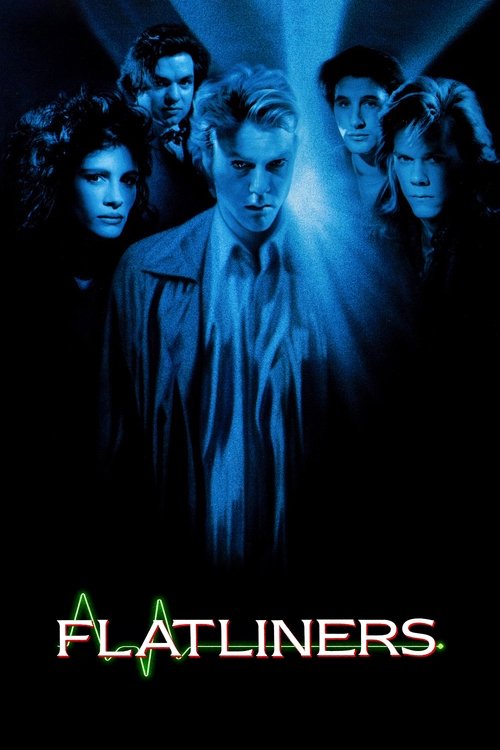
Flatliners
Five medical students want to find out if there is life after death. They plan to stop one of their hearts for a few seconds, thus simulating death, and then bring the person back to life.
Despite a respectable budget of $26.0M, Flatliners became a commercial success, earning $61.5M worldwide—a 136% return.
Nominated for 1 Oscar. 3 nominations


Plot Structure
Story beats plotted across runtime


Narrative Arc
Emotional journey through the story's key moments
Story Circle
Blueprint 15-beat structure
Arcplot Score Breakdown
Weighted: Precision (70%) + Arc (15%) + Theme (15%)
Flatliners (1990) showcases precise dramatic framework, characteristic of Joel Schumacher's storytelling approach. This structural analysis examines how the film's 15-point plot structure maps to proven narrative frameworks across 1 hour and 55 minutes. With an Arcplot score of 6.5, the film balances conventional beats with creative variation.
Characters
Cast & narrative archetypes

Nelson Wright
Rachel Mannus
David Labraccio
Joe Hurley
Randy Steckle
Main Cast & Characters
Nelson Wright
Played by Kiefer Sutherland
Ambitious medical student who initiates the near-death experiments, driven by curiosity about what lies beyond death and haunted by his past sins.
Rachel Mannus
Played by Julia Roberts
Compassionate medical student with a troubled past involving her father's suicide, seeking redemption and understanding through the experiments.
David Labraccio
Played by Kevin Bacon
Rational, skeptical medical student who resists the experiments initially but eventually participates, haunted by his past bullying of a young girl.
Joe Hurley
Played by William Baldwin
Playboy medical student with a superficial exterior who hides guilt over his treatment of women and past relationships.
Randy Steckle
Played by Oliver Platt
Videographer and technical support for the experiments, initially enthusiastic but becomes increasingly disturbed by the consequences.
Structural Analysis
The Status Quo at 1 minutes (1% through the runtime) establishes Nelson Wright is introduced as a brilliant, driven medical student conducting unauthorized experiments in abandoned hospital wings, establishing his arrogance and obsession with transcending medical boundaries.. Structural examination shows that this early placement immediately immerses viewers in the story world.
The inciting incident occurs at 15 minutes when Nelson reveals his radical proposal: to deliberately flatline and experience death, then be resuscitated. He asks his fellow students to help him cross over and bring him back, promising to explore what lies beyond.. At 13% through the film, this Disruption is delayed, allowing extended setup of the story world. This beat shifts the emotional landscape, launching the protagonist into the central conflict.
The First Threshold at 28 minutes marks the transition into Act II, occurring at 25% of the runtime. This indicates the protagonist's commitment to Nelson is flatlined for the first time, clinically dying as his heart stops. He crosses into death, experiencing vivid visions of his childhood. The team successfully resuscitates him, and there's no turning back., moving from reaction to action.
At 58 minutes, the Midpoint arrives at 50% of the runtime—precisely centered, creating perfect narrative symmetry. The analysis reveals that this crucial beat The visions begin crossing over into waking life. Nelson is attacked by a boy from his past—Billy Mahoney, whom he bullied as a child. What seemed like transcendent experiences become horrifying as past sins manifest as vengeful apparitions., fundamentally raising what's at risk. The emotional intensity shifts, dividing the narrative into clear before-and-after phases.
The Collapse moment at 87 minutes (75% through) represents the emotional nadir. Here, Nelson is nearly killed by the Billy Mahoney vision in a terrifying attack. He realizes they've unleashed something they cannot control, and that death will not let them go. The price of their hubris becomes clear: they must face what they've done or be destroyed., demonstrates the protagonist at their lowest point. This beat's placement in the final quarter sets up the climactic reversal.
The Second Threshold at 92 minutes initiates the final act resolution at 80% of the runtime. Nelson understands he must genuinely atone for his sins. David, Rachel, and Joe each realize they must confess, apologize, and make things right with those they hurt. This new understanding—redemption through accountability—gives them a path forward., demonstrating the transformation achieved throughout the journey.
Emotional Journey
Flatliners's emotional architecture traces a deliberate progression across 15 carefully calibrated beats.
Narrative Framework
This structural analysis employs proven narrative structure principles that track dramatic progression. By mapping Flatliners against these established plot points, we can identify how Joel Schumacher utilizes or subverts traditional narrative conventions. The plot point approach reveals not only adherence to structural principles but also creative choices that distinguish Flatliners within the drama genre.
Joel Schumacher's Structural Approach
Among the 17 Joel Schumacher films analyzed on Arcplot, the average structural score is 7.0, reflecting strong command of classical structure. Flatliners takes a more unconventional approach compared to the director's typical style. For comparative analysis, explore the complete Joel Schumacher filmography.
Comparative Analysis
Additional drama films include After Thomas, South Pacific and Dirty Dancing: Havana Nights. For more Joel Schumacher analyses, see Batman Forever, The Phantom of the Opera and Trespass.
Plot Points by Act
Act I
SetupStatus Quo
Nelson Wright is introduced as a brilliant, driven medical student conducting unauthorized experiments in abandoned hospital wings, establishing his arrogance and obsession with transcending medical boundaries.
Theme
During a conversation about medical ethics and the limits of science, a character questions whether some knowledge is forbidden for a reason, hinting at the dangerous consequences of playing God.
Worldbuilding
Introduction to the five medical students, their competitive dynamics, and the medical school environment. Nelson's philosophical questions about death and the afterlife are established, along with each character's personality and motivations.
Disruption
Nelson reveals his radical proposal: to deliberately flatline and experience death, then be resuscitated. He asks his fellow students to help him cross over and bring him back, promising to explore what lies beyond.
Resistance
The group debates the ethics and dangers of the experiment. Initial resistance gives way as Nelson's charisma and their own curiosity win out. They prepare equipment, set rules, and plan the first flatline experiment.
Act II
ConfrontationFirst Threshold
Nelson is flatlined for the first time, clinically dying as his heart stops. He crosses into death, experiencing vivid visions of his childhood. The team successfully resuscitates him, and there's no turning back.
Mirror World
Rachel emerges as the emotional center and voice of conscience. Her developing relationship with Nelson represents the theme of redemption, while her own desire to flatline reveals her need to confront her past.
Premise
The "fun and games" of competitive flatlining: each student takes their turn dying for progressively longer periods, experiencing profound visions. They feel euphoric, enlightened, god-like. The experiments intensify as they push boundaries further.
Midpoint
The visions begin crossing over into waking life. Nelson is attacked by a boy from his past—Billy Mahoney, whom he bullied as a child. What seemed like transcendent experiences become horrifying as past sins manifest as vengeful apparitions.
Opposition
The hauntings intensify for each student. Rachel is tormented by her father, David by women he hurt, Joe by a girl he recorded secretly. Their guilt manifests as escalating supernatural attacks. They realize the afterlife is making them pay for their sins. Relationships fracture under the strain.
Collapse
Nelson is nearly killed by the Billy Mahoney vision in a terrifying attack. He realizes they've unleashed something they cannot control, and that death will not let them go. The price of their hubris becomes clear: they must face what they've done or be destroyed.
Crisis
Nelson reaches his dark night of the soul, confronting the reality that he tortured Billy Mahoney as a child, driving him to suicide. The others face their own guilt. They realize the only way to stop the hauntings is to seek forgiveness and make amends.
Act III
ResolutionSecond Threshold
Nelson understands he must genuinely atone for his sins. David, Rachel, and Joe each realize they must confess, apologize, and make things right with those they hurt. This new understanding—redemption through accountability—gives them a path forward.
Synthesis
Each student confronts their sins: David apologizes to the women he wronged, Joe confesses his voyeurism, Rachel reconciles with her father's memory. Nelson goes to Billy Mahoney's mother to confess his childhood cruelty, seeking forgiveness. The hauntings cease as amends are made.
Transformation
Nelson, now humble and redeemed, is shown at peace. The group has learned that some boundaries exist for a reason, and that facing one's sins with honesty is the true path to redemption. They've been fundamentally changed by confronting death and guilt.