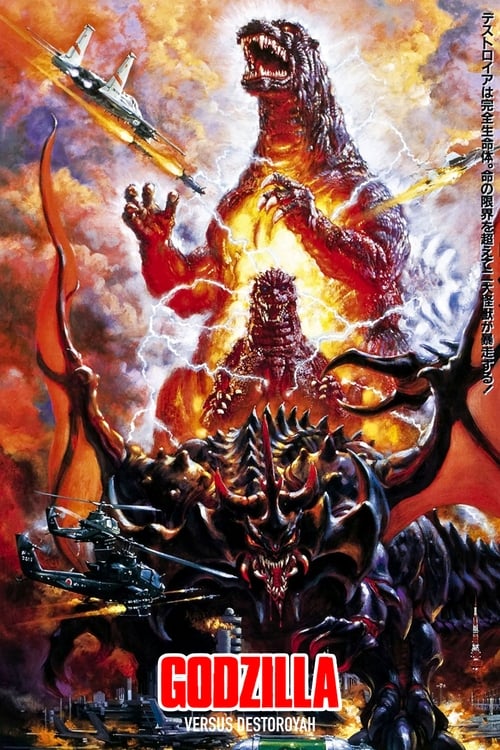
Godzilla vs. Destoroyah
A burning Godzilla, on the verge of meltdown, emerges to lay siege to Hong Kong. At the same time horrifying new organisms are discovered in Japan. These crustacean-like beings are seemingly born of the Oxygen Destroyer, the weapon that killed the original Godzilla.
Working with a small-scale budget of $10.0M, the film achieved a respectable showing with $18.0M in global revenue (+80% profit margin).


Plot Structure
Story beats plotted across runtime


Narrative Arc
Emotional journey through the story's key moments
Story Circle
Blueprint 15-beat structure
Arcplot Score Breakdown
Weighted: Precision (70%) + Arc (15%) + Theme (15%)
Godzilla vs. Destoroyah (1995) showcases strategically placed story structure, characteristic of Takao Okawara's storytelling approach. This structural analysis examines how the film's 15-point plot structure maps to proven narrative frameworks across 1 hour and 43 minutes. With an Arcplot score of 7.5, the film showcases strong structural fundamentals.
Characters
Cast & narrative archetypes

Kenichi Yamane
Miki Saegusa
Kenkichi Yamane
Yukari Yamane
Meru Ozawa
Godzilla Junior
Commander Takaki Aso
Destoroyah
Main Cast & Characters
Kenichi Yamane
Played by Akira Nakao
Marine biologist and son of the original Dr. Yamane, leading the scientific investigation into Godzilla's meltdown crisis
Miki Saegusa
Played by Megumi Odaka
Psychic with a telepathic connection to Godzilla, torn between her empathy for the monster and duty to humanity
Kenkichi Yamane
Played by Yasufumi Hayashi
College student and grandson of the original Dr. Yamane, who discovers the Precambrian organisms that become Destoroyah
Yukari Yamane
Played by Sayaka Osawa
Television reporter and Kenichi's sister, documenting the unfolding crisis
Meru Ozawa
Played by Saburo Shinoda
Senior scientist working on the crisis team to prevent Godzilla's nuclear meltdown
Godzilla Junior
Played by Hurricane Ryu
Godzilla's adopted offspring, maturing and bonding with his parent in the final film of the Heisei era
Commander Takaki Aso
Played by Akira Nakao
Military commander overseeing Japan's defense operations against both Godzilla and Destoroyah
Destoroyah
Played by Ryo Hariya
Horrific monster born from Precambrian organisms mutated by the Oxygen Destroyer, evolving through multiple forms
Structural Analysis
The Status Quo at 1 minutes (1% through the runtime) establishes Birth Island explodes in a catastrophic nuclear event, destroying Godzilla Junior's home and setting the stage for the unprecedented crisis to come.. Significantly, this early placement immediately immerses viewers in the story world.
The inciting incident occurs at 12 minutes when G-Force scientists confirm Godzilla's meltdown is irreversible and will cause a catastrophic explosion that could devastate Earth. Godzilla's death becomes inevitable, transforming the mission from combat to damage control.. At 12% through the film, this Disruption aligns precisely with traditional story structure. This beat shifts the emotional landscape, launching the protagonist into the central conflict.
The First Threshold at 26 minutes marks the transition into Act II, occurring at 25% of the runtime. This reveals the protagonist's commitment to G-Force commits to a desperate plan: develop freezing weapons to contain Godzilla's meltdown while simultaneously dealing with the evolving Destoroyah threat. They accept they must face both monsters while knowing Godzilla cannot be saved., moving from reaction to action.
At 52 minutes, the Midpoint arrives at 50% of the runtime—precisely centered, creating perfect narrative symmetry. Notably, this crucial beat Destoroyah evolves into its massive final demonic form, revealing itself as a threat equal to or greater than Godzilla himself. The stakes escalate from managing Godzilla's death to preventing the rise of an even more destructive monster born from humanity's own weapon., fundamentally raising what's at risk. The emotional intensity shifts, dividing the narrative into clear before-and-after phases.
The Collapse moment at 77 minutes (75% through) represents the emotional nadir. Here, Destoroyah brutally kills Godzilla Junior, blasting him from the sky and leaving his smoking corpse on the ground. Godzilla arrives to find his son dead, marking the film's darkest moment and removing the hope that Junior represented., indicates the protagonist at their lowest point. This beat's placement in the final quarter sets up the climactic reversal.
The Second Threshold at 82 minutes initiates the final act resolution at 80% of the runtime. Godzilla channels his rage and meltdown energy into his most powerful attack yet - the red spiral atomic ray. He accepts his death but will use his final moments to destroy his son's killer. Humans deploy all freeze weapons, coordinating with Godzilla's assault., demonstrating the transformation achieved throughout the journey.
Emotional Journey
Godzilla vs. Destoroyah's emotional architecture traces a deliberate progression across 15 carefully calibrated beats.
Narrative Framework
This structural analysis employs systematic plot point analysis that identifies crucial turning points. By mapping Godzilla vs. Destoroyah against these established plot points, we can identify how Takao Okawara utilizes or subverts traditional narrative conventions. The plot point approach reveals not only adherence to structural principles but also creative choices that distinguish Godzilla vs. Destoroyah within the action genre.
Takao Okawara's Structural Approach
Among the 4 Takao Okawara films analyzed on Arcplot, the average structural score is 7.1, reflecting strong command of classical structure. Godzilla vs. Destoroyah represents one of the director's most structurally precise works. For comparative analysis, explore the complete Takao Okawara filmography.
Comparative Analysis
Additional action films include The Bad Guys, Puss in Boots and Venom: The Last Dance. For more Takao Okawara analyses, see Godzilla vs. Mechagodzilla II, Godzilla vs. Mothra and Godzilla 2000: Millennium.
Plot Points by Act
Act I
SetupStatus Quo
Birth Island explodes in a catastrophic nuclear event, destroying Godzilla Junior's home and setting the stage for the unprecedented crisis to come.
Theme
Kenichi Yamane warns that the sins of the past have returned to haunt them, as the Oxygen Destroyer's legacy and Godzilla's unstable nuclear heart threaten humanity's future - we cannot escape the consequences of our actions.
Worldbuilding
Scientists discover Godzilla is in nuclear meltdown, glowing red-hot and potentially capable of destroying the planet. Meanwhile, prehistoric crustaceans mutated by the 1954 Oxygen Destroyer emerge in Tokyo Bay, establishing the dual threat.
Disruption
G-Force scientists confirm Godzilla's meltdown is irreversible and will cause a catastrophic explosion that could devastate Earth. Godzilla's death becomes inevitable, transforming the mission from combat to damage control.
Resistance
Scientists debate how to handle Godzilla's impending meltdown while studying the Destoroyah creatures. The team researches freeze weapons technology and investigates the connection between the mutations and Dr. Serizawa's Oxygen Destroyer from 1954.
Act II
ConfrontationFirst Threshold
G-Force commits to a desperate plan: develop freezing weapons to contain Godzilla's meltdown while simultaneously dealing with the evolving Destoroyah threat. They accept they must face both monsters while knowing Godzilla cannot be saved.
Mirror World
Godzilla Junior is discovered alive, now grown to sub-adult size. His survival represents hope and continuity, providing an emotional counterpoint to Godzilla's dying state and embodying the theme of legacy passing from one generation to the next.
Premise
The premise delivers on spectacle: Destoroyah creatures aggregate and evolve into larger forms, attacking the JSDF. Scientists race to complete freeze weapons. Junior is tracked and monitored. Multiple monster threats converge on Tokyo as both Godzilla and Destoroyah approach.
Midpoint
Destoroyah evolves into its massive final demonic form, revealing itself as a threat equal to or greater than Godzilla himself. The stakes escalate from managing Godzilla's death to preventing the rise of an even more destructive monster born from humanity's own weapon.
Opposition
Forces converge on Tokyo. Junior is lured to the city as bait. The Super X-III deploys with freeze weapons. Final-form Destoroyah attacks with devastating power. Godzilla's temperature continues rising toward critical meltdown. All three forces move toward inevitable collision.
Collapse
Destoroyah brutally kills Godzilla Junior, blasting him from the sky and leaving his smoking corpse on the ground. Godzilla arrives to find his son dead, marking the film's darkest moment and removing the hope that Junior represented.
Crisis
Godzilla mourns Junior's body, his anguish palpable. Miki Saegusa psychically feels Godzilla's grief and rage. The meltdown accelerates from emotional stress. In this dark night, Godzilla transforms grief into fury, his power surging as his temperature reaches critical levels.
Act III
ResolutionSecond Threshold
Godzilla channels his rage and meltdown energy into his most powerful attack yet - the red spiral atomic ray. He accepts his death but will use his final moments to destroy his son's killer. Humans deploy all freeze weapons, coordinating with Godzilla's assault.
Synthesis
The finale: Godzilla battles Destoroyah with overwhelming power, his spiral ray obliterating the creature. Destoroyah attempts to escape but is shot down and disintegrates. Godzilla begins melting down. Super X-III deploys maximum freeze power. Godzilla dissolves in nuclear fire, his body consumed. Junior absorbs the radiation and revives, transformed into a new adult Godzilla.
Transformation
The new Godzilla, reborn from Junior through his father's sacrifice, roars over Tokyo. Death has transformed into rebirth. The legacy continues. What began with destruction and inevitable death ends with hope and renewal, though the cycle of Godzilla will clearly continue.