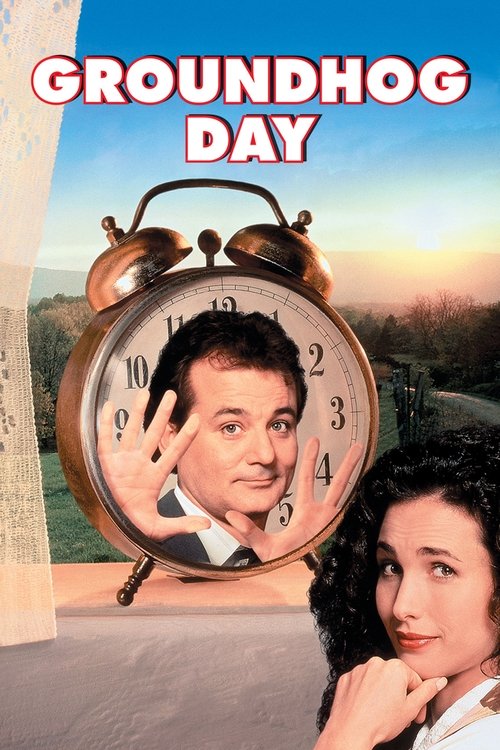
Groundhog Day
A narcissistic TV weatherman, along with his attractive-but-distant producer, and his mawkish cameraman, is sent to report on Groundhog Day in the small town of Punxsutawney, where he finds himself repeating the same day over and over.
Despite its limited budget of $14.6M, Groundhog Day became a financial success, earning $71.1M worldwide—a 387% return. The film's distinctive approach engaged audiences, proving that strong storytelling can transcend budget limitations.
1 BAFTA Award7 wins & 17 nominations


Plot Structure
Story beats plotted across runtime


Narrative Arc
Emotional journey through the story's key moments
Story Circle
Blueprint 15-beat structure
Arcplot Score Breakdown
Weighted: Precision (70%) + Arc (15%) + Theme (15%)
Groundhog Day (1993) exhibits deliberately positioned narrative design, characteristic of Harold Ramis's storytelling approach. This structural analysis examines how the film's 15-point plot structure maps to proven narrative frameworks across 1 hour and 41 minutes. With an Arcplot score of 6.9, the film balances conventional beats with creative variation.
Characters
Cast & narrative archetypes

Phil Connors
Rita Hanson
Larry
Ned Ryerson
Main Cast & Characters
Phil Connors
Played by Bill Murray
A cynical, self-centered TV weatherman trapped in a time loop, reliving Groundhog Day repeatedly until he transforms into a better person.
Rita Hanson
Played by Andie MacDowell
Phil's kind-hearted producer who believes in genuine goodness and becomes the object of his affection and moral compass.
Larry
Played by Chris Elliott
Phil's cheerful, optimistic cameraman who maintains enthusiasm despite Phil's constant cynicism.
Ned Ryerson
Played by Stephen Tobolowsky
An overly enthusiastic insurance salesman and Phil's former high school classmate who pesters him daily.
Structural Analysis
The Status Quo at 1 minutes (1% through the runtime) establishes Phil Connors on air as Pittsburgh weatherman, displaying his arrogant, dismissive personality. He's contemptuous of his job, his colleagues, and especially the assignment to cover Groundhog Day in Punxsutawney. His isolation and superiority complex are immediately established.. The analysis reveals that this early placement immediately immerses viewers in the story world.
The inciting incident occurs at 12 minutes when Phil wakes up to "I Got You Babe" and realizes it's February 2nd again. The time loop has begun. The external event that will force Phil to confront himself has occurred, though he doesn't yet understand what's happening to him.. At 12% through the film, this Disruption aligns precisely with traditional story structure. This beat shifts the emotional landscape, launching the protagonist into the central conflict.
The First Threshold at 26 minutes marks the transition into Act II, occurring at 26% of the runtime. This indicates the protagonist's commitment to Phil decides to exploit the time loop for personal gain. "I'm not going to live by their rules anymore." He actively chooses to use his situation selfishly - robbing banks, manipulating women, indulging every whim. This is his choice to enter the "new world" of consequence-free living., moving from reaction to action.
At 51 minutes, the Midpoint arrives at 50% of the runtime—precisely centered, creating perfect narrative symmetry. Significantly, this crucial beat Rita slaps Phil after his most elaborate seduction attempt, seeing through his manipulation: "I could never love someone like you, because you'll never love anyone but yourself." False defeat - Phil realizes he cannot manipulate his way to genuine connection. The stakes raise as he confronts the emptiness of his approach., fundamentally raising what's at risk. The emotional intensity shifts, dividing the narrative into clear before-and-after phases.
The Collapse moment at 74 minutes (73% through) represents the emotional nadir. Here, After his final suicide attempt, Phil breaks down completely in front of Rita: "I'm a god, not THE god... I'm a god - I'm not THE god, I don't think." His ego dies. He admits his complete powerlessness and despair. Rita comforts him through one night, but he wakes alone again. His old self has died., indicates the protagonist at their lowest point. This beat's placement in the final quarter sets up the climactic reversal.
The Second Threshold at 80 minutes initiates the final act resolution at 80% of the runtime. Phil decides to use the time loop to help others rather than himself. He saves the falling boy, changes the tire for the old ladies, performs the Heimlich maneuver, catches the falling woman. He synthesizes his accumulated knowledge with a new purpose: service. "What if there is no tomorrow? There wasn't one today."., demonstrating the transformation achieved throughout the journey.
Emotional Journey
Groundhog Day's emotional architecture traces a deliberate progression across 15 carefully calibrated beats.
Narrative Framework
This structural analysis employs structural analysis methodology used to understand storytelling architecture. By mapping Groundhog Day against these established plot points, we can identify how Harold Ramis utilizes or subverts traditional narrative conventions. The plot point approach reveals not only adherence to structural principles but also creative choices that distinguish Groundhog Day within the romance genre.
Harold Ramis's Structural Approach
Among the 10 Harold Ramis films analyzed on Arcplot, the average structural score is 6.9, demonstrating varied approaches to story architecture. Groundhog Day takes a more unconventional approach compared to the director's typical style. For comparative analysis, explore the complete Harold Ramis filmography.
Comparative Analysis
Additional romance films include South Pacific, Dirty Dancing: Havana Nights and The Evening Star. For more Harold Ramis analyses, see The Ice Harvest, Year One and National Lampoon's Vacation.
Plot Points by Act
Act I
SetupStatus Quo
Phil Connors on air as Pittsburgh weatherman, displaying his arrogant, dismissive personality. He's contemptuous of his job, his colleagues, and especially the assignment to cover Groundhog Day in Punxsutawney. His isolation and superiority complex are immediately established.
Theme
In the van to Punxsutawney, Rita asks Phil what he would do if he were stuck in one place and every day was exactly the same. This is the thematic question the film will answer: meaning comes not from what happens to us, but from how we choose to respond and serve others.
Worldbuilding
Establishing Phil's world: his contempt for small-town Punxsutawney, his rudeness to locals like Ned Ryerson, his professional cynicism during the Groundhog Day ceremony, and his desperate attempt to leave town immediately. We see his complete lack of human connection or empathy.
Disruption
Phil wakes up to "I Got You Babe" and realizes it's February 2nd again. The time loop has begun. The external event that will force Phil to confront himself has occurred, though he doesn't yet understand what's happening to him.
Resistance
Phil experiences multiple repetitions of the same day, moving from confusion to disbelief to testing the boundaries. He debates what's happening with Rita and Larry. He begins to realize the loop is real and wrestles with what to do with this knowledge.
Act II
ConfrontationFirst Threshold
Phil decides to exploit the time loop for personal gain. "I'm not going to live by their rules anymore." He actively chooses to use his situation selfishly - robbing banks, manipulating women, indulging every whim. This is his choice to enter the "new world" of consequence-free living.
Mirror World
Phil begins his campaign to seduce Rita by learning everything about her through repeated days. Rita represents the thematic opposite of Phil - she's genuine, compassionate, and values real connection. Their developing relationship will teach Phil what he truly needs.
Premise
The "fun and games" of the time loop. Phil indulges in hedonism, learns skills to impress Rita, manipulates situations for pleasure and profit. We see the promise of the premise - what would you do with infinite do-overs? But his attempts to win Rita through manipulation keep failing.
Midpoint
Rita slaps Phil after his most elaborate seduction attempt, seeing through his manipulation: "I could never love someone like you, because you'll never love anyone but yourself." False defeat - Phil realizes he cannot manipulate his way to genuine connection. The stakes raise as he confronts the emptiness of his approach.
Opposition
Phil spirals into despair and nihilism. He attempts suicide in increasingly creative ways - driving off a cliff with the groundhog, electrocuting himself in a bathtub, stepping in front of a truck, jumping from a building. Each time he wakes up again to "I Got You Babe." Nothing works. His flaws have caught up with him - his selfishness cannot free him.
Collapse
After his final suicide attempt, Phil breaks down completely in front of Rita: "I'm a god, not THE god... I'm a god - I'm not THE god, I don't think." His ego dies. He admits his complete powerlessness and despair. Rita comforts him through one night, but he wakes alone again. His old self has died.
Crisis
The dark night processed. Phil sits with Rita through one evening where she sees his vulnerability. He begins to shift from "what can I get" to observing the people around him. The first glimmers of awakening - noticing the homeless man, considering others' needs.
Act III
ResolutionSecond Threshold
Phil decides to use the time loop to help others rather than himself. He saves the falling boy, changes the tire for the old ladies, performs the Heimlich maneuver, catches the falling woman. He synthesizes his accumulated knowledge with a new purpose: service. "What if there is no tomorrow? There wasn't one today."
Synthesis
Phil executes his transformation fully. He learns piano, ice sculpting, French poetry. He helps everyone in town. He tries desperately to save the homeless man. He attends the Groundhog Day party as his best self - not to manipulate, but to genuinely connect. Rita falls for him naturally because he has become genuinely lovable.
Transformation
Phil wakes up on February 3rd with Rita beside him. "Something is different." "Anything different is good." The loop is broken. The selfish, isolated weatherman has become a compassionate, connected human being. He chooses to stay in Punxsutawney and build a life with Rita, the town he once scorned now his home.