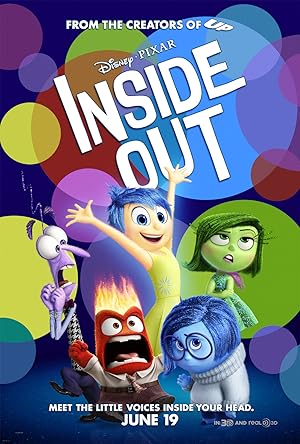
Inside Out
Growing up can be a bumpy road, and it's no exception for Riley, who is uprooted from her Midwest life when her father starts a new job in San Francisco. Like all of us, Riley is guided by her emotions - Joy, Fear, Anger, Disgust and Sadness. The emotions live in Headquarters, the control center inside Riley's mind, where they help advise her through everyday life. As Riley and her emotions struggle to adjust to a new life in San Francisco, turmoil ensues in Headquarters. Although Joy, Riley's main and most important emotion, tries to keep things positive, the emotions conflict on how best to navigate a new city, house and school.
Despite a massive budget of $175.0M, Inside Out became a financial success, earning $857.6M worldwide—a 390% return. This commercial performance validated the ambitious narrative scope, confirming that audiences embrace fresh perspective even at blockbuster scale.
1 Oscar. 99 wins & 118 nominations


Plot Structure
Story beats plotted across runtime


Narrative Arc
Emotional journey through the story's key moments
Story Circle
Blueprint 15-beat structure
Arcplot Score Breakdown
Weighted: Precision (70%) + Arc (15%) + Theme (15%)
Inside Out (2015) exemplifies meticulously timed narrative design, characteristic of Pete Docter's storytelling approach. This structural analysis examines how the film's 15-point plot structure maps to proven narrative frameworks across 1 hour and 35 minutes. With an Arcplot score of 3.5, the film takes an unconventional approach to traditional narrative frameworks.
Characters
Cast & narrative archetypes

Joy
Sadness
Riley Andersen
Fear
Anger
Disgust
Bing Bong
Main Cast & Characters
Joy
Played by Amy Poehler
The optimistic and energetic leader of Riley's emotions, dedicated to keeping Riley happy at all costs.
Sadness
Played by Phyllis Smith
A melancholic emotion who struggles to understand her purpose in Riley's emotional life.
Riley Andersen
Played by Kaitlyn Dias
An 11-year-old girl whose emotional journey forms the heart of the story as she moves from Minnesota to San Francisco.
Fear
Played by Bill Hader
A nervous and cautious emotion who keeps Riley safe from potential dangers, real or imagined.
Anger
Played by Lewis Black
A hot-tempered emotion who ensures Riley is treated fairly and reacts strongly to injustice.
Disgust
Played by Mindy Kaling
A sophisticated emotion who protects Riley from physical and social poison, focused on maintaining her image.
Bing Bong
Played by Richard Kind
Riley's forgotten imaginary friend from childhood who helps Joy and Sadness on their journey.
Structural Analysis
The Status Quo at 0 minutes (1% through the runtime) establishes Riley's first memory: Joy appears as baby Riley opens her eyes. Inside Headquarters, Joy introduces herself and the perfect happy life in Minnesota with loving parents, hockey, and best friend Meg.. Notably, this early placement immediately immerses viewers in the story world.
The inciting incident occurs at 10 minutes when Riley arrives at the decrepit San Francisco house. The moving van is lost, the house is cramped and old, and there's a dead mouse. Riley tries to stay positive but her world has been turned upside down.. At 10% through the film, this Disruption aligns precisely with traditional story structure. This beat shifts the emotional landscape, launching the protagonist into the central conflict.
The First Threshold at 18 minutes marks the transition into Act II, occurring at 19% of the runtime. This indicates the protagonist's commitment to At school, Riley breaks down crying in front of her class while recalling Minnesota. Sadness touches the memory, creating the first sad core memory. Joy tries to stop it from reaching long-term storage, and in the struggle, both Joy and Sadness are sucked out of Headquarters with all the core memories. The personality islands begin shutting down., moving from reaction to action.
At 42 minutes, the Midpoint arrives at 44% of the runtime—arriving early, accelerating into Act IIb complications. Structural examination shows that this crucial beat Friendship Island collapses into the Memory Dump while Joy, Sadness, and Bing Bong are on it. They fall into the abyss where forgotten memories fade to nothing. False defeat: Joy has lost everything - the core memories are gone, no way back to Headquarters, and Riley is falling apart., fundamentally raising what's at risk. The emotional intensity shifts, dividing the narrative into clear before-and-after phases.
The Collapse moment at 59 minutes (63% through) represents the emotional nadir. Here, Bing Bong sacrifices himself, jumping out of the wagon so Joy can escape the Memory Dump alone. He fades away, forgotten forever. Joy experiences profound loss and the "whiff of death" - the death of childhood innocence. Riley is on the bus running away, completely numb and emotionless., shows the protagonist at their lowest point. This beat's placement in the final quarter sets up the climactic reversal.
The Second Threshold at 66 minutes initiates the final act resolution at 70% of the runtime. Joy finds Sadness and gives her the core memories, finally trusting her. "Riley needs you." This is the synthesis - Joy learned that sadness isn't the enemy; suppressing sadness is. They use Imagination Land remnants to launch back up to Headquarters., demonstrating the transformation achieved throughout the journey.
Emotional Journey
Inside Out's emotional architecture traces a deliberate progression across 15 carefully calibrated beats.
Narrative Framework
This structural analysis employs systematic plot point analysis that identifies crucial turning points. By mapping Inside Out against these established plot points, we can identify how Pete Docter utilizes or subverts traditional narrative conventions. The plot point approach reveals not only adherence to structural principles but also creative choices that distinguish Inside Out within the animation genre.
Pete Docter's Structural Approach
Among the 4 Pete Docter films analyzed on Arcplot, the average structural score is 5.5, showcasing experimental approaches to narrative form. Inside Out takes a more unconventional approach compared to the director's typical style. For comparative analysis, explore the complete Pete Docter filmography.
Comparative Analysis
Additional animation films include The Bad Guys, Puss in Boots and Violet Evergarden: Eternity and the Auto Memory Doll. For more Pete Docter analyses, see Soul, Monsters, Inc. and Up.
Plot Points by Act
Act I
SetupStatus Quo
Riley's first memory: Joy appears as baby Riley opens her eyes. Inside Headquarters, Joy introduces herself and the perfect happy life in Minnesota with loving parents, hockey, and best friend Meg.
Theme
Dad tells 11-year-old Riley at dinner about the move to San Francisco: "You're gonna love it!" The theme emerges - we can't control what happens to us, but we can choose how we respond. Joy insists on keeping Riley happy despite the change.
Worldbuilding
Establishing Riley's emotional world inside Headquarters: Joy leads the five emotions (Sadness, Fear, Disgust, Anger), core memories power personality islands (Family, Hockey, Goofball, Friendship, Honesty), and long-term memory storage. Riley's life in Minnesota is happy and stable.
Disruption
Riley arrives at the decrepit San Francisco house. The moving van is lost, the house is cramped and old, and there's a dead mouse. Riley tries to stay positive but her world has been turned upside down.
Resistance
Joy tries desperately to maintain Riley's happiness as everything goes wrong: awkward first day at new school, missing her old life, dad stressed about work. Sadness keeps touching memories, turning them blue. Joy doesn't understand why Sadness exists and tries to keep her away from the controls.
Act II
ConfrontationFirst Threshold
At school, Riley breaks down crying in front of her class while recalling Minnesota. Sadness touches the memory, creating the first sad core memory. Joy tries to stop it from reaching long-term storage, and in the struggle, both Joy and Sadness are sucked out of Headquarters with all the core memories. The personality islands begin shutting down.
Mirror World
Joy and Sadness meet Bing Bong, Riley's forgotten imaginary friend, in Long Term Memory. He represents the innocence and memories Joy is trying to preserve. His presence introduces the question: what happens to memories we outgrow?
Premise
The "promise of the premise" - exploring Riley's mind. Joy and Sadness journey through Long Term Memory, Imagination Land, Abstract Thought, and Dream Productions trying to get back to Headquarters. Meanwhile, Fear, Anger, and Disgust try to run Riley without Joy, making everything worse. Islands start crumbling.
Midpoint
Friendship Island collapses into the Memory Dump while Joy, Sadness, and Bing Bong are on it. They fall into the abyss where forgotten memories fade to nothing. False defeat: Joy has lost everything - the core memories are gone, no way back to Headquarters, and Riley is falling apart.
Opposition
Joy tries to escape the Memory Dump using Bing Bong's wagon rocket. Back in Headquarters, Anger has a "great idea" - run away back to Minnesota. Riley steals mom's credit card and plans to leave. More personality islands collapse (Hockey, Honesty). Joy discovers an old sad memory that turned joyful - the first crack in her worldview.
Collapse
Bing Bong sacrifices himself, jumping out of the wagon so Joy can escape the Memory Dump alone. He fades away, forgotten forever. Joy experiences profound loss and the "whiff of death" - the death of childhood innocence. Riley is on the bus running away, completely numb and emotionless.
Crisis
Joy examines the core memories and realizes her mistake: the happiest memories had Sadness in them. Riley needed to be sad to bring people together. Joy finally understands Sadness's purpose. She races back to Headquarters to find Sadness.
Act III
ResolutionSecond Threshold
Joy finds Sadness and gives her the core memories, finally trusting her. "Riley needs you." This is the synthesis - Joy learned that sadness isn't the enemy; suppressing sadness is. They use Imagination Land remnants to launch back up to Headquarters.
Synthesis
Joy and Sadness return to Headquarters. Sadness takes control and makes Riley get off the bus. Riley returns home and finally opens up to her parents about how sad and scared she feels. They comfort her, creating a new core memory that's both blue (sad) and gold (joyful). New, more complex personality islands emerge. Riley adjusts to San Francisco.
Transformation
One year later: an expanded Headquarters with a bigger console and more complex emotions. Riley, now 12, plays hockey for her San Francisco team with new friends. Core memories are now multi-colored, reflecting emotional complexity. Joy and Sadness work together harmoniously. Riley has grown up.