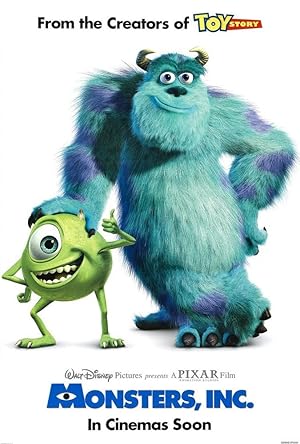
Monsters, Inc.
A city of monsters with no humans called Monstropolis centers around the city's power company, Monsters, Inc. The lovable, confident, tough, furry blue behemoth-like giant monster named James P. Sullivan (better known as Sulley) and his wisecracking best friend, short, green cyclops monster Mike Wazowski, discover what happens when the real world interacts with theirs in the form of a 2-year-old baby girl dubbed "Boo," who accidentally sneaks into the monster world with Sulley one night. And now it's up to Sulley and Mike to send Boo back in her door before anybody finds out, especially two evil villains such as Sulley's main rival as a scarer, chameleon-like Randall (a monster that Boo is very afraid of), who possesses the ability to change the color of his skin, and Mike and Sulley's boss Mr. Waternoose, the chairman and chief executive officer of Monsters, Inc.
Despite a significant budget of $115.0M, Monsters, Inc. became a financial success, earning $579.7M worldwide—a 404% return.
1 Oscar. 15 wins & 38 nominations


Plot Structure
Story beats plotted across runtime


Narrative Arc
Emotional journey through the story's key moments
Story Circle
Blueprint 15-beat structure
Arcplot Score Breakdown
Weighted: Precision (70%) + Arc (15%) + Theme (15%)
Monsters, Inc. (2001) exhibits strategically placed dramatic framework, characteristic of Pete Docter's storytelling approach. This structural analysis examines how the film's 15-point plot structure maps to proven narrative frameworks across 1 hour and 32 minutes. With an Arcplot score of 3.2, the film takes an unconventional approach to traditional narrative frameworks.
Characters
Cast & narrative archetypes

James P. Sullivan (Sulley)
Mike Wazowski
Boo
Randall Boggs
Henry J. Waternoose
Celia Mae
Roz
Main Cast & Characters
James P. Sullivan (Sulley)
Played by John Goodman
The top scarer at Monsters, Inc. who discovers compassion when he befriends a human child named Boo.
Mike Wazowski
Played by Billy Crystal
Sulley's best friend and assistant, a small one-eyed monster with big ambitions and unwavering loyalty.
Boo
Played by Mary Gibbs
A fearless human toddler who accidentally enters the monster world and transforms Sulley's perspective on everything.
Randall Boggs
Played by Steve Buscemi
Sulley's jealous rival who resorts to cheating and kidnapping to become the top scarer.
Henry J. Waternoose
Played by James Coburn
The CEO of Monsters, Inc. who prioritizes the company's survival over ethics, willing to harm children.
Celia Mae
Played by Jennifer Tilly
Mike's girlfriend and receptionist at Monsters, Inc., devoted to Mike despite the chaos he brings.
Roz
Played by Bob Peterson
The slug-like dispatch manager with a gravelly voice who watches Mike closely and hides her true identity.
Structural Analysis
The Status Quo at 1 minutes (1% through the runtime) establishes Sulley is the top scarer at Monsters, Inc., living a successful life in Monstropolis where children's screams power the city. He and Mike are best friends and partners, confident in their world where monsters fear human children as toxic.. Notably, this early placement immediately immerses viewers in the story world.
The inciting incident occurs at 10 minutes when Sulley discovers a door left active on the scare floor after hours. When he investigates, a human child (Boo) escapes into the monster world, causing chaos and panic. Everything Sulley believes about human toxicity is challenged.. At 11% through the film, this Disruption aligns precisely with traditional story structure. This beat shifts the emotional landscape, launching the protagonist into the central conflict.
The First Threshold at 21 minutes marks the transition into Act II, occurring at 22% of the runtime. This reveals the protagonist's commitment to Sulley makes the active choice to protect Boo and take her home to his apartment rather than report her to authorities. He commits to keeping her safe and finding a way to return her himself, crossing into new territory of caring for a child., moving from reaction to action.
At 41 minutes, the Midpoint arrives at 45% of the runtime—arriving early, accelerating into Act IIb complications. The analysis reveals that this crucial beat Sulley accidentally scares Boo during a demonstration to show Randall he's still an effective scarer. Boo recoils from him in fear, and Sulley realizes the harm his profession causes. Stakes raise as Randall and Waternoose close in on their scheme., fundamentally raising what's at risk. The emotional intensity shifts, dividing the narrative into clear before-and-after phases.
The Collapse moment at 62 minutes (67% through) represents the emotional nadir. Here, Sulley and Mike are exiled in the frozen Himalayas, seemingly with no way back. Sulley has lost everything: his job, reputation, and access to Boo. He faces the "death" of his old identity and separation from the child he's grown to love., shows the protagonist at their lowest point. This beat's placement in the final quarter sets up the climactic reversal.
The Second Threshold at 65 minutes initiates the final act resolution at 71% of the runtime. Sulley and Mike return to Monsters Inc. With new understanding: laughter generates more energy than screams. Armed with this revelation and determination to save Boo and expose the conspiracy, they break back into the facility for the final confrontation., demonstrating the transformation achieved throughout the journey.
Emotional Journey
Monsters, Inc.'s emotional architecture traces a deliberate progression across 15 carefully calibrated beats.
Narrative Framework
This structural analysis employs proven narrative structure principles that track dramatic progression. By mapping Monsters, Inc. against these established plot points, we can identify how Pete Docter utilizes or subverts traditional narrative conventions. The plot point approach reveals not only adherence to structural principles but also creative choices that distinguish Monsters, Inc. within the animation genre.
Pete Docter's Structural Approach
Among the 4 Pete Docter films analyzed on Arcplot, the average structural score is 5.5, showcasing experimental approaches to narrative form. Monsters, Inc. takes a more unconventional approach compared to the director's typical style. For comparative analysis, explore the complete Pete Docter filmography.
Comparative Analysis
Additional animation films include The Bad Guys, Puss in Boots and Violet Evergarden: Eternity and the Auto Memory Doll. For more Pete Docter analyses, see Soul, Inside Out and Up.
Plot Points by Act
Act I
SetupStatus Quo
Sulley is the top scarer at Monsters, Inc., living a successful life in Monstropolis where children's screams power the city. He and Mike are best friends and partners, confident in their world where monsters fear human children as toxic.
Theme
Mike tells Sulley about his date with Celia, mentioning "She's the one." This plants the theme about connection and love being what truly matters, not just professional success or fear-based power.
Worldbuilding
Establishment of Monstropolis, Monsters Inc., the scare floor operations, scream energy crisis, competition with Randall, and the belief that human children are deadly toxic. Introduces key relationships and the rules of this world.
Disruption
Sulley discovers a door left active on the scare floor after hours. When he investigates, a human child (Boo) escapes into the monster world, causing chaos and panic. Everything Sulley believes about human toxicity is challenged.
Resistance
Sulley and Mike debate what to do with Boo. They try multiple failed schemes to return her: sneaking her into the locker room, hiding her at Harryhausen's restaurant. Mike wants to turn her in; Sulley grows protective. They realize she's not toxic.
Act II
ConfrontationFirst Threshold
Sulley makes the active choice to protect Boo and take her home to his apartment rather than report her to authorities. He commits to keeping her safe and finding a way to return her himself, crossing into new territory of caring for a child.
Mirror World
Boo's relationship with Sulley deepens as they play together in his apartment. She laughs, drawing energy, and Sulley discovers genuine joy in making her happy rather than afraid. This relationship carries the theme: connection over fear.
Premise
The "fun and games" of Sulley and Mike trying to return Boo while avoiding detection. Includes the sushi restaurant chaos, sneaking Boo onto the scare floor disguised in a costume, and navigating the dangers of keeping her secret while bonding with her.
Midpoint
Sulley accidentally scares Boo during a demonstration to show Randall he's still an effective scarer. Boo recoils from him in fear, and Sulley realizes the harm his profession causes. Stakes raise as Randall and Waternoose close in on their scheme.
Opposition
Randall captures Boo for his scream extraction machine. Sulley and Mike rescue her and discover the conspiracy. They seek help from Waternoose, but he betrays them, revealing he's behind the plot. Sulley and Boo are banished to the Himalayas.
Collapse
Sulley and Mike are exiled in the frozen Himalayas, seemingly with no way back. Sulley has lost everything: his job, reputation, and access to Boo. He faces the "death" of his old identity and separation from the child he's grown to love.
Crisis
Sulley processes his failure in the Himalayas, realizing what truly matters. He reconciles with Mike, who helps him return through a village door. Sulley is transformed, now motivated purely by love for Boo, not professional success.
Act III
ResolutionSecond Threshold
Sulley and Mike return to Monsters Inc. with new understanding: laughter generates more energy than screams. Armed with this revelation and determination to save Boo and expose the conspiracy, they break back into the facility for the final confrontation.
Synthesis
The door vault chase sequence, exposing Waternoose's confession on the scare floor, defeating Randall, and returning Boo safely to her room. The company transforms from scream power to laugh power. Sulley becomes the new CEO, revolutionizing the industry.
Transformation
Mike has rebuilt Boo's door. Sulley enters her room one last time and hears her voice: "Kitty!" The monster who once believed in fear has been transformed by love. He smiles, completing his arc from top scarer to loving protector.