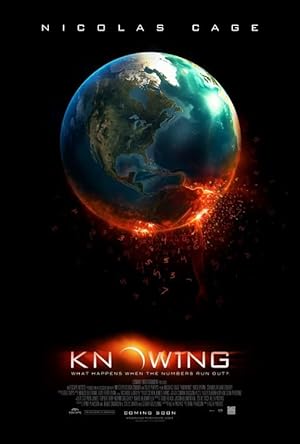
Knowing
In the fall of 1959, for a time capsule, students draw pictures of life as they imagine it will be in 50 years. Lucinda, an odd child who hears voices, swiftly writes a long string of numbers. In 2009, the capsule is opened; student Caleb Koestler gets Lucinda's "drawing" and his father John, an astrophysicist and grieving widower, takes a look. He discovers dates of disasters over the past 50 years with the number who died. Three dates remain, all coming soon. He investigates, learns of Lucinda, and looks for her family. He fears for his son, who's started to hear voices and who is visited by a silent stranger who shows him a vision of fire and destruction. What's going on?
Despite a mid-range budget of $50.0M, Knowing became a box office success, earning $155.4M worldwide—a 211% return.
1 win & 6 nominations


Plot Structure
Story beats plotted across runtime


Narrative Arc
Emotional journey through the story's key moments
Story Circle
Blueprint 15-beat structure
Arcplot Score Breakdown
Weighted: Precision (70%) + Arc (15%) + Theme (15%)
Knowing (2009) demonstrates carefully calibrated story structure, characteristic of Alex Proyas's storytelling approach. This structural analysis examines how the film's 15-point plot structure maps to proven narrative frameworks across 2 hours and 1 minutes. With an Arcplot score of 6.7, the film balances conventional beats with creative variation.
Characters
Cast & narrative archetypes

John Koestler
Caleb Koestler
Diana Wayland
Abby Wayland
Lucinda Embry
Main Cast & Characters
John Koestler
Played by Nicolas Cage
MIT astrophysics professor who discovers a pattern of disasters predicted in a 50-year-old time capsule document. Struggles with grief over his wife's death while racing to prevent catastrophic events.
Caleb Koestler
Played by Chandler Canterbury
John's young son who begins receiving mysterious visions and communication from otherworldly beings. Connected to the prophecy through the time capsule.
Diana Wayland
Played by Rose Byrne
Daughter of Lucinda, the girl who wrote the prophecy. Initially skeptical but joins John in trying to save their children from the predicted apocalypse.
Abby Wayland
Played by Lara Robinson
Diana's daughter who, like Caleb, is contacted by the mysterious beings. One of the chosen children connected to the prophecy.
Lucinda Embry
Played by Lara Robinson
The disturbed girl who wrote the prophetic number sequence in 1959. Haunted by visions of future disasters and the Whisper People.
Structural Analysis
The Status Quo at 1 minutes (1% through the runtime) establishes 1959: Young Lucinda at school, hearing voices, establishing the world of prophecy and children. John Koestler is introduced as an MIT professor and widowed father living a rational, ordered life with his son Caleb.. Of particular interest, this early placement immediately immerses viewers in the story world.
The inciting incident occurs at 15 minutes when Caleb opens the time capsule envelope and receives Lucinda's page of numbers instead of a drawing. The mysterious sheet covered in seemingly random digits disrupts their ordinary world.. At 12% through the film, this Disruption aligns precisely with traditional story structure. This beat shifts the emotional landscape, launching the protagonist into the central conflict.
The First Threshold at 31 minutes marks the transition into Act II, occurring at 25% of the runtime. This reveals the protagonist's commitment to John witnesses a plane crash exactly as predicted by the numbers, with the precise death toll. He actively chooses to pursue the mystery further, accepting that the predictions are real and he must act on them., moving from reaction to action.
At 61 minutes, the Midpoint arrives at 50% of the runtime—precisely centered, creating perfect narrative symmetry. Structural examination shows that this crucial beat John witnesses the subway disaster and saves some people, but cannot prevent the event itself. False victory (he saved a few) meets false defeat (he couldn't stop it). He realizes the predictions are unstoppable, and discovers the final date means global extinction., fundamentally raising what's at risk. The emotional intensity shifts, dividing the narrative into clear before-and-after phases.
The Collapse moment at 92 minutes (76% through) represents the emotional nadir. Here, Diana dies in a car crash trying to flee with the children, and John is forced to accept he cannot save everyone or prevent the inevitable. The death of hope that Earth can be saved, and the literal death of his ally., shows the protagonist at their lowest point. This beat's placement in the final quarter sets up the climactic reversal.
The Second Threshold at 97 minutes initiates the final act resolution at 80% of the runtime. John realizes the Strangers are saving the children to preserve humanity elsewhere. He chooses faith over control, accepting he must let Caleb go to save him. He synthesizes his love for his son with acceptance of a larger plan., demonstrating the transformation achieved throughout the journey.
Emotional Journey
Knowing's emotional architecture traces a deliberate progression across 15 carefully calibrated beats.
Narrative Framework
This structural analysis employs structural analysis methodology used to understand storytelling architecture. By mapping Knowing against these established plot points, we can identify how Alex Proyas utilizes or subverts traditional narrative conventions. The plot point approach reveals not only adherence to structural principles but also creative choices that distinguish Knowing within the mystery genre.
Alex Proyas's Structural Approach
Among the 5 Alex Proyas films analyzed on Arcplot, the average structural score is 7.0, reflecting strong command of classical structure. Knowing takes a more unconventional approach compared to the director's typical style. For comparative analysis, explore the complete Alex Proyas filmography.
Comparative Analysis
Additional mystery films include Lone Star, The Wicker Man and A Soldier's Story. For more Alex Proyas analyses, see I, Robot, The Crow and Gods of Egypt.
Plot Points by Act
Act I
SetupStatus Quo
1959: Young Lucinda at school, hearing voices, establishing the world of prophecy and children. John Koestler is introduced as an MIT professor and widowed father living a rational, ordered life with his son Caleb.
Theme
John's colleague asks whether events are random or predetermined. John states he believes everything is random chance, establishing the central thematic question of determinism versus randomness.
Worldbuilding
Establishment of John's life as an astrophysics professor, his relationship with grieving son Caleb, his deterministic worldview, and the background of his wife's death. The time capsule ceremony at Caleb's school is set up.
Disruption
Caleb opens the time capsule envelope and receives Lucinda's page of numbers instead of a drawing. The mysterious sheet covered in seemingly random digits disrupts their ordinary world.
Resistance
John discovers the numbers predict disasters with dates, death tolls, and coordinates. He debates whether to believe the pattern is real or coincidence, investigates past events, and resists the implication that future disasters are predetermined.
Act II
ConfrontationFirst Threshold
John witnesses a plane crash exactly as predicted by the numbers, with the precise death toll. He actively chooses to pursue the mystery further, accepting that the predictions are real and he must act on them.
Mirror World
John meets Diana and Abby, Lucinda's daughter and granddaughter. Diana represents faith and belief versus John's skepticism, creating the relational subplot that will teach John about faith, protection, and letting go.
Premise
John and Diana investigate the predictions together, racing to prevent disasters. The promise of the premise: can they stop catastrophes or save people if the future is predetermined? Investigation of Lucinda's history and the remaining predictions.
Midpoint
John witnesses the subway disaster and saves some people, but cannot prevent the event itself. False victory (he saved a few) meets false defeat (he couldn't stop it). He realizes the predictions are unstoppable, and discovers the final date means global extinction.
Opposition
The Strangers intensify their contact with Caleb and Abby. Diana resists the truth and tries to run. John's rational worldview crumbles as he realizes Earth faces a solar flare extinction event. Pressure mounts as the final date approaches and Diana refuses to accept the truth.
Collapse
Diana dies in a car crash trying to flee with the children, and John is forced to accept he cannot save everyone or prevent the inevitable. The death of hope that Earth can be saved, and the literal death of his ally.
Crisis
John grieves Diana's death and faces the impossible choice of letting Caleb go with the Strangers or keeping him to die on Earth. Dark night of wrestling with faith versus control, and acceptance versus despair.
Act III
ResolutionSecond Threshold
John realizes the Strangers are saving the children to preserve humanity elsewhere. He chooses faith over control, accepting he must let Caleb go to save him. He synthesizes his love for his son with acceptance of a larger plan.
Synthesis
John takes Caleb and Abby to the extraction point, says goodbye to his son, and reconciles with his father. The children are taken by the Strangers as the solar flare destroys Earth. John chooses to die with his family rather than alone.
Transformation
Caleb and Abby arrive at a new world, running toward a glowing tree in an Eden-like paradise. John, who believed in randomness, has sacrificed everything on faith that his son will survive. The closing image mirrors the opening but shows rebirth and transcendence.