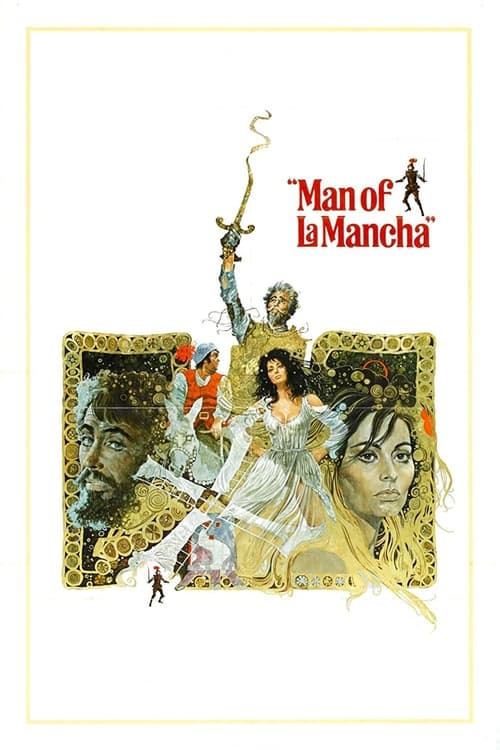
Man of La Mancha
In the 16th century, poet, playwright and part-time actor Miguel de Cervantes has been arrested, together with his manservant, by the Spanish Inquisition. They're accused of presenting an entertainment offensive to the Inquisition. Inside the huge dungeon into which they have been cast, the other inmates gang up on Cervantes and his manservant, staging a mock trial, with the intention of stealing or burning his possessions. Cervantes wishes to desperately save a manuscript he carries with him and stages, with costumes, makeup, and the participation of the other prisoners, an unusual defense—the story of Don Quixote.
The film underperformed commercially against its tight budget of $12.0M, earning $11.5M globally (-4% loss).
Nominated for 1 Oscar. 2 wins & 3 nominations


Plot Structure
Story beats plotted across runtime


Narrative Arc
Emotional journey through the story's key moments
Story Circle
Blueprint 15-beat structure
Arcplot Score Breakdown
Weighted: Precision (70%) + Arc (15%) + Theme (15%)
Man of La Mancha (1972) exemplifies meticulously timed dramatic framework, characteristic of Arthur Hiller's storytelling approach. This structural analysis examines how the film's 15-point plot structure maps to proven narrative frameworks across 2 hours and 12 minutes. With an Arcplot score of 6.5, the film balances conventional beats with creative variation.
Structural Analysis
The Status Quo at 2 minutes (1% through the runtime) establishes Cervantes and his servant are thrown into a dungeon cell in Seville by the Spanish Inquisition, clutching a manuscript. The prisoners immediately threaten to steal their possessions in a kangaroo court.. The analysis reveals that this early placement immediately immerses viewers in the story world.
The inciting incident occurs at 17 minutes when Cervantes fully commits to the charade, transforming into the character of Don Quixote. The play-within-a-prison begins as Alonso Quijana declares himself a knight-errant who will right all wrongs and fight for justice.. At 13% through the film, this Disruption is delayed, allowing extended setup of the story world. This beat shifts the emotional landscape, launching the protagonist into the central conflict.
The First Threshold at 33 minutes marks the transition into Act II, occurring at 25% of the runtime. This shows the protagonist's commitment to Don Quixote arrives at the inn (which he sees as a castle) and encounters Aldonza, the abused kitchen wench. He chooses to see her as the noble lady Dulcinea and commits fully to his impossible dream, kneeling before her despite her protests and the mockery of others., moving from reaction to action.
At 66 minutes, the Midpoint arrives at 50% of the runtime—precisely centered, creating perfect narrative symmetry. The analysis reveals that this crucial beat Don Quixote delivers "The Impossible Dream" - his statement of purpose and idealism. This false victory moment shows him at his most inspiring and convinced of his mission, but the stakes are about to raise as the real world begins to push back harder against his delusions., fundamentally raising what's at risk. The emotional intensity shifts, dividing the narrative into clear before-and-after phases.
The Collapse moment at 99 minutes (75% through) represents the emotional nadir. Here, The Knight of Mirrors defeats Don Quixote, forcing him to see himself as he truly is - a foolish old man. His dream dies as he is confronted with mirrors showing his deluded reality. He collapses, broken, and is carried away in a cage back to his home., illustrates the protagonist at their lowest point. This beat's placement in the final quarter sets up the climactic reversal.
The Second Threshold at 106 minutes initiates the final act resolution at 80% of the runtime. Aldonza arrives and insists she is Dulcinea - she has been transformed by Quixote's vision of her. Her testimony rekindles the old man's spirit. He recognizes her and in his final moments reclaims his identity as Don Quixote, validating that his impossible dream had real power., demonstrating the transformation achieved throughout the journey.
Emotional Journey
Man of La Mancha's emotional architecture traces a deliberate progression across 15 carefully calibrated beats.
Narrative Framework
This structural analysis employs systematic plot point analysis that identifies crucial turning points. By mapping Man of La Mancha against these established plot points, we can identify how Arthur Hiller utilizes or subverts traditional narrative conventions. The plot point approach reveals not only adherence to structural principles but also creative choices that distinguish Man of La Mancha within the adventure genre.
Arthur Hiller's Structural Approach
Among the 10 Arthur Hiller films analyzed on Arcplot, the average structural score is 7.2, reflecting strong command of classical structure. Man of La Mancha takes a more unconventional approach compared to the director's typical style. For comparative analysis, explore the complete Arthur Hiller filmography.
Comparative Analysis
Additional adventure films include The Black Stallion, The Bad Guys and Puss in Boots. For more Arthur Hiller analyses, see The Babe, Silver Streak and The In-Laws.
Plot Points by Act
Act I
SetupStatus Quo
Cervantes and his servant are thrown into a dungeon cell in Seville by the Spanish Inquisition, clutching a manuscript. The prisoners immediately threaten to steal their possessions in a kangaroo court.
Theme
The Duke (head prisoner) declares that Cervantes must defend his life and possessions in a trial. Cervantes proposes to defend himself "in the form of a charade" - suggesting that life itself is a form of performance and illusion, introducing the theme of idealism vs. reality.
Worldbuilding
The dungeon setting is established with its brutal hierarchy and desperate prisoners. Cervantes reveals he is accused of foreclosing on a monastery. The prisoners form a mock court, and Cervantes begins transforming them into characters for his play.
Disruption
Cervantes fully commits to the charade, transforming into the character of Don Quixote. The play-within-a-prison begins as Alonso Quijana declares himself a knight-errant who will right all wrongs and fight for justice.
Resistance
Don Quixote recruits the peasant Sancho Panza as his squire, promises him an island to govern, and sets forth on his quest. His niece and housekeeper try to dissuade him. The muleteers and barber mock his madness but cannot deter him.
Act II
ConfrontationFirst Threshold
Don Quixote arrives at the inn (which he sees as a castle) and encounters Aldonza, the abused kitchen wench. He chooses to see her as the noble lady Dulcinea and commits fully to his impossible dream, kneeling before her despite her protests and the mockery of others.
Mirror World
Don Quixote sings "Dulcinea" to Aldonza, projecting his vision of purity and nobility onto her. Aldonza is bewildered and angry, but also touched - she represents the thematic counterpoint, someone whose harsh reality directly opposes Quixote's idealistic vision.
Premise
The "fun and games" of Quixote's quest: he is dubbed a knight by the innkeeper, battles the windmills (thinking them giants), frees the prisoners, and continues to treat Aldonza as Dulcinea. His madness inspires and frustrates those around him in equal measure.
Midpoint
Don Quixote delivers "The Impossible Dream" - his statement of purpose and idealism. This false victory moment shows him at his most inspiring and convinced of his mission, but the stakes are about to raise as the real world begins to push back harder against his delusions.
Opposition
The Priest and Barber arrive with the plan to capture Quixote and return him home. Aldonza is brutally assaulted by the muleteers, shattering the illusion of nobility. The Knight of Mirrors is employed to defeat Quixote by forcing him to see his true reflection and confront reality.
Collapse
The Knight of Mirrors defeats Don Quixote, forcing him to see himself as he truly is - a foolish old man. His dream dies as he is confronted with mirrors showing his deluded reality. He collapses, broken, and is carried away in a cage back to his home.
Crisis
Alonso Quijana lies dying in his bed, his madness cured but his spirit crushed. He has returned to sanity but lost his purpose. The housekeeper and niece are relieved, but Sancho mourns the loss of Don Quixote. All seems lost and gray.
Act III
ResolutionSecond Threshold
Aldonza arrives and insists she is Dulcinea - she has been transformed by Quixote's vision of her. Her testimony rekindles the old man's spirit. He recognizes her and in his final moments reclaims his identity as Don Quixote, validating that his impossible dream had real power.
Synthesis
Don Quixote dies peacefully, his quest complete. The play-within-the-prison ends. Back in the dungeon, Cervantes has defended his manuscript and his idealism. The prisoners return his possessions, moved by the story. Cervantes is called before the Inquisition but walks forward with dignity.
Transformation
As Cervantes ascends the stairs to face the Inquisition, the prisoners softly sing "The Impossible Dream" in solidarity. The idealism has infected them. Where the film began with cynicism and brutality, it ends with hope and shared purpose - the dream lives on.