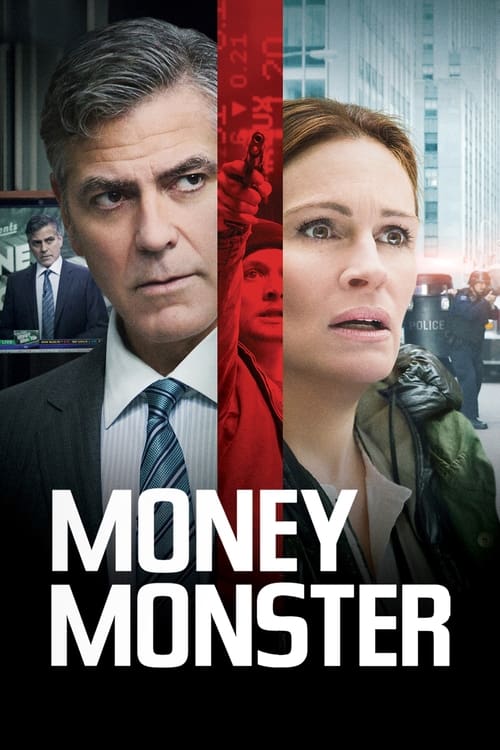
Money Monster
Financial TV host Lee Gates and his producer Patty are put in an extreme situation when an irate investor takes over their studio.
Despite a respectable budget of $27.0M, Money Monster became a solid performer, earning $93.3M worldwide—a 245% return.


Plot Structure
Story beats plotted across runtime


Narrative Arc
Emotional journey through the story's key moments
Story Circle
Blueprint 15-beat structure
Arcplot Score Breakdown
Weighted: Precision (70%) + Arc (15%) + Theme (15%)
Money Monster (2016) showcases deliberately positioned story structure, characteristic of Jodie Foster's storytelling approach. This structural analysis examines how the film's 15-point plot structure maps to proven narrative frameworks across 1 hour and 38 minutes. With an Arcplot score of 7.4, the film balances conventional beats with creative variation.
Characters
Cast & narrative archetypes

Lee Gates
Patty Fenn
Kyle Budwell
Walt Camby
Diane Lester
Captain Powell
Main Cast & Characters
Lee Gates
Played by George Clooney
A flamboyant TV financial guru whose show is hijacked during a live broadcast, forcing him to confront his role in audience losses.
Patty Fenn
Played by Julia Roberts
The show's veteran director who remains calm under pressure and works to save Lee's life while managing the crisis from the control room.
Kyle Budwell
Played by Jack O'Connell
A desperate investor who lost everything following Lee's stock advice, taking Lee hostage live on air to get answers.
Walt Camby
Played by Dominic West
The corrupt CEO of IBIS whose company's mysterious $800 million loss triggered the hostage crisis.
Diane Lester
Played by Caitriona Balfe
IBIS's Chief Communications Officer who attempts to control the narrative and protect the company during the unfolding scandal.
Captain Powell
Played by Giancarlo Esposito
The NYPD hostage negotiator who works to resolve the situation peacefully while law enforcement surrounds the building.
Structural Analysis
The Status Quo at 1 minutes (1% through the runtime) establishes Lee Gates performs his flashy opening number for "Money Monster," dancing and using props to make stock advice entertaining. His producer Patty Fenn directs from the control room, maintaining the show's spectacle while preparing to leave for a new job.. Of particular interest, this early placement immediately immerses viewers in the story world.
The inciting incident occurs at 11 minutes when Kyle Budwell storms onto the live set with a gun, taking Lee hostage and forcing him into an explosive vest. The ordinary broadcast becomes a hostage crisis on live television, transforming the show from entertainment into a life-or-death situation.. At 11% through the film, this Disruption aligns precisely with traditional story structure. This beat shifts the emotional landscape, launching the protagonist into the central conflict.
The First Threshold at 24 minutes marks the transition into Act II, occurring at 24% of the runtime. This shows the protagonist's commitment to Lee commits to helping Kyle find real answers about the IBIS crash instead of just stalling. He chooses to use his platform to investigate the truth rather than perform damage control, actively turning the hostage situation into genuine journalism., moving from reaction to action.
At 49 minutes, the Midpoint arrives at 50% of the runtime—precisely centered, creating perfect narrative symmetry. Structural examination shows that this crucial beat Diane Lester reveals that the "algorithm glitch" explanation is false and that Camby has been unreachable. This false defeat raises the stakes dramatically—the loss wasn't accidental but deliberate fraud, and the responsible party is hiding. The conspiracy is bigger than anyone thought., fundamentally raising what's at risk. The emotional intensity shifts, dividing the narrative into clear before-and-after phases.
The Collapse moment at 74 minutes (76% through) represents the emotional nadir. Here, Kyle's girlfriend appears on camera and publicly rejects him, saying he's an embarrassment and their relationship is over. This personal betrayal, broadcast to millions, crushes Kyle's last hope for human connection and nearly breaks his resolve to continue., reveals the protagonist at their lowest point. This beat's placement in the final quarter sets up the climactic reversal.
The Second Threshold at 78 minutes initiates the final act resolution at 80% of the runtime. The team locates Camby in Johannesburg. Lee and Kyle decide to take their broadcast into the streets to confront IBIS headquarters directly, bringing the truth to the public square. Lee synthesizes his media platform with Kyle's moral outrage to force accountability., demonstrating the transformation achieved throughout the journey.
Emotional Journey
Money Monster's emotional architecture traces a deliberate progression across 15 carefully calibrated beats.
Narrative Framework
This structural analysis employs structural analysis methodology used to understand storytelling architecture. By mapping Money Monster against these established plot points, we can identify how Jodie Foster utilizes or subverts traditional narrative conventions. The plot point approach reveals not only adherence to structural principles but also creative choices that distinguish Money Monster within the thriller genre.
Jodie Foster's Structural Approach
Among the 3 Jodie Foster films analyzed on Arcplot, the average structural score is 7.1, reflecting strong command of classical structure. Money Monster represents one of the director's most structurally precise works. For comparative analysis, explore the complete Jodie Foster filmography.
Comparative Analysis
Additional thriller films include The Warriors, Thunderball and Rustom. For more Jodie Foster analyses, see Little Man Tate, Home for the Holidays.
Plot Points by Act
Act I
SetupStatus Quo
Lee Gates performs his flashy opening number for "Money Monster," dancing and using props to make stock advice entertaining. His producer Patty Fenn directs from the control room, maintaining the show's spectacle while preparing to leave for a new job.
Theme
Patty tells Lee, "It's not a real investment show, it's a variety show." This establishes the film's central theme about the difference between financial entertainment and actual journalism, and the dangerous consequences when spectacle replaces substance.
Worldbuilding
The show broadcasts live as Lee discusses the IBIS stock crash. We meet the crew, learn about the $800 million loss blamed on a "computer glitch," and see Lee's superficial approach to finance. Patty manages chaos in the control room while planning her departure.
Disruption
Kyle Budwell storms onto the live set with a gun, taking Lee hostage and forcing him into an explosive vest. The ordinary broadcast becomes a hostage crisis on live television, transforming the show from entertainment into a life-or-death situation.
Resistance
Kyle demands answers about his lost $60,000 investment while police surround the building. Lee tries to talk his way out, offering money and apologies. Patty debates cutting the feed but decides to keep broadcasting. The crew debates how to handle the crisis while Kyle explains his desperate situation.
Act II
ConfrontationFirst Threshold
Lee commits to helping Kyle find real answers about the IBIS crash instead of just stalling. He chooses to use his platform to investigate the truth rather than perform damage control, actively turning the hostage situation into genuine journalism.
Mirror World
Lee begins to see Kyle not as a criminal but as a victim of the system Lee himself promotes. Their unlikely partnership forms as Lee recognizes his own complicity in misleading ordinary investors for entertainment value.
Premise
The investigation unfolds on live TV as the team tracks down IBIS executives. They discover CEO Walt Camby is unreachable. Communications Officer Diane Lester is brought on air. The premise delivers on its promise: a real financial investigation conducted under hostage conditions with millions watching.
Midpoint
Diane Lester reveals that the "algorithm glitch" explanation is false and that Camby has been unreachable. This false defeat raises the stakes dramatically—the loss wasn't accidental but deliberate fraud, and the responsible party is hiding. The conspiracy is bigger than anyone thought.
Opposition
Pressure intensifies as police prepare to storm the studio. The team uncovers evidence that Camby orchestrated the crash. Kyle becomes more unstable as time runs out. IBIS executives stonewall while Patty and her crew dig deeper, tracking Camby's location and financial movements.
Collapse
Kyle's girlfriend appears on camera and publicly rejects him, saying he's an embarrassment and their relationship is over. This personal betrayal, broadcast to millions, crushes Kyle's last hope for human connection and nearly breaks his resolve to continue.
Crisis
Kyle processes the public humiliation and considers giving up. Lee, now genuinely connected to Kyle, tries to restore his will to see this through. They face the dark realization that even exposing the truth may not bring justice or healing.
Act III
ResolutionSecond Threshold
The team locates Camby in Johannesburg. Lee and Kyle decide to take their broadcast into the streets to confront IBIS headquarters directly, bringing the truth to the public square. Lee synthesizes his media platform with Kyle's moral outrage to force accountability.
Synthesis
Lee and Kyle march to Federal Hall with the bomb vest, surrounded by crowds and cameras. They force a confession from Camby via satellite. The truth is exposed on live television to millions. Police snipers take position. Kyle achieves his goal of accountability but is killed by a sniper as the vest is removed.
Transformation
Lee holds the dying Kyle, devastated by the loss. The final image shows Lee transformed from an entertainer into someone who understands the real human cost of treating finance as a game. The truth was revealed, but justice came at the price of Kyle's life.