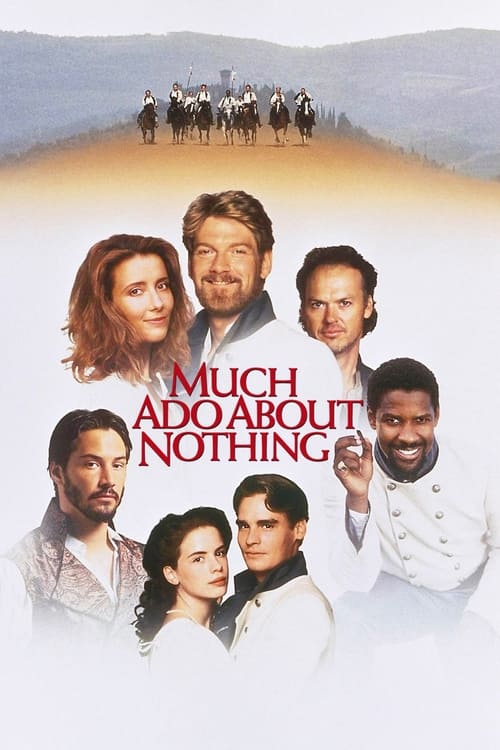
Much Ado About Nothing
In this Shakespearean farce, Hero and her groom-to-be, Claudio, team up with Claudio's commanding officer, Don Pedro, the week before their wedding to hatch a matchmaking scheme. Their targets are sharp-witted duo Benedick and Beatrice -- a tough task indeed, considering their corresponding distaste for love and each other. Meanwhile, meddling Don John plots to ruin the wedding.
Despite its modest budget of $11.0M, Much Ado About Nothing became a financial success, earning $22.6M worldwide—a 105% return.
Nominated for 1 BAFTA Award5 wins & 11 nominations


Plot Structure
Story beats plotted across runtime


Narrative Arc
Emotional journey through the story's key moments
Story Circle
Blueprint 15-beat structure
Arcplot Score Breakdown
Weighted: Precision (70%) + Arc (15%) + Theme (15%)
Much Ado About Nothing (1993) showcases precise story structure, characteristic of Kenneth Branagh's storytelling approach. This structural analysis examines how the film's 15-point plot structure maps to proven narrative frameworks across 1 hour and 51 minutes. With an Arcplot score of 7.7, the film showcases strong structural fundamentals.
Characters
Cast & narrative archetypes

Benedick
Beatrice
Claudio
Hero
Don Pedro
Don John
Leonato
Dogberry
Main Cast & Characters
Benedick
Played by Kenneth Branagh
A witty bachelor soldier who engages in verbal sparring with Beatrice and claims he will never marry.
Beatrice
Played by Emma Thompson
A sharp-tongued, independent woman who matches Benedick's wit and scorns marriage until tricked into love.
Claudio
Played by Robert Sean Leonard
A young soldier who falls quickly in love with Hero but is easily manipulated by Don John's deception.
Hero
Played by Kate Beckinsale
Leonato's gentle and virtuous daughter who becomes the victim of a cruel slander orchestrated by Don John.
Don Pedro
Played by Denzel Washington
The Prince of Aragon, a noble leader who orchestrates the romance between Benedick and Beatrice.
Don John
Played by Keanu Reeves
The illegitimate brother of Don Pedro, a bitter villain who plots to destroy Claudio and Hero's wedding.
Leonato
Played by Richard Briers
The governor of Messina and father of Hero, a welcoming host who suffers deeply from his daughter's shaming.
Dogberry
Played by Michael Keaton
A bumbling constable who comically mangles language but ultimately uncovers Don John's villainy.
Structural Analysis
The Status Quo at 1 minutes (1% through the runtime) establishes The household of Leonato in Messina prepares joyfully for the arrival of Don Pedro and his soldiers, establishing a world of leisure, wit, and romantic possibility. Beatrice and Benedick's antagonistic relationship is immediately evident.. Significantly, this early placement immediately immerses viewers in the story world.
The inciting incident occurs at 13 minutes when Don Pedro proposes to woo Hero on Claudio's behalf at the masked ball, setting the romantic plot in motion. This external catalyst transforms the social gathering into a arena for courtship and deception.. At 12% through the film, this Disruption aligns precisely with traditional story structure. This beat shifts the emotional landscape, launching the protagonist into the central conflict.
The First Threshold at 28 minutes marks the transition into Act II, occurring at 25% of the runtime. This demonstrates the protagonist's commitment to Don Pedro, Leonato, and Claudio stage their first conversation for Benedick to overhear, making him believe Beatrice is desperately in love with him. Benedick chooses to believe it and opens himself to love, abandoning his bachelor philosophy., moving from reaction to action.
At 55 minutes, the Midpoint arrives at 50% of the runtime—precisely centered, creating perfect narrative symmetry. Significantly, this crucial beat Don John executes his plot, convincing Don Pedro and Claudio that Hero is unfaithful by staging a false scene at her window with Borachio and Margaret. This false defeat transforms the comedy into potential tragedy and raises the stakes enormously., fundamentally raising what's at risk. The emotional intensity shifts, dividing the narrative into clear before-and-after phases.
The Collapse moment at 83 minutes (75% through) represents the emotional nadir. Here, Benedick challenges Claudio to a duel, fracturing the brotherhood of soldiers and putting friendship, honor, and love in direct conflict. The "merry war" has become actual violence, and Hero's reputation (a metaphorical death) seems irreparably destroyed., reveals the protagonist at their lowest point. This beat's placement in the final quarter sets up the climactic reversal.
The Second Threshold at 88 minutes initiates the final act resolution at 79% of the runtime. Borachio is captured by the Watch and confesses the entire plot, revealing Hero's innocence. This new information provides the synthesis needed: the truth emerges through the bumbling but sincere efforts of Dogberry and the watchmen, vindicating Hero., demonstrating the transformation achieved throughout the journey.
Emotional Journey
Much Ado About Nothing's emotional architecture traces a deliberate progression across 15 carefully calibrated beats.
Narrative Framework
This structural analysis employs proven narrative structure principles that track dramatic progression. By mapping Much Ado About Nothing against these established plot points, we can identify how Kenneth Branagh utilizes or subverts traditional narrative conventions. The plot point approach reveals not only adherence to structural principles but also creative choices that distinguish Much Ado About Nothing within the drama genre.
Kenneth Branagh's Structural Approach
Among the 11 Kenneth Branagh films analyzed on Arcplot, the average structural score is 7.0, reflecting strong command of classical structure. Much Ado About Nothing represents one of the director's most structurally precise works. For comparative analysis, explore the complete Kenneth Branagh filmography.
Comparative Analysis
Additional drama films include After Thomas, South Pacific and Dirty Dancing: Havana Nights. For more Kenneth Branagh analyses, see Mary Shelley's Frankenstein, Thor and Henry V.
Plot Points by Act
Act I
SetupStatus Quo
The household of Leonato in Messina prepares joyfully for the arrival of Don Pedro and his soldiers, establishing a world of leisure, wit, and romantic possibility. Beatrice and Benedick's antagonistic relationship is immediately evident.
Theme
Leonato remarks on the "merry war" between Beatrice and Benedick, establishing the theme: love requires letting down defensive walls and risking vulnerability, even when pride tells us to do otherwise.
Worldbuilding
Introduction of the dual courtships: Claudio's immediate love for Hero and the sparring between Beatrice and Benedick. Don John is established as the malcontent. The world of Messina is one of abundance, music, and sophisticated wordplay.
Disruption
Don Pedro proposes to woo Hero on Claudio's behalf at the masked ball, setting the romantic plot in motion. This external catalyst transforms the social gathering into a arena for courtship and deception.
Resistance
The masked ball occurs with multiple deceptions. Don John attempts to sabotage Claudio's courtship but fails. Claudio and Hero are betrothed. Don Pedro and the others devise the "gulling" plots to trick Beatrice and Benedick into falling in love.
Act II
ConfrontationFirst Threshold
Don Pedro, Leonato, and Claudio stage their first conversation for Benedick to overhear, making him believe Beatrice is desperately in love with him. Benedick chooses to believe it and opens himself to love, abandoning his bachelor philosophy.
Mirror World
Hero and Ursula perform the same trick on Beatrice, who overhears that Benedick loves her. This parallel subplot mirrors and illuminates the main theme: pride is the enemy of love, and sometimes we need others' help to see the truth.
Premise
The "fun and games" of watching Beatrice and Benedick awkwardly navigate their newfound feelings while maintaining their witty facades. Preparations continue for Claudio and Hero's wedding. The promise of romantic comedy is fulfilled with humor and tenderness.
Midpoint
Don John executes his plot, convincing Don Pedro and Claudio that Hero is unfaithful by staging a false scene at her window with Borachio and Margaret. This false defeat transforms the comedy into potential tragedy and raises the stakes enormously.
Opposition
The wedding day arrives. Claudio publicly shames and rejects Hero at the altar. Hero collapses. The Friar proposes the plan to fake Hero's death. Beatrice and Benedick confess their love, but Beatrice demands Benedick kill Claudio, testing their new bond against old loyalty.
Collapse
Benedick challenges Claudio to a duel, fracturing the brotherhood of soldiers and putting friendship, honor, and love in direct conflict. The "merry war" has become actual violence, and Hero's reputation (a metaphorical death) seems irreparably destroyed.
Crisis
The dark night as characters grapple with grief, anger, and confusion. Leonato mourns his daughter's ruined honor. Claudio and Don Pedro face Leonato's wrath. The community is fractured, and it seems impossible that joy can be restored.
Act III
ResolutionSecond Threshold
Borachio is captured by the Watch and confesses the entire plot, revealing Hero's innocence. This new information provides the synthesis needed: the truth emerges through the bumbling but sincere efforts of Dogberry and the watchmen, vindicating Hero.
Synthesis
Claudio performs penance at Hero's "tomb." Leonato makes Claudio agree to marry his "niece" (actually Hero disguised). The wedding proceeds with reveals: Hero lives, Beatrice and Benedick acknowledge their love through discovered sonnets, and Don John is captured.
Transformation
Benedick kisses Beatrice and calls for dancing, having transformed from cynical bachelor to married man. The image of communal celebration mirrors the opening but now includes the formerly defensive lovers, fully integrated into the social fabric through vulnerability and love.