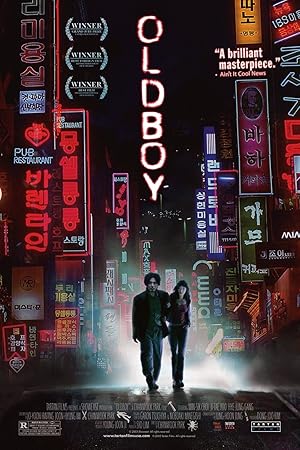
Oldboy
Abducted on a rainy night in 1988, the obnoxious drunk, Oh Dae-Su, much to his surprise, wakes up locked in a windowless and dilapidated hotel room, for an unknown reason. There, his invisible and pitiless captors will feed him, clothe him, and sedate him to avert a desperate suicide--and as his only companion and a window to the world is the TV in his stark cell--the only thing that helps Oh Dae-Su keep going is his daily journal. Then, unexpectedly, after fifteen long years in captivity, the perplexed prisoner is deliberately released, encouraged to track down his tormentor to finally get his retribution. However, who would hate Oh Dae-Su so much he would deny him of a quick and clean death?
Despite its tight budget of $3.0M, Oldboy became a commercial success, earning $17.5M worldwide—a 483% return. The film's bold vision engaged audiences, proving that strong storytelling can transcend budget limitations.
44 wins & 28 nominations


Plot Structure
Story beats plotted across runtime


Narrative Arc
Emotional journey through the story's key moments
Story Circle
Blueprint 15-beat structure
Arcplot Score Breakdown
Weighted: Precision (70%) + Arc (15%) + Theme (15%)
Oldboy (2003) showcases strategically placed dramatic framework, characteristic of Park Chan-wook's storytelling approach. This structural analysis examines how the film's 15-point plot structure maps to proven narrative frameworks across 2 hours. With an Arcplot score of 7.5, the film showcases strong structural fundamentals.
Structural Analysis
The Status Quo at 1 minutes (1% through the runtime) establishes Oh Dae-su is a drunk, irresponsible husband and father being held at a police station on his daughter's birthday, representing his ordinary world of selfishness and disconnection from family.. Of particular interest, this early placement immediately immerses viewers in the story world.
The inciting incident occurs at 13 minutes when Dae-su is suddenly imprisoned in a sealed private cell with no explanation, learning through television that his wife has been murdered and he's the prime suspect - his old life is destroyed.. At 11% through the film, this Disruption aligns precisely with traditional story structure. This beat shifts the emotional landscape, launching the protagonist into the central conflict.
The First Threshold at 27 minutes marks the transition into Act II, occurring at 23% of the runtime. This indicates the protagonist's commitment to Dae-su is suddenly released and placed on a rooftop with money and a cell phone, choosing to pursue answers and revenge rather than return to normal life., moving from reaction to action.
At 54 minutes, the Midpoint arrives at 45% of the runtime—arriving early, accelerating into Act IIb complications. Of particular interest, this crucial beat Dae-su meets his captor Lee Woo-jin face-to-face for the first time, who reveals this is all a game and Dae-su has only five days to discover why he was imprisoned or Mi-do will die., fundamentally raising what's at risk. The emotional intensity shifts, dividing the narrative into clear before-and-after phases.
The Collapse moment at 81 minutes (68% through) represents the emotional nadir. Here, Woo-jin reveals the horrifying truth: Mi-do is Dae-su's daughter, and Woo-jin orchestrated their incestuous relationship as revenge for Dae-su spreading rumors that led to his sister's suicide., shows the protagonist at their lowest point. This beat's placement in the final quarter sets up the climactic reversal.
The Second Threshold at 86 minutes initiates the final act resolution at 72% of the runtime. Woo-jin reveals he will keep the secret and commits suicide, having achieved his revenge, while Dae-su must now live with the unbearable knowledge alone., demonstrating the transformation achieved throughout the journey.
Emotional Journey
Oldboy's emotional architecture traces a deliberate progression across 15 carefully calibrated beats.
Narrative Framework
This structural analysis employs systematic plot point analysis that identifies crucial turning points. By mapping Oldboy against these established plot points, we can identify how Park Chan-wook utilizes or subverts traditional narrative conventions. The plot point approach reveals not only adherence to structural principles but also creative choices that distinguish Oldboy within the action genre.
Park Chan-wook's Structural Approach
Among the 5 Park Chan-wook films analyzed on Arcplot, the average structural score is 6.9, demonstrating varied approaches to story architecture. Oldboy represents one of the director's most structurally precise works. For comparative analysis, explore the complete Park Chan-wook filmography.
Comparative Analysis
Additional action films include The Bad Guys, Puss in Boots and Venom: The Last Dance. For more Park Chan-wook analyses, see Decision to Leave, The Handmaiden and Stoker.
Plot Points by Act
Act I
SetupStatus Quo
Oh Dae-su is a drunk, irresponsible husband and father being held at a police station on his daughter's birthday, representing his ordinary world of selfishness and disconnection from family.
Theme
The detective says "Laugh and the world laughs with you, weep and you weep alone" - establishing the theme of isolation, revenge, and the consequences of past actions.
Worldbuilding
Establishing Dae-su's ordinary life, his release from the police station, and his mysterious abduction into a private prison where he will spend 15 years without explanation.
Disruption
Dae-su is suddenly imprisoned in a sealed private cell with no explanation, learning through television that his wife has been murdered and he's the prime suspect - his old life is destroyed.
Resistance
Dae-su survives 15 years of imprisonment through television, writing journals, training his body, and preparing for revenge against his unknown captor.
Act II
ConfrontationFirst Threshold
Dae-su is suddenly released and placed on a rooftop with money and a cell phone, choosing to pursue answers and revenge rather than return to normal life.
Mirror World
Dae-su meets Mi-do, a young sushi chef who becomes his love interest and emotional anchor, representing the possibility of connection and humanity amid his quest for vengeance.
Premise
Dae-su investigates his imprisonment, fights his way through enemies in the famous hallway sequence, searches for clues about his captor's identity, and grows closer to Mi-do.
Midpoint
Dae-su meets his captor Lee Woo-jin face-to-face for the first time, who reveals this is all a game and Dae-su has only five days to discover why he was imprisoned or Mi-do will die.
Opposition
Dae-su desperately investigates his high school past, uncovers connections to Woo-jin's sister's suicide, falls deeper in love with Mi-do, and becomes trapped in Woo-jin's psychological manipulation.
Collapse
Woo-jin reveals the horrifying truth: Mi-do is Dae-su's daughter, and Woo-jin orchestrated their incestuous relationship as revenge for Dae-su spreading rumors that led to his sister's suicide.
Crisis
Dae-su experiences total psychological collapse, cutting out his own tongue in a gesture of silencing himself, begging Woo-jin not to reveal the truth to Mi-do.
Act III
ResolutionSecond Threshold
Woo-jin reveals he will keep the secret and commits suicide, having achieved his revenge, while Dae-su must now live with the unbearable knowledge alone.
Synthesis
Dae-su seeks hypnosis to erase his memory of the truth, attempting to split his identity so he can continue loving Mi-do without the burden of knowledge.
Transformation
Dae-su embraces Mi-do in the snow, his face showing ambiguous expressions suggesting uncertainty about whether he truly forgot or chooses to live with the lie - transformed from ignorant to knowing, innocent to guilty.