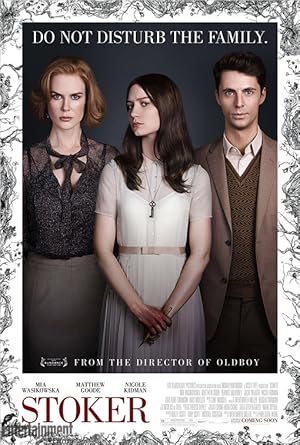
Stoker
India Stoker (Mia Wasikowska) was not prepared to lose her father and best friend Richard (Dermot Mulroney) in a tragic auto accident. The solitude of her woodsy family estate, the peace of her tranquil town, and the unspoken somberness of her home life are suddenly upended by not only this mysterious accident, but by the sudden arrival of her Uncle Charlie (Matthew Goode), who she never knew existed. When Charlie moves in with her and her emotionally unstable mother Evie (Nicole Kidman), India thinks the void left by her father's death is finally being filled by his closest bloodline. Soon after his arrival, India comes to suspect that this mysterious, charming man has ulterior motives. Yet instead of feeling outrage or horror, this friendless young woman becomes increasingly infatuated with him.
Working with a tight budget of $12.0M, the film achieved a modest success with $12.1M in global revenue (+1% profit margin).
7 wins & 42 nominations


Plot Structure
Story beats plotted across runtime


Narrative Arc
Emotional journey through the story's key moments
Story Circle
Blueprint 15-beat structure
Arcplot Score Breakdown
Weighted: Precision (70%) + Arc (15%) + Theme (15%)
Stoker (2013) exhibits deliberately positioned narrative design, characteristic of Park Chan-wook's storytelling approach. This structural analysis examines how the film's 15-point plot structure maps to proven narrative frameworks across 1 hour and 39 minutes. With an Arcplot score of 7.3, the film balances conventional beats with creative variation.
Characters
Cast & narrative archetypes

India Stoker
Charlie Stoker
Evelyn Stoker
Richard Stoker
Main Cast & Characters
India Stoker
Played by Mia Wasikowska
A peculiar, isolated 18-year-old girl who discovers her true nature after her father's death and her uncle's arrival.
Charlie Stoker
Played by Matthew Goode
India's mysterious uncle who appears after her father's death, charming and dangerous with dark secrets.
Evelyn Stoker
Played by Nicole Kidman
India's emotionally distant, unstable mother who becomes infatuated with Charlie after her husband's death.
Richard Stoker
Played by Dermot Mulroney
India's deceased father who protected her from Charlie and understood her unusual nature.
Structural Analysis
The Status Quo at 1 minutes (1% through the runtime) establishes India Stoker, isolated and peculiar, narrates about her heightened senses on her 18th birthday, establishing her as withdrawn, watchful, and fundamentally different from others. She sits alone in her distinctive saddle shoes, observing rather than participating.. Structural examination shows that this early placement immediately immerses viewers in the story world.
The inciting incident occurs at 11 minutes when Uncle Charlie appears at the funeral—a man India never knew existed. Charming and mysterious, he insinuates himself into the household immediately, announcing he'll be staying with them. His presence is unsettling, and India's mother is strangely receptive to him.. At 11% through the film, this Disruption aligns precisely with traditional story structure. This beat shifts the emotional landscape, launching the protagonist into the central conflict.
The First Threshold at 25 minutes marks the transition into Act II, occurring at 25% of the runtime. This demonstrates the protagonist's commitment to India finds evidence that Charlie may have killed Mrs. McGarrick and possibly her father. Rather than flee or report him, she becomes intrigued. When a classmate attempts to assault her in the woods, Charlie appears and together they witness something dark—India crosses from innocent observer to complicit participant., moving from reaction to action.
At 50 minutes, the Midpoint arrives at 50% of the runtime—precisely centered, creating perfect narrative symmetry. Significantly, this crucial beat India commits her first murder. When her predatory classmate Whip attacks her in the woods, India kills him herself with Charlie's guidance. This is a false victory—she experiences ecstatic liberation but has crossed an irreversible moral threshold. Charlie and India bury the body together, cementing their bond., fundamentally raising what's at risk. The emotional intensity shifts, dividing the narrative into clear before-and-after phases.
The Collapse moment at 74 minutes (75% through) represents the emotional nadir. Here, Charlie murders Aunt Gwendolyn in front of India in the freezer, then frames it as an invitation for India to fully join him. This is India's "whiff of death"—the death of any possibility of returning to innocence. She must now choose whether to become Charlie's partner in murder or destroy him., reveals the protagonist at their lowest point. This beat's placement in the final quarter sets up the climactic reversal.
The Second Threshold at 79 minutes initiates the final act resolution at 80% of the runtime. India achieves synthesis: she accepts her violent nature but rejects Charlie's control. She realizes her father wasn't suppressing her darkness but teaching her to channel it through hunting. She won't be Charlie's apprentice—she'll be her own monster. She prepares to act on her own terms., demonstrating the transformation achieved throughout the journey.
Emotional Journey
Stoker's emotional architecture traces a deliberate progression across 15 carefully calibrated beats.
Narrative Framework
This structural analysis employs systematic plot point analysis that identifies crucial turning points. By mapping Stoker against these established plot points, we can identify how Park Chan-wook utilizes or subverts traditional narrative conventions. The plot point approach reveals not only adherence to structural principles but also creative choices that distinguish Stoker within the drama genre.
Park Chan-wook's Structural Approach
Among the 5 Park Chan-wook films analyzed on Arcplot, the average structural score is 6.9, demonstrating varied approaches to story architecture. Stoker represents one of the director's most structurally precise works. For comparative analysis, explore the complete Park Chan-wook filmography.
Comparative Analysis
Additional drama films include After Thomas, South Pacific and Dirty Dancing: Havana Nights. For more Park Chan-wook analyses, see Oldboy, Decision to Leave and The Handmaiden.
Plot Points by Act
Act I
SetupStatus Quo
India Stoker, isolated and peculiar, narrates about her heightened senses on her 18th birthday, establishing her as withdrawn, watchful, and fundamentally different from others. She sits alone in her distinctive saddle shoes, observing rather than participating.
Theme
At the funeral, Mrs. McGarrick warns Evelyn about Charlie: "Just as a flower does not choose its color, we are not responsible for what we have come to be. Only once you realize this do you become free." This speaks to the film's core question about inherited darkness and choice.
Worldbuilding
India's father Richard has died in a car accident on her 18th birthday. We learn of her strange upbringing, her hunting trips with her father, the annual saddle shoes he gave her, and her distant relationship with her theatrical mother Evelyn. The gothic family estate and India's peculiar sensory sensitivity are established.
Disruption
Uncle Charlie appears at the funeral—a man India never knew existed. Charming and mysterious, he insinuates himself into the household immediately, announcing he'll be staying with them. His presence is unsettling, and India's mother is strangely receptive to him.
Resistance
India resists Charlie's presence while her mother welcomes it. Strange events occur: the housekeeper Mrs. McGarrick disappears, India discovers hidden letters from Charlie written to her throughout her life (all intercepted), and she becomes increasingly suspicious. Charlie seems to be testing India, watching her carefully.
Act II
ConfrontationFirst Threshold
India finds evidence that Charlie may have killed Mrs. McGarrick and possibly her father. Rather than flee or report him, she becomes intrigued. When a classmate attempts to assault her in the woods, Charlie appears and together they witness something dark—India crosses from innocent observer to complicit participant.
Mirror World
Charlie becomes India's dark mirror and teacher, showing her that she shares his violent nature. He doesn't seduce her romantically but rather philosophically, offering her the truth about herself that her father tried to suppress through hunting rituals. Their relationship carries the film's thematic weight about nature versus nurture.
Premise
The "promise of the premise"—the gothic psychosexual dance between India and Charlie. She investigates her family's dark history, discovers Charlie killed his own brother (her father) and likely his parents, and realizes her father had been protecting her from Charlie. Yet she's drawn to Charlie's acceptance of their shared violent nature.
Midpoint
India commits her first murder. When her predatory classmate Whip attacks her in the woods, India kills him herself with Charlie's guidance. This is a false victory—she experiences ecstatic liberation but has crossed an irreversible moral threshold. Charlie and India bury the body together, cementing their bond.
Opposition
India spirals deeper into darkness, reliving the murder with pleasure. Her mother Evelyn, jealous of India and Charlie's connection and increasingly unstable, attempts to seduce Charlie. Aunt Gwendolyn arrives warning about Charlie's past institutionalization and the suspicious deaths around him. The family dysfunction intensifies as all secrets begin surfacing.
Collapse
Charlie murders Aunt Gwendolyn in front of India in the freezer, then frames it as an invitation for India to fully join him. This is India's "whiff of death"—the death of any possibility of returning to innocence. She must now choose whether to become Charlie's partner in murder or destroy him.
Crisis
India retreats into herself, processing what she's become. She reviews memories of her father, understanding now that he killed Charlie's brother (his twin) to protect her from this very fate. The question crystallizes: Will she become Charlie, or will she forge her own dark path?
Act III
ResolutionSecond Threshold
India achieves synthesis: she accepts her violent nature but rejects Charlie's control. She realizes her father wasn't suppressing her darkness but teaching her to channel it through hunting. She won't be Charlie's apprentice—she'll be her own monster. She prepares to act on her own terms.
Synthesis
India executes her plan. She allows Charlie to believe she'll join him, then kills him with a hunting rifle during an attempted sexual encounter—rejecting both him and her mother. She shoots her mother Evelyn non-fatally, framing the scene to suggest mutual destruction between Charlie and Evelyn. She walks away, transformed and free.
Transformation
India drives away in Charlie's car wearing her saddle shoes, picking up a hitchhiker. The film's opening narration reveals itself as her future self reflecting on this birthday. The final image mirrors the opening but shows her transformation: no longer passive observer but active predator, having fully embraced her dark inheritance on her own terms.