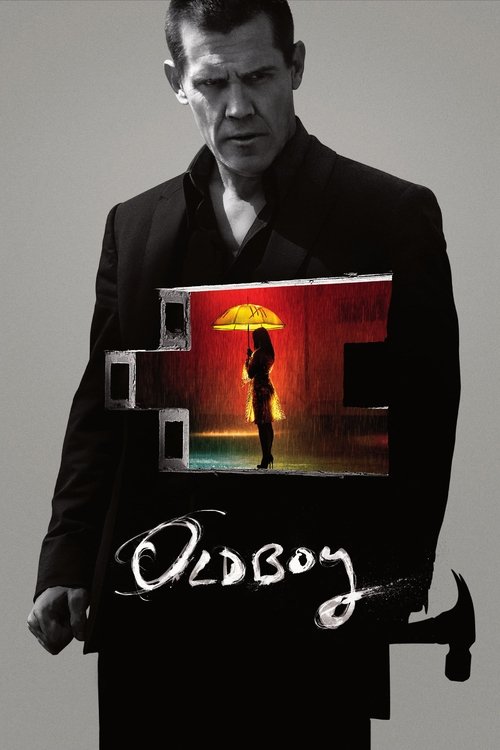
Oldboy
A man has only three and a half days and limited resources to discover why he was imprisoned in a nondescript room for 20 years without any explanation.
The film commercial failure against its respectable budget of $30.0M, earning $5.2M globally (-83% loss). While initial box office returns were modest, the film has gained appreciation for its bold vision within the drama genre.


Plot Structure
Story beats plotted across runtime


Narrative Arc
Emotional journey through the story's key moments
Story Circle
Blueprint 15-beat structure
Arcplot Score Breakdown
Weighted: Precision (70%) + Arc (15%) + Theme (15%)
Oldboy (2013) exemplifies precise story structure, characteristic of Spike Lee's storytelling approach. This structural analysis examines how the film's 15-point plot structure maps to proven narrative frameworks across 1 hour and 44 minutes. With an Arcplot score of 6.9, the film balances conventional beats with creative variation.
Characters
Cast & narrative archetypes

Joe Doucett
Marie Sebastian
Adrian Pryce
Chaney
Chucky
Mia Doucett
Main Cast & Characters
Joe Doucett
Played by Josh Brolin
An advertising executive who is inexplicably imprisoned for 20 years, then released and driven by obsession to discover why he was held captive and who is responsible.
Marie Sebastian
Played by Elizabeth Olsen
A young social worker who becomes romantically involved with Joe while helping him uncover the truth about his imprisonment.
Adrian Pryce
Played by Sharlto Copley
A wealthy and enigmatic man with a dark secret from the past who orchestrated Joe's imprisonment as part of an elaborate revenge scheme.
Chaney
Played by Samuel L. Jackson
The mysterious and silent bodyguard who works for Adrian and serves as his primary enforcer.
Chucky
Played by Michael Imperioli
Joe's old friend who helps him navigate the outside world after his release and assists in his quest for answers.
Mia Doucett
Played by Elvy Yost
Joe's estranged daughter who was only three years old when he disappeared, now grown up and unaware of her father's fate.
Structural Analysis
The Status Quo at 1 minutes (1% through the runtime) establishes Joe Doucett is a drunken, failed advertising executive who abandons his young daughter's birthday to chase a business deal, showing his broken, selfish life.. Of particular interest, this early placement immediately immerses viewers in the story world.
The inciting incident occurs at 12 minutes when Joe is kidnapped off the street by unknown assailants and wakes up imprisoned in a sealed hotel room with no explanation.. At 12% through the film, this Disruption aligns precisely with traditional story structure. This beat shifts the emotional landscape, launching the protagonist into the central conflict.
The First Threshold at 25 minutes marks the transition into Act II, occurring at 24% of the runtime. This demonstrates the protagonist's commitment to After 20 years, Joe is suddenly and mysteriously released, choosing to pursue answers and vengeance rather than simply returning to normal life., moving from reaction to action.
At 52 minutes, the Midpoint arrives at 50% of the runtime—precisely centered, creating perfect narrative symmetry. The analysis reveals that this crucial beat Joe discovers the identity of his captor, Adrian Pryce, and believes he's gaining the upper hand in his quest for revenge, not realizing he's playing into a deeper trap., fundamentally raising what's at risk. The emotional intensity shifts, dividing the narrative into clear before-and-after phases.
The Collapse moment at 78 minutes (75% through) represents the emotional nadir. Here, Adrian reveals the full scope of his revenge: Joe has unknowingly committed incest with his own daughter, and Adrian shows him proof, destroying Joe's psyche completely., reveals the protagonist at their lowest point. This beat's placement in the final quarter sets up the climactic reversal.
The Second Threshold at 84 minutes initiates the final act resolution at 81% of the runtime. Joe begs Adrian to erase Marie's memories and his own, offering complete submission and cutting out his own tongue to prove he'll keep the secret, choosing sacrifice over vengeance., demonstrating the transformation achieved throughout the journey.
Emotional Journey
Oldboy's emotional architecture traces a deliberate progression across 15 carefully calibrated beats.
Narrative Framework
This structural analysis employs systematic plot point analysis that identifies crucial turning points. By mapping Oldboy against these established plot points, we can identify how Spike Lee utilizes or subverts traditional narrative conventions. The plot point approach reveals not only adherence to structural principles but also creative choices that distinguish Oldboy within the drama genre.
Spike Lee's Structural Approach
Among the 13 Spike Lee films analyzed on Arcplot, the average structural score is 7.0, demonstrating varied approaches to story architecture. Oldboy takes a more unconventional approach compared to the director's typical style. For comparative analysis, explore the complete Spike Lee filmography.
Comparative Analysis
Additional drama films include After Thomas, South Pacific and Dirty Dancing: Havana Nights. For more Spike Lee analyses, see Summer of Sam, Inside Man and Clockers.
Plot Points by Act
Act I
SetupStatus Quo
Joe Doucett is a drunken, failed advertising executive who abandons his young daughter's birthday to chase a business deal, showing his broken, selfish life.
Theme
A stranger mentions "monsters are created, not born," foreshadowing the central question of whether Joe's sins created his own tormentor.
Worldbuilding
Establishing Joe's life as a self-destructive alcoholic, his failed marriage, neglected daughter, and desperate career situation, showing a man at rock bottom.
Disruption
Joe is kidnapped off the street by unknown assailants and wakes up imprisoned in a sealed hotel room with no explanation.
Resistance
Joe attempts to understand his captivity, watches TV learning he's been framed for his ex-wife's murder, and begins years of imprisonment training himself physically and mentally for revenge.
Act II
ConfrontationFirst Threshold
After 20 years, Joe is suddenly and mysteriously released, choosing to pursue answers and vengeance rather than simply returning to normal life.
Mirror World
Joe meets Marie, a young nurse who helps him, beginning a relationship that will become central to the film's thematic and emotional core.
Premise
Joe investigates his captivity with Marie's help, following clues about the Chinese restaurant, tracking down leads, and slowly piecing together a revenge plan while growing closer to Marie.
Midpoint
Joe discovers the identity of his captor, Adrian Pryce, and believes he's gaining the upper hand in his quest for revenge, not realizing he's playing into a deeper trap.
Opposition
Adrian tightens his psychological game, Joe realizes Marie is actually his grown daughter, and the horrifying truth of Adrian's elaborate revenge for Joe's past cruelty emerges.
Collapse
Adrian reveals the full scope of his revenge: Joe has unknowingly committed incest with his own daughter, and Adrian shows him proof, destroying Joe's psyche completely.
Crisis
Joe breaks down in complete despair, realizing the magnitude of what has been done to him and what he's done, facing the unbearable weight of Adrian's perfect revenge.
Act III
ResolutionSecond Threshold
Joe begs Adrian to erase Marie's memories and his own, offering complete submission and cutting out his own tongue to prove he'll keep the secret, choosing sacrifice over vengeance.
Synthesis
Adrian completes his revenge by committing suicide, Joe undergoes hypnotherapy to forget the truth, and attempts to build a new life with Marie in ignorance of their true relationship.
Transformation
Joe embraces Marie, but his expression reveals the hypnosis may not have worked—he may still know the truth, trapped in a hell of his own making, the monster he created.