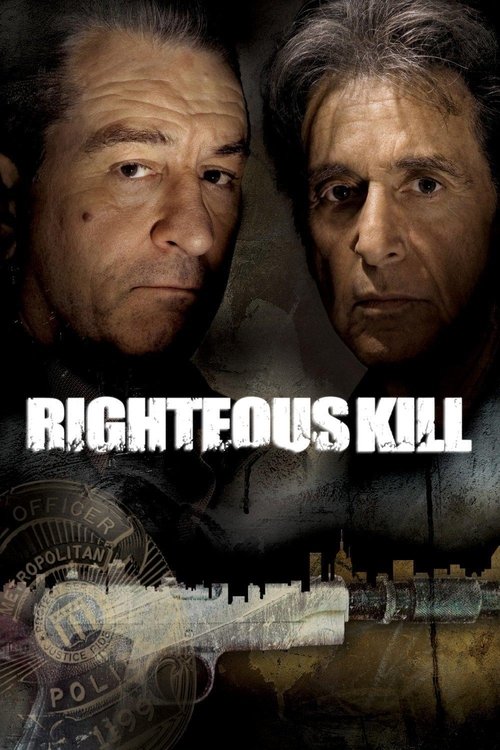
Righteous Kill
Two veteran New York City detectives work to identify the possible connection between a recent murder and a case they believe they solved years ago; is there a serial killer on the loose, and did they perhaps put the wrong person behind bars?
Working with a mid-range budget of $60.0M, the film achieved a modest success with $79.5M in global revenue (+32% profit margin).
1 win & 2 nominations


Plot Structure
Story beats plotted across runtime


Narrative Arc
Emotional journey through the story's key moments
Story Circle
Blueprint 15-beat structure
Arcplot Score Breakdown
Weighted: Precision (70%) + Arc (15%) + Theme (15%)
Righteous Kill (2008) demonstrates carefully calibrated story structure, characteristic of Jon Avnet's storytelling approach. This structural analysis examines how the film's 15-point plot structure maps to proven narrative frameworks across 1 hour and 41 minutes. With an Arcplot score of 6.8, the film balances conventional beats with creative variation.
Characters
Cast & narrative archetypes

David Fisk
Thomas Cowan
Karen Corelli
Lt. William Hingis
Simon Perez
Ted Riley
Main Cast & Characters
David Fisk
Played by Robert De Niro
A veteran NYPD detective known as 'Turk' who narrates his vigilante confession while being the prime suspect in a serial killer case.
Thomas Cowan
Played by Al Pacino
Turk's longtime partner nicknamed 'Rooster', a by-the-book detective who becomes entangled in the vigilante murder investigation.
Karen Corelli
Played by Carla Gugino
A forensic detective and Turk's romantic partner who investigates the poetry killer case while struggling with their relationship.
Lt. William Hingis
Played by Brian Dennehy
The police lieutenant overseeing the investigation who must balance departmental politics with catching a cop killer.
Simon Perez
Played by John Leguizamo
A young detective partnered with Hingis who works on the poetry killer case and suspects the veteran detectives.
Ted Riley
Played by Donnie Wahlberg
Internal Affairs detective investigating corruption and the vigilante killings within the police department.
Structural Analysis
The Status Quo at 1 minutes (1% through the runtime) establishes Turk confesses to the poetry murders on camera, establishing the veteran detective partnership of Turk and Rooster in the NYPD.. Significantly, this early placement immediately immerses viewers in the story world.
The inciting incident occurs at 12 minutes when First poetry murder discovered: a criminal they previously arrested is found dead with a poem left at the scene, beginning the serial killer investigation.. At 12% through the film, this Disruption aligns precisely with traditional story structure. This beat shifts the emotional landscape, launching the protagonist into the central conflict.
The First Threshold at 26 minutes marks the transition into Act II, occurring at 25% of the runtime. This demonstrates the protagonist's commitment to The detectives commit to solving the poetry murders despite mounting pressure and suspicion falling on them, diving fully into the investigation., moving from reaction to action.
At 51 minutes, the Midpoint arrives at 51% of the runtime—precisely centered, creating perfect narrative symmetry. Of particular interest, this crucial beat False defeat: Evidence strongly implicates Turk as the poetry killer. Internal affairs closes in. His gun ballistics match one of the murders., fundamentally raising what's at risk. The emotional intensity shifts, dividing the narrative into clear before-and-after phases.
The Collapse moment at 75 minutes (75% through) represents the emotional nadir. Here, Turk appears completely guilty, isolated from everyone. His career and life are destroyed. The weight of evidence is overwhelming and his partner seems to have turned against him., illustrates the protagonist at their lowest point. This beat's placement in the final quarter sets up the climactic reversal.
The Second Threshold at 80 minutes initiates the final act resolution at 80% of the runtime. The revelation: Rooster is actually the poetry killer. He framed Turk. The opening confession was misdirection. Truth emerges about who has been executing criminals., demonstrating the transformation achieved throughout the journey.
Emotional Journey
Righteous Kill's emotional architecture traces a deliberate progression across 15 carefully calibrated beats.
Narrative Framework
This structural analysis employs structural analysis methodology used to understand storytelling architecture. By mapping Righteous Kill against these established plot points, we can identify how Jon Avnet utilizes or subverts traditional narrative conventions. The plot point approach reveals not only adherence to structural principles but also creative choices that distinguish Righteous Kill within the crime genre.
Jon Avnet's Structural Approach
Among the 5 Jon Avnet films analyzed on Arcplot, the average structural score is 7.0, reflecting strong command of classical structure. Righteous Kill takes a more unconventional approach compared to the director's typical style. For comparative analysis, explore the complete Jon Avnet filmography.
Comparative Analysis
Additional crime films include The Bad Guys, Rustom and The Whole Ten Yards. For more Jon Avnet analyses, see Fried Green Tomatoes, 88 Minutes and Red Corner.
Plot Points by Act
Act I
SetupStatus Quo
Turk confesses to the poetry murders on camera, establishing the veteran detective partnership of Turk and Rooster in the NYPD.
Theme
Discussion of justice vs. law, and whether the system truly protects the innocent. The question: when does righteous justice become murder?
Worldbuilding
Introduction to the world of veteran NYPD detectives Turk and Rooster, their relationships with forensics expert Karen and lawyer girlfriend, and the broken justice system they navigate daily.
Disruption
First poetry murder discovered: a criminal they previously arrested is found dead with a poem left at the scene, beginning the serial killer investigation.
Resistance
Turk and Rooster investigate the murders while internal affairs begins scrutinizing them. More bodies appear with poems. Evidence starts pointing toward someone with inside knowledge.
Act II
ConfrontationFirst Threshold
The detectives commit to solving the poetry murders despite mounting pressure and suspicion falling on them, diving fully into the investigation.
Mirror World
Turk's relationship with Karen deepens, reflecting the theme of loyalty and trust as she becomes conflicted about protecting him versus seeking truth.
Premise
The investigation intensifies with more poetry murders. Evidence mounts against Turk. The exploration of vigilante justice and whether the killer is actually doing good by eliminating criminals the system failed to stop.
Midpoint
False defeat: Evidence strongly implicates Turk as the poetry killer. Internal affairs closes in. His gun ballistics match one of the murders.
Opposition
Turk is suspended and under investigation. Rooster tries to help but grows suspicious. More murders occur. The walls close in as everyone believes Turk is the killer.
Collapse
Turk appears completely guilty, isolated from everyone. His career and life are destroyed. The weight of evidence is overwhelming and his partner seems to have turned against him.
Crisis
Turk processes his dark night, questioning everything about justice, loyalty, and his partnership with Rooster. The emotional fallout of apparent betrayal and failure.
Act III
ResolutionSecond Threshold
The revelation: Rooster is actually the poetry killer. He framed Turk. The opening confession was misdirection. Truth emerges about who has been executing criminals.
Synthesis
Final confrontation between Turk and Rooster. The true nature of their partnership and Rooster's vigilante justice is revealed. Resolution of the moral question about righteous killing.
Transformation
Turk must face the consequences and moral compromise. The final image shows the cost of the choices made, contrasting with the opening to show what was lost.