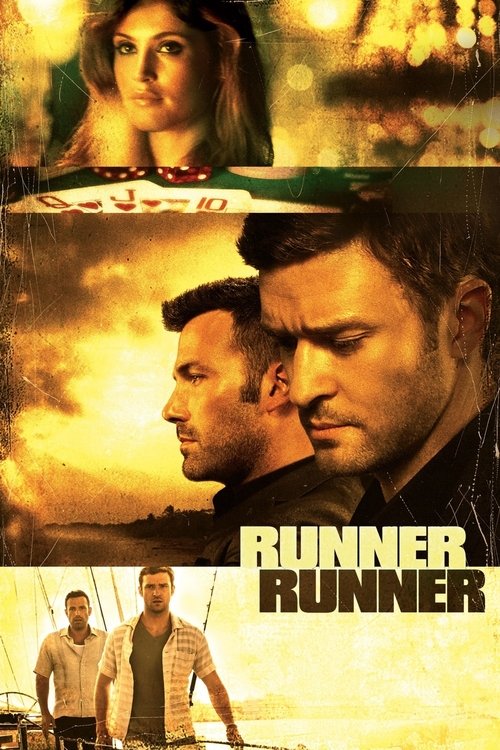
Runner Runner
When a poor college student who cracks an online poker game goes bust, he arranges a face-to-face with the man he thinks cheated him, a sly offshore entrepreneur.
Despite a moderate budget of $30.0M, Runner Runner became a financial success, earning $62.6M worldwide—a 109% return.


Plot Structure
Story beats plotted across runtime


Narrative Arc
Emotional journey through the story's key moments
Story Circle
Blueprint 15-beat structure
Arcplot Score Breakdown
Weighted: Precision (70%) + Arc (15%) + Theme (15%)
Runner Runner (2013) reveals deliberately positioned story structure, characteristic of Brad Furman's storytelling approach. This structural analysis examines how the film's 15-point plot structure maps to proven narrative frameworks across 1 hour and 28 minutes. With an Arcplot score of 6.8, the film balances conventional beats with creative variation.
Characters
Cast & narrative archetypes

Richie Furst
Ivan Block
Rebecca Shafran
Agent Shavers
Main Cast & Characters
Richie Furst
Played by Justin Timberlake
A Princeton grad student who loses his tuition money to online poker and travels to Costa Rica to confront the gambling site's owner.
Ivan Block
Played by Ben Affleck
A charismatic and ruthless online gambling mogul who operates from Costa Rica and draws Richie into his dangerous world.
Rebecca Shafran
Played by Gemma Arterton
Ivan Block's right-hand associate who becomes romantically involved with Richie while harboring her own secrets.
Agent Shavers
Played by Anthony Mackie
An FBI agent investigating Ivan Block's illegal gambling operations who tries to turn Richie into an informant.
Structural Analysis
The Status Quo at 1 minutes (1% through the runtime) establishes Richie Furst is a Princeton grad student working multiple jobs to pay tuition, running small-stakes online poker referrals. He's brilliant with numbers but struggling financially, caught between legitimate academic life and the allure of easy money.. Structural examination shows that this early placement immediately immerses viewers in the story world.
The inciting incident occurs at 11 minutes when Richie loses his entire tuition fund playing online poker on a site he believes cheated him. He analyzes the data and discovers statistical proof of fraud. This loss destroys his immediate future and forces a desperate decision.. At 12% through the film, this Disruption aligns precisely with traditional story structure. This beat shifts the emotional landscape, launching the protagonist into the central conflict.
The First Threshold at 22 minutes marks the transition into Act II, occurring at 25% of the runtime. This reveals the protagonist's commitment to Richie boards a plane to Costa Rica to confront Ivan Block. This is his active choice to leave the safe academic world and enter the dangerous world of offshore gambling. No turning back., moving from reaction to action.
At 44 minutes, the Midpoint arrives at 51% of the runtime—precisely centered, creating perfect narrative symmetry. The analysis reveals that this crucial beat FBI Agent Shavers approaches Richie and reveals that Block is under investigation for corruption, bribery, and illegal gambling. Richie is now implicated and must cooperate or face prosecution. False victory becomes false defeat: the dream life is actually a trap., fundamentally raising what's at risk. The emotional intensity shifts, dividing the narrative into clear before-and-after phases.
The Collapse moment at 67 minutes (76% through) represents the emotional nadir. Here, Block discovers Richie's betrayal. Someone close to Richie is killed or seriously threatened (whiff of death), demonstrating that Block will destroy anyone who crosses him. Richie realizes he's in mortal danger and the FBI may not protect him. All seems lost., illustrates the protagonist at their lowest point. This beat's placement in the final quarter sets up the climactic reversal.
The Second Threshold at 71 minutes initiates the final act resolution at 80% of the runtime. Richie has a realization: he can use his mathematical skills and inside knowledge to turn Block's system against him. He gathers critical evidence or formulates a plan to expose Block while protecting himself. He synthesizes what Rebecca taught him about the business with his own analytical abilities., demonstrating the transformation achieved throughout the journey.
Emotional Journey
Runner Runner's emotional architecture traces a deliberate progression across 15 carefully calibrated beats.
Narrative Framework
This structural analysis employs proven narrative structure principles that track dramatic progression. By mapping Runner Runner against these established plot points, we can identify how Brad Furman utilizes or subverts traditional narrative conventions. The plot point approach reveals not only adherence to structural principles but also creative choices that distinguish Runner Runner within the crime genre.
Brad Furman's Structural Approach
Among the 3 Brad Furman films analyzed on Arcplot, the average structural score is 6.9, demonstrating varied approaches to story architecture. Runner Runner takes a more unconventional approach compared to the director's typical style. For comparative analysis, explore the complete Brad Furman filmography.
Comparative Analysis
Additional crime films include The Bad Guys, Rustom and The Whole Ten Yards. For more Brad Furman analyses, see The Lincoln Lawyer, The Infiltrator.
Plot Points by Act
Act I
SetupStatus Quo
Richie Furst is a Princeton grad student working multiple jobs to pay tuition, running small-stakes online poker referrals. He's brilliant with numbers but struggling financially, caught between legitimate academic life and the allure of easy money.
Theme
A colleague or professor warns Richie about gambling: "The house always wins." This establishes the thematic question: can you beat a rigged system, and at what cost?
Worldbuilding
Setup of Richie's world at Princeton: his academic pressure, financial struggles, his side hustle promoting online poker sites, and his talent for mathematics and probability. We see his relationship with his father and his moral boundaries being tested.
Disruption
Richie loses his entire tuition fund playing online poker on a site he believes cheated him. He analyzes the data and discovers statistical proof of fraud. This loss destroys his immediate future and forces a desperate decision.
Resistance
Richie debates his options: accept the loss and drop out, or confront the poker site owner. Friends advise against it, but Richie discovers the site is owned by Ivan Block, a wealthy offshore gambling mogul in Costa Rica. He decides to travel there to confront Block with evidence of the fraud.
Act II
ConfrontationFirst Threshold
Richie boards a plane to Costa Rica to confront Ivan Block. This is his active choice to leave the safe academic world and enter the dangerous world of offshore gambling. No turning back.
Mirror World
Richie meets Rebecca Shafran, Block's associate and potential love interest. She represents the glamorous but morally compromised world Richie is entering. She embodies the thematic tension between success and integrity.
Premise
The "fun and games" of living the high life in Costa Rica. Block is impressed by Richie's intelligence and offers him a job instead of a refund. Richie becomes Block's protégé, enjoying wealth, luxury, parties, and Rebecca's company while helping run the online poker empire. This is what the audience came for: the seductive world of offshore gambling.
Midpoint
FBI Agent Shavers approaches Richie and reveals that Block is under investigation for corruption, bribery, and illegal gambling. Richie is now implicated and must cooperate or face prosecution. False victory becomes false defeat: the dream life is actually a trap.
Opposition
Richie is caught between the FBI and Block. He tries to play both sides, gathering evidence for the FBI while maintaining Block's trust. Block grows suspicious, the pressure intensifies, and Richie discovers the true depths of Block's corruption and violence. Rebecca's loyalty is questioned, and danger escalates.
Collapse
Block discovers Richie's betrayal. Someone close to Richie is killed or seriously threatened (whiff of death), demonstrating that Block will destroy anyone who crosses him. Richie realizes he's in mortal danger and the FBI may not protect him. All seems lost.
Crisis
Richie faces his dark night of the soul, processing the collapse and realizing he must take action himself. He can't rely on the FBI or play it safe anymore. He must use his intelligence to outmaneuver Block at his own game.
Act III
ResolutionSecond Threshold
Richie has a realization: he can use his mathematical skills and inside knowledge to turn Block's system against him. He gathers critical evidence or formulates a plan to expose Block while protecting himself. He synthesizes what Rebecca taught him about the business with his own analytical abilities.
Synthesis
The finale: Richie executes his plan to bring down Block, likely involving cooperation with the FBI, protecting Rebecca, and using evidence of Block's crimes. The confrontation comes to a head, and Richie must prove he's learned to beat the house by changing the game entirely.
Transformation
Richie has returned to his world, transformed. He's no longer the naïve student who thought he could beat the system through cleverness alone. He understands the true cost of corruption and has chosen integrity over easy money. The final image mirrors the opening but shows his growth.