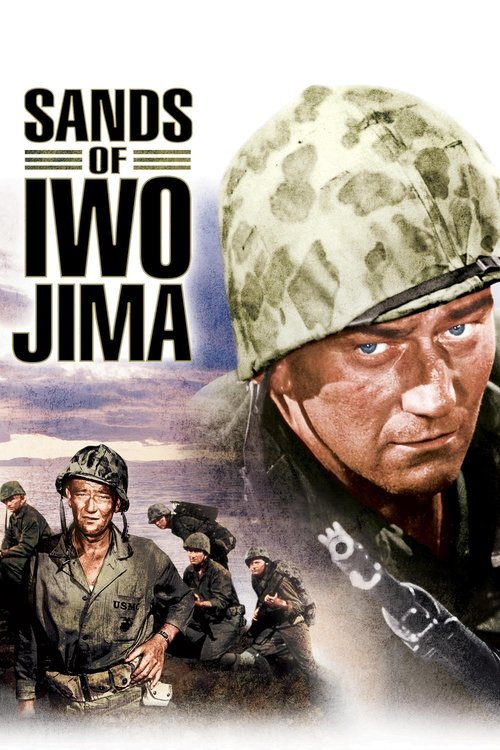
Sands of Iwo Jima
Haunted by personal demons, Marine Sgt. John Stryker is hated and feared by his men, who see him as a cold-hearted sadist. But when their boots hit the beaches, they begin to understand the reason for Stryker's rigid form of discipline.
Despite its small-scale budget of $1.0M, Sands of Iwo Jima became a box office phenomenon, earning $7.8M worldwide—a remarkable 680% return. The film's unconventional structure resonated with audiences, confirming that strong storytelling can transcend budget limitations.
Nominated for 4 Oscars. 1 win & 5 nominations


Plot Structure
Story beats plotted across runtime


Narrative Arc
Emotional journey through the story's key moments
Story Circle
Blueprint 15-beat structure
Arcplot Score Breakdown
Weighted: Precision (70%) + Arc (15%) + Theme (15%)
Sands of Iwo Jima (1950) exhibits carefully calibrated narrative architecture, characteristic of Allan Dwan's storytelling approach. This structural analysis examines how the film's 15-point plot structure maps to proven narrative frameworks across 1 hour and 40 minutes. With an Arcplot score of 7.0, the film balances conventional beats with creative variation.
Characters
Cast & narrative archetypes

Sgt. John M. Stryker
Pfc. Peter Conway
Pfc. Al Thomas
Cpl. Robert Dunne
Pfc. Benny Regazzi
Pfc. Charlie Bass
Pfc. 'Sky' Choynski
Main Cast & Characters
Sgt. John M. Stryker
Played by John Wayne
A tough, battle-hardened Marine sergeant who trains his squad with brutal discipline to prepare them for combat.
Pfc. Peter Conway
Played by John Agar
The son of a Marine colonel who resents Stryker's methods and struggles with his father's legacy.
Pfc. Al Thomas
Played by Adele Mara
A young Marine who learns to respect Stryker and becomes a capable soldier through harsh training.
Cpl. Robert Dunne
Played by Forrest Tucker
A former construction worker who becomes Stryker's most reliable NCO and learns leadership.
Pfc. Benny Regazzi
Played by Wally Cassell
An Italian-American Marine who provides comic relief but proves his courage in battle.
Pfc. Charlie Bass
Played by James Brown
A farm boy who struggles with homesickness and fear but ultimately stands his ground.
Pfc. 'Sky' Choynski
Played by Richard Webb
A confident, wisecracking Marine who initially clashes with Stryker's authority.
Structural Analysis
The Status Quo at 1 minutes (1% through the runtime) establishes New Marine recruits arrive at Camp Tarawa in New Zealand for training, establishing the raw, undisciplined state of the squad before Sergeant Stryker shapes them into Marines.. Significantly, this early placement immediately immerses viewers in the story world.
The inciting incident occurs at 12 minutes when The squad receives orders for deployment to combat in the Pacific Theater. The reality of war replaces the safety of training camp, forcing the men to confront that their survival now depends on the harsh lessons Stryker has been drilling into them.. At 12% through the film, this Disruption aligns precisely with traditional story structure. This beat shifts the emotional landscape, launching the protagonist into the central conflict.
The First Threshold at 25 minutes marks the transition into Act II, occurring at 25% of the runtime. This demonstrates the protagonist's commitment to The squad lands at Tarawa and enters their first major combat engagement. The men must now apply their training under fire, crossing from preparation into the brutal reality of warfare where Stryker's methods will be tested., moving from reaction to action.
At 50 minutes, the Midpoint arrives at 50% of the runtime—precisely centered, creating perfect narrative symmetry. Of particular interest, this crucial beat After a successful operation, the squad earns a brief respite. Stryker attempts to reconnect with his estranged family through a letter, revealing his vulnerability. The false victory—they've survived and bonded, but the war's biggest challenge still awaits at Iwo Jima., fundamentally raising what's at risk. The emotional intensity shifts, dividing the narrative into clear before-and-after phases.
The Collapse moment at 75 minutes (75% through) represents the emotional nadir. Here, During the brutal Iwo Jima assault, the squad suffers devastating losses. A moment of critical failure threatens the mission and the surviving men's faith in themselves and their sergeant. The whiff of death hangs heavy as beloved squad members fall in the volcanic ash., illustrates the protagonist at their lowest point. This beat's placement in the final quarter sets up the climactic reversal.
The Second Threshold at 80 minutes initiates the final act resolution at 80% of the runtime. The Marines receive orders for the final push to Mount Suribachi. Conway and the squad, now fully understanding Stryker's methods, commit to the mission with renewed purpose. The internal conflict between duty and resentment resolves as the men embrace their training and brotherhood., demonstrating the transformation achieved throughout the journey.
Emotional Journey
Sands of Iwo Jima's emotional architecture traces a deliberate progression across 15 carefully calibrated beats.
Narrative Framework
This structural analysis employs a 15-point narrative structure framework that maps key story moments. By mapping Sands of Iwo Jima against these established plot points, we can identify how Allan Dwan utilizes or subverts traditional narrative conventions. The plot point approach reveals not only adherence to structural principles but also creative choices that distinguish Sands of Iwo Jima within the war genre.
Comparative Analysis
Additional war films include Fury, Shenandoah and More American Graffiti.
Plot Points by Act
Act I
SetupStatus Quo
New Marine recruits arrive at Camp Tarawa in New Zealand for training, establishing the raw, undisciplined state of the squad before Sergeant Stryker shapes them into Marines.
Theme
A veteran Marine tells the recruits that in war, you either learn to follow orders and work as a unit, or you die—establishing the theme of duty versus individualism and the cost of leadership.
Worldbuilding
Introduction to the squad members including Private Pete Conway, whose father was a celebrated Marine colonel, and his resentment of military authority. Sergeant Stryker's harsh training methods and personal demons are established, along with the camaraderie and conflicts within the unit.
Disruption
The squad receives orders for deployment to combat in the Pacific Theater. The reality of war replaces the safety of training camp, forcing the men to confront that their survival now depends on the harsh lessons Stryker has been drilling into them.
Resistance
The squad debates Stryker's methods and leadership. Conway openly challenges Stryker's authority, representing the men's resistance to his demanding style. Stryker's troubled past with his estranged wife and son is revealed, adding depth to his hard exterior and hinting at why he pushes his men so relentlessly.
Act II
ConfrontationFirst Threshold
The squad lands at Tarawa and enters their first major combat engagement. The men must now apply their training under fire, crossing from preparation into the brutal reality of warfare where Stryker's methods will be tested.
Mirror World
During a lull in fighting, the personal relationships between squad members deepen. Conway begins to see glimpses of humanity in Stryker, and the bond between soldiers facing death together starts to form—carrying the theme of how war forges brotherhood.
Premise
The squad fights through the Pacific campaign, experiencing the horrors and heroism of island warfare. Combat sequences showcase both Stryker's tactical brilliance and the human cost of battle. The men gradually transform from recruits into hardened Marines while grappling with loss and the moral weight of killing.
Midpoint
After a successful operation, the squad earns a brief respite. Stryker attempts to reconnect with his estranged family through a letter, revealing his vulnerability. The false victory—they've survived and bonded, but the war's biggest challenge still awaits at Iwo Jima.
Opposition
Preparation for the Iwo Jima invasion intensifies pressure on the squad. Personal conflicts resurface as fear mounts. Stryker's leadership is questioned when a man dies due to what some see as his rigidity. The Japanese fortifications on Iwo Jima represent an almost impossible objective, and casualties among familiar faces increase.
Collapse
During the brutal Iwo Jima assault, the squad suffers devastating losses. A moment of critical failure threatens the mission and the surviving men's faith in themselves and their sergeant. The whiff of death hangs heavy as beloved squad members fall in the volcanic ash.
Crisis
In the aftermath of heavy casualties, the surviving Marines must process their grief while the battle continues. Conway and the others confront the true meaning of Stryker's harsh training—it was always about survival, about bringing as many men home as possible.
Act III
ResolutionSecond Threshold
The Marines receive orders for the final push to Mount Suribachi. Conway and the squad, now fully understanding Stryker's methods, commit to the mission with renewed purpose. The internal conflict between duty and resentment resolves as the men embrace their training and brotherhood.
Synthesis
The final assault on Mount Suribachi. The squad fights with precision and courage born from Stryker's training. In a moment of quiet after securing position, Stryker is killed by a Japanese sniper—but his legacy lives on in the men he shaped. The iconic flag raising on Iwo Jima provides the visual climax.
Transformation
Conway takes Stryker's letter—intended for his son—and becomes the leader Stryker trained him to be. The American flag waves over Iwo Jima as Conway leads the squad forward with Stryker's words: "Saddle up, let's get back in the war." The cycle of mentorship and sacrifice continues.