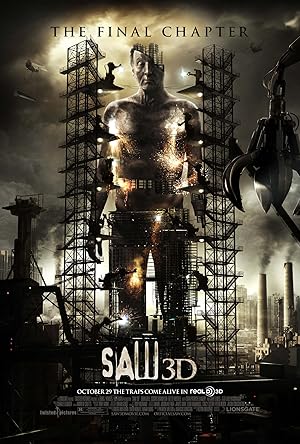
Saw 3D
After trying to kill Mark Hoffman, Jill Tuck goes into protective custody. Detective Matt Gibson agrees to take her into protective custody once she signs an affidavit, revealing that Mark Hoffman is the new Jigsaw Killer. Meanwhile, Bobby Dagen, a self-proclaimed Jigsaw Survivor, is put through his own series of tests, where he must save both his friends and his wife.
Despite a respectable budget of $17.0M, Saw 3D became a box office phenomenon, earning $136.2M worldwide—a remarkable 701% return.


Plot Structure
Story beats plotted across runtime


Narrative Arc
Emotional journey through the story's key moments
Story Circle
Blueprint 15-beat structure
Arcplot Score Breakdown
Weighted: Precision (70%) + Arc (15%) + Theme (15%)
Saw 3D (2010) demonstrates deliberately positioned narrative design, characteristic of Kevin Greutert's storytelling approach. This structural analysis examines how the film's 15-point plot structure maps to proven narrative frameworks across 1 hour and 30 minutes. With an Arcplot score of 7.4, the film balances conventional beats with creative variation.
Characters
Cast & narrative archetypes

Bobby Dagen
Dr. Lawrence Gordon
Detective Matt Gibson
Jill Tuck
Detective Mark Hoffman
Joyce Dagen
John Kramer / Jigsaw
Main Cast & Characters
Bobby Dagen
Played by Sean Patrick Flanery
A self-help author who claims to be a Jigsaw survivor but is actually a fraud, forced into a real game to save his wife.
Dr. Lawrence Gordon
Played by Cary Elwes
The survivor from the first film who has become Jigsaw's accomplice, revealed as the final piece of the puzzle.
Detective Matt Gibson
Played by Chad Donella
An internal affairs detective investigating the Jigsaw murders and attempting to stop the remaining games.
Jill Tuck
Played by Betsy Russell
Jigsaw's widow who attempts to follow his final instructions and becomes a target herself.
Detective Mark Hoffman
Played by Costas Mandylor
The corrupt detective and Jigsaw apprentice seeking revenge against Jill for her betrayal.
Joyce Dagen
Played by Gina Holden
Bobby's wife who is trapped in a game as leverage to motivate her husband to complete his tests.
John Kramer / Jigsaw
Played by Tobin Bell
The deceased mastermind whose legacy and final instructions continue to drive the events of the film.
Structural Analysis
The Status Quo at 1 minutes (1% through the runtime) establishes The public trap: Brad, Ryan, and Dina are chained in a storefront window as a crowd watches, forced to choose who lives in a deadly love triangle.. Of particular interest, this early placement immediately immerses viewers in the story world.
The inciting incident occurs at 11 minutes when Bobby Dagen wakes up in a trap. He discovers his wife Joyce is also captured and in danger. The message reveals he lied about being a Jigsaw survivor and now must endure real tests.. At 13% through the film, this Disruption is delayed, allowing extended setup of the story world. This beat shifts the emotional landscape, launching the protagonist into the central conflict.
The First Threshold at 23 minutes marks the transition into Act II, occurring at 25% of the runtime. This demonstrates the protagonist's commitment to Bobby chooses to enter the first major trap room to save his publicist Nina, pulling fish hooks through her body and chest. He commits to the deadly game, accepting the consequences of his lies., moving from reaction to action.
At 46 minutes, the Midpoint arrives at 51% of the runtime—precisely centered, creating perfect narrative symmetry. Significantly, this crucial beat Bobby fails to save his lawyer Suzanne, who is hanged by chains. He realizes he may not be able to save everyone. Simultaneously, Hoffman infiltrates the police station - stakes escalate dramatically., fundamentally raising what's at risk. The emotional intensity shifts, dividing the narrative into clear before-and-after phases.
The Collapse moment at 68 minutes (76% through) represents the emotional nadir. Here, Bobby reaches the final room but discovers he must pierce his pectoral muscles with hooks to lift himself - the very trap he lied about surviving. Hoffman captures Jill, placing her in the reverse bear trap., reveals the protagonist at their lowest point. This beat's placement in the final quarter sets up the climactic reversal.
The Second Threshold at 72 minutes initiates the final act resolution at 80% of the runtime. Bobby makes a final agonizing attempt to pierce his chest and reach the key, but fails. Hoffman activates Jill's trap. Both storylines reach their irreversible conclusions., demonstrating the transformation achieved throughout the journey.
Emotional Journey
Saw 3D's emotional architecture traces a deliberate progression across 15 carefully calibrated beats.
Narrative Framework
This structural analysis employs a 15-point narrative structure framework that maps key story moments. By mapping Saw 3D against these established plot points, we can identify how Kevin Greutert utilizes or subverts traditional narrative conventions. The plot point approach reveals not only adherence to structural principles but also creative choices that distinguish Saw 3D within the crime genre.
Kevin Greutert's Structural Approach
Among the 4 Kevin Greutert films analyzed on Arcplot, the average structural score is 7.0, reflecting strong command of classical structure. Saw 3D represents one of the director's most structurally precise works. For comparative analysis, explore the complete Kevin Greutert filmography.
Comparative Analysis
Additional crime films include The Bad Guys, Rustom and The Whole Ten Yards. For more Kevin Greutert analyses, see Saw X, Jessabelle and Saw VI.
Plot Points by Act
Act I
SetupStatus Quo
The public trap: Brad, Ryan, and Dina are chained in a storefront window as a crowd watches, forced to choose who lives in a deadly love triangle.
Theme
Jigsaw's message plays: "The truth will set you free, but it will also cost you." The theme of lies, false survival stories, and the price of deception is established.
Worldbuilding
Bobby Dagen is introduced as a self-help guru who claims to be a Jigsaw survivor, profiting from his book and speaking tours. Detective Gibson investigates Jigsaw murders. Jill Tuck has Hoffman's trap evidence.
Disruption
Bobby Dagen wakes up in a trap. He discovers his wife Joyce is also captured and in danger. The message reveals he lied about being a Jigsaw survivor and now must endure real tests.
Resistance
Bobby learns the rules: he must navigate through traps to save his team and wife before time runs out. Detective Gibson pursues Hoffman. Jill goes into protective custody and reveals Hoffman's identity.
Act II
ConfrontationFirst Threshold
Bobby chooses to enter the first major trap room to save his publicist Nina, pulling fish hooks through her body and chest. He commits to the deadly game, accepting the consequences of his lies.
Mirror World
Bobby encounters his best friend Cale in a trap, representing the relationships he's betrayed with his deception. The parallel story of Hoffman vs. Jill intensifies the theme of betrayal and revenge.
Premise
Bobby navigates multiple trap rooms (Nina, Cale, Suzanne), facing the human cost of his lies. Meanwhile, Hoffman hunts Jill while evading police. The promise: brutal traps exposing Bobby's fraud.
Midpoint
Bobby fails to save his lawyer Suzanne, who is hanged by chains. He realizes he may not be able to save everyone. Simultaneously, Hoffman infiltrates the police station - stakes escalate dramatically.
Opposition
Bobby's failures mount as time runs out. Hoffman executes his revenge plan at the police station, killing Gibson and others. Both protagonists face increasing opposition as their worlds collapse around them.
Collapse
Bobby reaches the final room but discovers he must pierce his pectoral muscles with hooks to lift himself - the very trap he lied about surviving. Hoffman captures Jill, placing her in the reverse bear trap.
Crisis
Bobby desperately attempts the hook trap but cannot complete it due to his lies and lack of real survival experience. Hoffman prepares to execute Jill, savoring his revenge. Both face their darkest moments.
Act III
ResolutionSecond Threshold
Bobby makes a final agonizing attempt to pierce his chest and reach the key, but fails. Hoffman activates Jill's trap. Both storylines reach their irreversible conclusions.
Synthesis
Joyce burns to death as Bobby fails. Jill dies in the reverse bear trap. Hoffman is attacked by Dr. Gordon and fellow survivors, locked in the bathroom from the first film. Justice is served, but at terrible cost.
Transformation
Bobby weeps in the aftermath, having lost everything due to his lies. Hoffman screams in the bathroom, his fate sealed. The final image reveals the price of deception and the inescapable nature of truth.