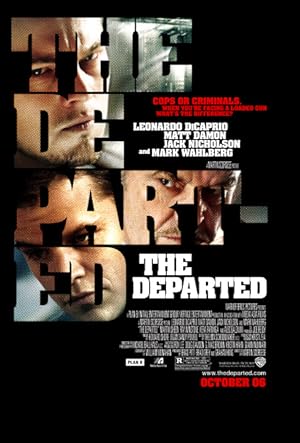
The Departed
In this crime-action tour de force, the South Boston state police force is waging war on Irish-American organized crime. Young undercover cop Billy Costigan is assigned to infiltrate the mob syndicate run by gangland chief Frank Costello. While Billy quickly gains Costello's confidence, Colin Sullivan, a hardened young criminal who has infiltrated the state police as an informer for the syndicate is rising to a position of power in the Special Investigation Unit. Each man becomes deeply consumed by their double lives, gathering information about the plans and counter-plans of the operations they have penetrated. But when it becomes clear to both the mob and the police that there is a mole in their midst, Billy and Colin are suddenly in danger of being caught and exposed to the enemy - and each must race to uncover the identity of the other man in time to save themselves. But is either willing to turn on their friends and comrades they've made during their long stints undercover?
Despite a significant budget of $90.0M, The Departed became a solid performer, earning $291.5M worldwide—a 224% return.
4 Oscars. 100 wins & 141 nominations


Plot Structure
Story beats plotted across runtime


Narrative Arc
Emotional journey through the story's key moments
Story Circle
Blueprint 15-beat structure
Arcplot Score Breakdown
Weighted: Precision (70%) + Arc (15%) + Theme (15%)
The Departed (2006) reveals deliberately positioned narrative architecture, characteristic of Martin Scorsese's storytelling approach. This structural analysis examines how the film's 15-point plot structure maps to proven narrative frameworks across 2 hours and 31 minutes. With an Arcplot score of 5.3, the film takes an unconventional approach to traditional narrative frameworks.
Characters
Cast & narrative archetypes

Billy Costigan
Colin Sullivan
Frank Costello
Sgt. Sean Dignam
Capt. George Ellerby
Capt. Oliver Queenan
Madolyn Madden
Mr. French
Main Cast & Characters
Billy Costigan
Played by Leonardo DiCaprio
An undercover state trooper infiltrating the Irish mob, torn between duty and survival in a world where his identity is constantly at risk.
Colin Sullivan
Played by Matt Damon
A mole planted by the mob inside the Massachusetts State Police, living a double life while climbing the ranks of law enforcement.
Frank Costello
Played by Jack Nicholson
A ruthless Irish mob boss who controls organized crime in Boston and has infiltrated the police department.
Sgt. Sean Dignam
Played by Mark Wahlberg
A crude, confrontational staff sergeant who suspects there's a mole in the department and doesn't trust anyone.
Capt. George Ellerby
Played by Alec Baldwin
The captain of the Special Investigation Unit who oversees the investigation into Costello's organization.
Capt. Oliver Queenan
Played by Martin Sheen
The compassionate captain who recruits and handles Billy Costigan as an undercover operative.
Madolyn Madden
Played by Vera Farmiga
A police psychiatrist who becomes romantically involved with both Colin Sullivan and Billy Costigan without knowing their true identities.
Mr. French
Played by Ray Winstone
Frank Costello's right-hand man and enforcer, loyal and ruthless in protecting his boss.
Structural Analysis
The Status Quo at 1 minutes (1% through the runtime) establishes Frank Costello's monologue over images of 1970s South Boston establishes the brutal criminal underworld. "I don't want to be a product of my environment. I want my environment to be a product of me." The world is corrupt from the start.. The analysis reveals that this early placement immediately immerses viewers in the story world.
The inciting incident occurs at 16 minutes when Captain Queenan and Sergeant Dignam approach Billy with a proposition: go undercover to infiltrate Frank Costello's organization. Billy's legitimate police career is derailed before it begins - he must become the criminal his family raised him to escape.. At 11% through the film, this Disruption aligns precisely with traditional story structure. This beat shifts the emotional landscape, launching the protagonist into the central conflict.
The First Threshold at 33 minutes marks the transition into Act II, occurring at 22% of the runtime. This indicates the protagonist's commitment to Billy makes contact with Costello's crew and proves himself through violence, officially entering the criminal underworld as an undercover operative. There's no turning back - his police identity is erased, and only Queenan and Dignam know the truth., moving from reaction to action.
At 66 minutes, the Midpoint arrives at 44% of the runtime—arriving early, accelerating into Act IIb complications. Of particular interest, this crucial beat The microprocessor deal goes wrong when both moles tip off their respective sides. Costello and the police both realize definitively that they have been infiltrated. The hunt for the rats becomes the central focus - Billy and Colin are now actively being hunted by the people they're betraying., fundamentally raising what's at risk. The emotional intensity shifts, dividing the narrative into clear before-and-after phases.
The Collapse moment at 98 minutes (65% through) represents the emotional nadir. Here, Captain Queenan is thrown from a rooftop by Costello's men, dying in front of a helpless Billy who cannot break cover to save him. Billy's only lifeline to his true identity and the only person who can verify he's a cop is dead. He is utterly alone., indicates the protagonist at their lowest point. This beat's placement in the final quarter sets up the climactic reversal.
The Second Threshold at 107 minutes initiates the final act resolution at 71% of the runtime. Billy obtains Costello's personal records and discovers Colin Sullivan's identity as the mole. Armed with this knowledge, he finally has proof and a target. He can now take action to reclaim his identity and bring down the corruption from within., demonstrating the transformation achieved throughout the journey.
Emotional Journey
The Departed's emotional architecture traces a deliberate progression across 15 carefully calibrated beats.
Narrative Framework
This structural analysis employs structural analysis methodology used to understand storytelling architecture. By mapping The Departed against these established plot points, we can identify how Martin Scorsese utilizes or subverts traditional narrative conventions. The plot point approach reveals not only adherence to structural principles but also creative choices that distinguish The Departed within the crime genre.
Martin Scorsese's Structural Approach
Among the 18 Martin Scorsese films analyzed on Arcplot, the average structural score is 6.0, showcasing experimental approaches to narrative form. The Departed takes a more unconventional approach compared to the director's typical style. For comparative analysis, explore the complete Martin Scorsese filmography.
Comparative Analysis
Additional crime films include The Bad Guys, Rustom and The Whole Ten Yards. For more Martin Scorsese analyses, see Casino, Killers of the Flower Moon and After Hours.
Plot Points by Act
Act I
SetupStatus Quo
Frank Costello's monologue over images of 1970s South Boston establishes the brutal criminal underworld. "I don't want to be a product of my environment. I want my environment to be a product of me." The world is corrupt from the start.
Theme
Frank Costello tells young Colin Sullivan, "When you decide to be something, you can be it." This encapsulates the film's exploration of identity, loyalty, and the masks people wear - can you truly become what you pretend to be?
Worldbuilding
Parallel setup of Colin Sullivan and Billy Costigan. Colin is groomed by Costello then joins the State Police as a mole. Billy, despite his criminal family connections, enters the police academy with genuine intentions. Both men's dual identities are established.
Disruption
Captain Queenan and Sergeant Dignam approach Billy with a proposition: go undercover to infiltrate Frank Costello's organization. Billy's legitimate police career is derailed before it begins - he must become the criminal his family raised him to escape.
Resistance
Billy debates the undercover assignment, serves staged jail time to build his criminal credentials, and reluctantly commits to the operation. Queenan acts as his guide, preparing him for the dangerous double life ahead. Colin simultaneously advances in the Special Investigations Unit.
Act II
ConfrontationFirst Threshold
Billy makes contact with Costello's crew and proves himself through violence, officially entering the criminal underworld as an undercover operative. There's no turning back - his police identity is erased, and only Queenan and Dignam know the truth.
Mirror World
Billy meets Madolyn, a psychiatrist mandated by his undercover role. Their connection represents the possibility of genuine human intimacy amid his web of lies. She becomes the one person who might see through his masks to who he really is.
Premise
The cat-and-mouse game intensifies. Billy rises in Costello's organization while feeding intelligence to Queenan. Colin uses his position to protect Costello. Both moles operate in parallel, each hunting the other without knowing their identity. Tension builds as both sides realize they have a rat.
Midpoint
The microprocessor deal goes wrong when both moles tip off their respective sides. Costello and the police both realize definitively that they have been infiltrated. The hunt for the rats becomes the central focus - Billy and Colin are now actively being hunted by the people they're betraying.
Opposition
Paranoia consumes both organizations. Billy struggles to maintain his cover as Costello grows suspicious of everyone. Colin desperately tries to identify the police informant before he's exposed. Madolyn becomes romantically involved with both men, unknowingly connecting the two moles. The pressure becomes unbearable.
Collapse
Captain Queenan is thrown from a rooftop by Costello's men, dying in front of a helpless Billy who cannot break cover to save him. Billy's only lifeline to his true identity and the only person who can verify he's a cop is dead. He is utterly alone.
Crisis
Billy spirals into despair, his identity crisis reaching its peak. With Queenan dead and Dignam suspended, no one can confirm he's really a cop. Costello reveals he's been an FBI informant, adding another layer of betrayal. Billy realizes everyone is wearing masks.
Act III
ResolutionSecond Threshold
Billy obtains Costello's personal records and discovers Colin Sullivan's identity as the mole. Armed with this knowledge, he finally has proof and a target. He can now take action to reclaim his identity and bring down the corruption from within.
Synthesis
Colin kills Costello to bury his secrets. Billy contacts Colin, setting up the final confrontation. In a tense rooftop meeting, Billy arrests Colin and has him in custody - justice seems imminent. But Trooper Barrigan, another Costello mole, executes Billy in the elevator. Colin kills Barrigan to cover his tracks.
Transformation
Dignam executes Colin in his apartment. A rat crawls across the balcony railing with the Massachusetts State House dome visible behind it. The image mirrors the opening - corruption persists, the system consumes everyone, and identity remains meaningless when everyone is playing a role.