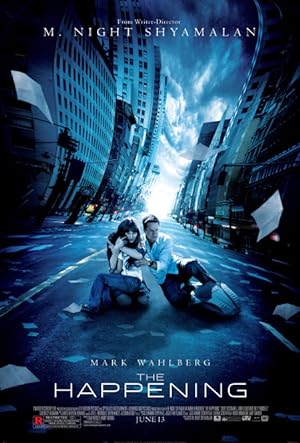
The Happening
Elliot Moore is a high school science teacher who quizzes his class one day about an article in the New York Times. It's about the sudden, mysterious disappearance of bees. Yet again Nature is doing something inexplicable, and whatever science has to say about it will be, in the end, only a theory. Scientists will bring out more theories, but no explanations, when a more urgent dilemma hits the planet. It begins in Central Park. Suddenly and inexplicably, the behavior of everyone in the park changes in a most bizarre and horrible way. Soon, the strange behavior spreads throughout the city and beyond. Elliot, his wife, Alma, and Jess, the young daughter of a friend, will only have theories to guide them where to run and where to hide. But theories may not be enough.
Despite a mid-range budget of $60.0M, The Happening became a commercial success, earning $163.4M worldwide—a 172% return.
3 wins & 10 nominations


Plot Structure
Story beats plotted across runtime


Narrative Arc
Emotional journey through the story's key moments
Story Circle
Blueprint 15-beat structure
Arcplot Score Breakdown
Weighted: Precision (70%) + Arc (15%) + Theme (15%)
The Happening (2008) reveals meticulously timed plot construction, characteristic of M. Night Shyamalan's storytelling approach. This structural analysis examines how the film's 15-point plot structure maps to proven narrative frameworks across 1 hour and 30 minutes. With an Arcplot score of 7.2, the film balances conventional beats with creative variation.
Characters
Cast & narrative archetypes

Elliot Moore
Alma Moore
Julian
Jess
Mrs. Jones
Main Cast & Characters
Elliot Moore
Played by Mark Wahlberg
A high school science teacher trying to survive a mysterious environmental crisis while reconciling with his wife.
Alma Moore
Played by Zooey Deschanel
Elliot's wife, struggling with marital problems while fleeing an unexplained threat.
Julian
Played by John Leguizamo
Elliot's friend and fellow teacher who tries to protect his daughter during the crisis.
Jess
Played by Ashlyn Sanchez
Julian's young daughter who travels with Elliot and Alma.
Mrs. Jones
Played by Betty Buckley
An eccentric, reclusive woman who reluctantly shelters the survivors.
Structural Analysis
The Status Quo at 1 minutes (1% through the runtime) establishes Central Park, New York City. Two women sit on a bench reading as the wind stirs. People begin to freeze in place, confused, before methodically killing themselves. The ordinary world is already infected with something deeply wrong.. The analysis reveals that this early placement immediately immerses viewers in the story world.
The inciting incident occurs at 11 minutes when The school is evacuated as reports confirm the attacks are spreading beyond New York. Elliot, Alma, Julian, and Jess rush to catch a train out of Philadelphia. The disruption is external and unexplained—an invisible threat forcing evacuation.. At 12% through the film, this Disruption aligns precisely with traditional story structure. This beat shifts the emotional landscape, launching the protagonist into the central conflict.
The First Threshold at 23 minutes marks the transition into Act II, occurring at 25% of the runtime. This reveals the protagonist's commitment to Elliot makes the active choice to take responsibility for Jess and lead their small group away from the population centers after the train stops. He decides they must flee into rural Pennsylvania, committing to survival and to protecting the child entrusted to them., moving from reaction to action.
At 45 minutes, the Midpoint arrives at 50% of the runtime—precisely centered, creating perfect narrative symmetry. Structural examination shows that this crucial beat The survivors split into smaller groups after learning that larger groups trigger the attacks. Elliot realizes the plants are targeting groups based on size—the larger the group, the bigger the threat. This is a false defeat: understanding the enemy's rules doesn't help; it only isolates them further and makes survival harder., fundamentally raising what's at risk. The emotional intensity shifts, dividing the narrative into clear before-and-after phases.
The Collapse moment at 68 minutes (75% through) represents the emotional nadir. Here, The trio arrives at the farmhouse of Mrs. Jones, an isolated and paranoid old woman who lives alone. She is hostile and disturbed. When morning comes, she is affected by the toxin and kills herself by smashing her head through windows. Elliot, Alma, and Jess are separated in the two buildings of the property with no way to reach each other safely., illustrates the protagonist at their lowest point. This beat's placement in the final quarter sets up the climactic reversal.
The Second Threshold at 72 minutes initiates the final act resolution at 80% of the runtime. Elliot decides they should go outside together rather than die apart. "If we're going to die, I want to be with you." He, Alma, and Jess step outside into the wind, choosing connection over isolation—the thematic answer to both their marital distance and humanity's separation from nature., demonstrating the transformation achieved throughout the journey.
Emotional Journey
The Happening's emotional architecture traces a deliberate progression across 15 carefully calibrated beats.
Narrative Framework
This structural analysis employs a 15-point narrative structure framework that maps key story moments. By mapping The Happening against these established plot points, we can identify how M. Night Shyamalan utilizes or subverts traditional narrative conventions. The plot point approach reveals not only adherence to structural principles but also creative choices that distinguish The Happening within the adventure genre.
M. Night Shyamalan's Structural Approach
Among the 14 M. Night Shyamalan films analyzed on Arcplot, the average structural score is 7.0, reflecting strong command of classical structure. The Happening represents one of the director's most structurally precise works. For comparative analysis, explore the complete M. Night Shyamalan filmography.
Comparative Analysis
Additional adventure films include The Black Stallion, The Bad Guys and Puss in Boots. For more M. Night Shyamalan analyses, see Signs, Unbreakable and The Sixth Sense.
Plot Points by Act
Act I
SetupStatus Quo
Central Park, New York City. Two women sit on a bench reading as the wind stirs. People begin to freeze in place, confused, before methodically killing themselves. The ordinary world is already infected with something deeply wrong.
Theme
In his high school science class, Elliot discusses the disappearance of honeybees with his students. He states that science cannot explain everything and that nature has forces beyond our understanding. "An act of nature and we'll never fully understand it." This establishes the theme that humanity is not in control of nature.
Worldbuilding
We meet Elliot Moore, a Philadelphia high school science teacher, and his strained relationship with wife Alma. His friend Julian and Julian's daughter Jess are introduced. News breaks of a mysterious event in New York where people are killing themselves en masse, initially suspected to be a terrorist attack.
Disruption
The school is evacuated as reports confirm the attacks are spreading beyond New York. Elliot, Alma, Julian, and Jess rush to catch a train out of Philadelphia. The disruption is external and unexplained—an invisible threat forcing evacuation.
Resistance
On the train heading west, passengers share news and theories. Julian receives a call that his wife is trapped in New Jersey. The train suddenly stops in a small Pennsylvania town after losing contact with everyone. Julian leaves to find his wife, entrusting Jess to Elliot and Alma. The group debates what to do as fear spreads.
Act II
ConfrontationFirst Threshold
Elliot makes the active choice to take responsibility for Jess and lead their small group away from the population centers after the train stops. He decides they must flee into rural Pennsylvania, committing to survival and to protecting the child entrusted to them.
Mirror World
The fractured relationship between Elliot and Alma comes into focus. Alma admits she met another man for dessert, and the distance between them is palpable. Their emotional disconnection mirrors humanity's disconnection from nature. Jess becomes a catalyst for them to reconnect by forcing cooperation and care.
Premise
The group travels through the Pennsylvania countryside, witnessing the escalating horror. They see mass suicides, encounter a paranoid nursery owner who explains his theory about plants releasing toxins, and desperately try to outrun the wind carrying the neurotoxin. Each encounter reveals more about the phenomenon and raises the stakes.
Midpoint
The survivors split into smaller groups after learning that larger groups trigger the attacks. Elliot realizes the plants are targeting groups based on size—the larger the group, the bigger the threat. This is a false defeat: understanding the enemy's rules doesn't help; it only isolates them further and makes survival harder.
Opposition
Elliot, Alma, and Jess become increasingly isolated. They witness more deaths, narrowly escape multiple attacks, and grow more desperate. The toxin begins affecting smaller and smaller groups. They discover Julian has died. The antagonist—nature itself—cannot be fought or reasoned with, only fled.
Collapse
The trio arrives at the farmhouse of Mrs. Jones, an isolated and paranoid old woman who lives alone. She is hostile and disturbed. When morning comes, she is affected by the toxin and kills herself by smashing her head through windows. Elliot, Alma, and Jess are separated in the two buildings of the property with no way to reach each other safely.
Crisis
Elliot and Alma are trapped in separate buildings, communicating through an old speaking tube. They believe they will die. The wind howls outside. Elliot confesses his love; Alma admits she only had dessert with the other man. They reconcile emotionally, accepting what seems to be their fate.
Act III
ResolutionSecond Threshold
Elliot decides they should go outside together rather than die apart. "If we're going to die, I want to be with you." He, Alma, and Jess step outside into the wind, choosing connection over isolation—the thematic answer to both their marital distance and humanity's separation from nature.
Synthesis
The toxin stops. The event ends as mysteriously as it began. News reports confirm it lasted only a day. Experts debate whether it was a warning from nature. Elliot and Alma return to Philadelphia with Jess, whom they have effectively adopted. Life returns to normal, but the threat of recurrence lingers.
Transformation
Three months later, Elliot and Alma have reconciled and Alma reveals she is pregnant. They have chosen life and connection. The final scene shifts to Paris where the same phenomenon begins again—the wind stirs, people freeze. Nature's warning was not heeded. The cycle continues.