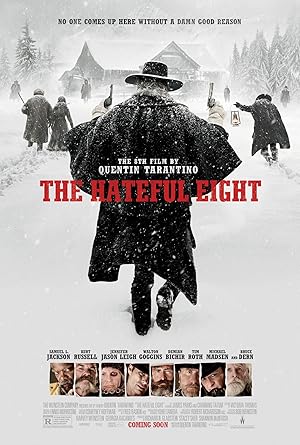
The Hateful Eight
Some time after the Civil War, a stagecoach hurtles through the wintry Wyoming landscape. Bounty hunter John Ruth and his fugitive captive Daisy Domergue race towards the town of Red Rock, where Ruth will bring Daisy to justice. Along the road, they encounter Major Marquis Warren (an infamous bounty hunter) and Chris Mannix (a man who claims to be Red Rock's new sheriff). Lost in a blizzard, the bunch seeks refuge at Minnie's Haberdashery. When they arrive they are greeted by unfamiliar faces: Bob, who claims to be taking care of the place while Minnie is gone; Oswaldo Mobray, the hangman of Red Rock; Joe Gage, a cow puncher; and confederate general Sanford Smithers. As the storm overtakes the mountainside, the eight travelers come to learn that they might not make it to Red Rock after all...
Despite a mid-range budget of $44.0M, The Hateful Eight became a financial success, earning $155.8M worldwide—a 254% return.
1 Oscar. 46 wins & 116 nominations


Plot Structure
Story beats plotted across runtime


Narrative Arc
Emotional journey through the story's key moments
Story Circle
Blueprint 15-beat structure
Arcplot Score Breakdown
Weighted: Precision (70%) + Arc (15%) + Theme (15%)
The Hateful Eight (2015) showcases deliberately positioned dramatic framework, characteristic of Quentin Tarantino's storytelling approach. This structural analysis examines how the film's 15-point plot structure maps to proven narrative frameworks across 3 hours and 8 minutes. With an Arcplot score of 4.1, the film takes an unconventional approach to traditional narrative frameworks.
Characters
Cast & narrative archetypes

Major Marquis Warren
John Ruth
Daisy Domergue
Chris Mannix
Oswaldo Mobray
Joe Gage
General Sanford Smithers
Bob
Main Cast & Characters
Major Marquis Warren
Played by Samuel L. Jackson
A former Union soldier turned bounty hunter carrying three dead bounties and a letter from Abraham Lincoln.
John Ruth
Played by Kurt Russell
A bounty hunter known as "The Hangman" who transports prisoner Daisy Domergue to Red Rock for hanging.
Daisy Domergue
Played by Jennifer Jason Leigh
A vicious criminal being transported to hang in Red Rock, member of the Domergue gang.
Chris Mannix
Played by Walton Goggins
A renegade Confederate militiaman claiming to be the new sheriff of Red Rock.
Oswaldo Mobray
Played by Tim Roth
An Englishman claiming to be the hangman of Red Rock, eloquent and refined in manner.
Joe Gage
Played by Michael Madsen
A quiet cowboy claiming to be visiting his mother for Christmas, keeps to himself at Minnie's.
General Sanford Smithers
Played by Bruce Dern
An elderly former Confederate general traveling to visit his son's grave, filled with bitterness.
Bob
Played by Demián Bichir
A Mexican man claiming to be taking care of Minnie's Haberdashery while she's away.
Structural Analysis
The Status Quo at 2 minutes (1% through the runtime) establishes A wooden crucifix stands frozen in the Wyoming snow as a stagecoach approaches. The image establishes a harsh, unforgiving world where faith and violence coexist, and strangers must rely on each other to survive the coming blizzard.. The analysis reveals that this early placement immediately immerses viewers in the story world.
The inciting incident occurs at 18 minutes when The blizzard intensifies, forcing the stagecoach to abandon its route to Red Rock and seek shelter at Minnie's Haberdashery. The storm becomes an inescapable force that will trap these strangers together, making confrontation inevitable.. At 10% through the film, this Disruption aligns precisely with traditional story structure. This beat shifts the emotional landscape, launching the protagonist into the central conflict.
The First Threshold at 38 minutes marks the transition into Act II, occurring at 20% of the runtime. This demonstrates the protagonist's commitment to The group arrives at Minnie's Haberdashery to find it occupied by strangers—Oswaldo Mobray, Joe Gage, Bob the Mexican, and General Smithers. Warren immediately senses something is wrong: Minnie would never leave a Mexican in charge. He chooses to enter despite his suspicions., moving from reaction to action.
At 76 minutes, the Midpoint arrives at 40% of the runtime—significantly early, compressing the first half. Notably, this crucial beat Warren reveals his Lincoln Letter is fake—he forged it to gain white people's trust. Then he goads General Smithers into drawing on him by describing sexually humiliating and murdering his son. Warren executes Smithers. The false victory of controlling the room becomes a false defeat as he's revealed as a manipulative killer., fundamentally raising what's at risk. The emotional intensity shifts, dividing the narrative into clear before-and-after phases.
The Collapse moment at 113 minutes (60% through) represents the emotional nadir. Here, Jody Domergue shoots Warren from beneath the floorboards. Warren is gut-shot and dying. The hidden gang member emerges, and it's revealed that Bob, Oswaldo, Joe Gage, and Jody have been working together all along. The whiff of death becomes literal as Warren bleeds out., illustrates the protagonist at their lowest point. This beat's placement in the final quarter sets up the climactic reversal.
The Second Threshold at 121 minutes initiates the final act resolution at 64% of the runtime. Mannix, despite being a racist Confederate, chooses to ally with Warren against Daisy's gang. Their shared commitment to frontier justice transcends their hatred. Warren tosses Mannix a gun—the synthesis of enemy soldiers becoming partners in law., demonstrating the transformation achieved throughout the journey.
Emotional Journey
The Hateful Eight's emotional architecture traces a deliberate progression across 15 carefully calibrated beats.
Narrative Framework
This structural analysis employs proven narrative structure principles that track dramatic progression. By mapping The Hateful Eight against these established plot points, we can identify how Quentin Tarantino utilizes or subverts traditional narrative conventions. The plot point approach reveals not only adherence to structural principles but also creative choices that distinguish The Hateful Eight within the crime genre.
Quentin Tarantino's Structural Approach
Among the 11 Quentin Tarantino films analyzed on Arcplot, the average structural score is 4.6, showcasing experimental approaches to narrative form. The Hateful Eight takes a more unconventional approach compared to the director's typical style. For comparative analysis, explore the complete Quentin Tarantino filmography.
Comparative Analysis
Additional crime films include The Bad Guys, Rustom and The Whole Ten Yards. For more Quentin Tarantino analyses, see Kill Bill: The Whole Bloody Affair, Reservoir Dogs and Django Unchained.
Plot Points by Act
Act I
SetupStatus Quo
A wooden crucifix stands frozen in the Wyoming snow as a stagecoach approaches. The image establishes a harsh, unforgiving world where faith and violence coexist, and strangers must rely on each other to survive the coming blizzard.
Theme
John Ruth tells Warren, "When you get to where you're going, you gonna have to make a lot of decisions about who you trust." This establishes the film's central question about trust, identity, and whether anyone can truly be believed in a world of self-interest.
Worldbuilding
Chapter One introduces the post-Civil War landscape through stagecoach encounters. We meet Major Warren with his bounties, learn of John Ruth's paranoid protection of Daisy Domergue, and pick up Chris Mannix claiming to be the new sheriff of Red Rock. Tensions between Union and Confederate ideologies simmer.
Disruption
The blizzard intensifies, forcing the stagecoach to abandon its route to Red Rock and seek shelter at Minnie's Haberdashery. The storm becomes an inescapable force that will trap these strangers together, making confrontation inevitable.
Resistance
The stagecoach travels through the worsening storm as Ruth debates whether to trust Warren and Mannix. Warren's Lincoln Letter becomes a point of contention and bonding. The debate centers on who these men really are and whether their claimed identities can be believed.
Act II
ConfrontationFirst Threshold
The group arrives at Minnie's Haberdashery to find it occupied by strangers—Oswaldo Mobray, Joe Gage, Bob the Mexican, and General Smithers. Warren immediately senses something is wrong: Minnie would never leave a Mexican in charge. He chooses to enter despite his suspicions.
Mirror World
General Sanford Smithers represents the old Confederate order that Warren fought against. Their relationship embodies the film's exploration of racial hatred, justice, and revenge—forcing Warren to confront whether legal justice or personal vengeance defines him.
Premise
The promise of the premise: eight dangerous people trapped together, each with secrets. Warren interrogates the occupants, Ruth guards Daisy obsessively, and alliances shift. The haberdashery becomes a pressure cooker of suspicion as Warren tries to identify who doesn't belong.
Midpoint
Warren reveals his Lincoln Letter is fake—he forged it to gain white people's trust. Then he goads General Smithers into drawing on him by describing sexually humiliating and murdering his son. Warren executes Smithers. The false victory of controlling the room becomes a false defeat as he's revealed as a manipulative killer.
Opposition
Someone has poisoned the coffee. John Ruth and O.B. drink it and die violently. Warren realizes the conspiracy runs deeper than he knew—there are gang members hidden among them. He must identify the poisoner while Daisy's allies prepare to strike. The hunters become the hunted.
Collapse
Jody Domergue shoots Warren from beneath the floorboards. Warren is gut-shot and dying. The hidden gang member emerges, and it's revealed that Bob, Oswaldo, Joe Gage, and Jody have been working together all along. The whiff of death becomes literal as Warren bleeds out.
Crisis
Chapter Five flashes back to show Jody's gang arriving before the stagecoach, murdering Minnie and her people, and setting the trap. Warren and Mannix are dying, outnumbered, and seemingly without hope. The full scope of the deception is revealed.
Act III
ResolutionSecond Threshold
Mannix, despite being a racist Confederate, chooses to ally with Warren against Daisy's gang. Their shared commitment to frontier justice transcends their hatred. Warren tosses Mannix a gun—the synthesis of enemy soldiers becoming partners in law.
Synthesis
Warren and the wounded Mannix systematically eliminate the remaining gang members. Jody is killed under the floorboards. In a standoff, Warren and Mannix take control. They debate Daisy's fate—whether to let her go or hang her for Ruth. They choose to honor Ruth's mission and hang her together.
Transformation
As they bleed to death, the black Union Major and the white Confederate sympathizer read the fake Lincoln Letter together, finding meaning in its fabricated words about equality. Daisy hangs. Two dying enemies share a moment of mutual respect, transformed by their partnership into something approaching brotherhood.