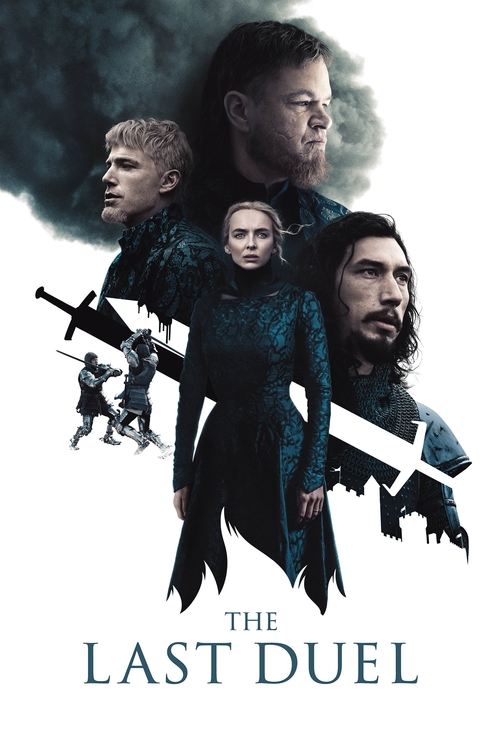
The Last Duel
King Charles VI declares that Knight Jean de Carrouges settle his dispute with his squire, Jacques Le Gris, by challenging him to a duel.
The film commercial failure against its substantial budget of $100.0M, earning $30.6M globally (-69% loss). While initial box office returns were modest, the film has gained appreciation for its fresh perspective within the history genre.
5 wins & 44 nominations


Plot Structure
Story beats plotted across runtime


Narrative Arc
Emotional journey through the story's key moments
Story Circle
Blueprint 15-beat structure
Arcplot Score Breakdown
Weighted: Precision (70%) + Arc (15%) + Theme (15%)
The Last Duel (2021) exemplifies carefully calibrated story structure, characteristic of Ridley Scott's storytelling approach. This structural analysis examines how the film's 15-point plot structure maps to proven narrative frameworks across 2 hours and 33 minutes. With an Arcplot score of 6.6, the film balances conventional beats with creative variation.
Structural Analysis
The Status Quo at 2 minutes (1% through the runtime) establishes Jean de Carrouges prepares for the duel at dawn, armored and solemn. He exists in a world of rigid honor codes, loyal service, and unfulfilled ambition as a knight in 14th-century France.. Structural examination shows that this early placement immediately immerses viewers in the story world.
The inciting incident occurs at 19 minutes when Carrouges is denied land he believes is rightfully his when Count Pierre awards the disputed estate of Aunou-le-Faucon to Jacques Le Gris instead. This betrayal fractures the friendship and ignites Carrouges' sense of injustice.. At 13% through the film, this Disruption is delayed, allowing extended setup of the story world. This beat shifts the emotional landscape, launching the protagonist into the central conflict.
The First Threshold at 38 minutes marks the transition into Act II, occurring at 25% of the runtime. This indicates the protagonist's commitment to Marguerite accuses Jacques Le Gris of raping her while Carrouges was away. Carrouges chooses to believe her and pursue justice through legal channels, entering a new world of accusation and mortal stakes., moving from reaction to action.
At 77 minutes, the Midpoint arrives at 50% of the runtime—precisely centered, creating perfect narrative symmetry. Structural examination shows that this crucial beat The narrative shifts to "The Truth According to Marguerite," the definitive perspective. Her voice centers the story, revealing the misogyny she endures and the reality of her assault. The stakes crystallize: her life depends on the duel's outcome., fundamentally raising what's at risk. The emotional intensity shifts, dividing the narrative into clear before-and-after phases.
The Collapse moment at 115 minutes (75% through) represents the emotional nadir. Here, King Charles VI decrees the trial by combat. If Carrouges loses, Marguerite will be burned at the stake for false accusation. Her life is utterly in the hands of men fighting for their own honor, not her justice., indicates the protagonist at their lowest point. This beat's placement in the final quarter sets up the climactic reversal.
The Second Threshold at 122 minutes initiates the final act resolution at 80% of the runtime. The duel begins. Carrouges and Le Gris enter the lists. This is the final threshold—combat will determine whose "truth" prevails, though only Marguerite's truth is real. Resolution through violence begins., demonstrating the transformation achieved throughout the journey.
Emotional Journey
The Last Duel's emotional architecture traces a deliberate progression across 15 carefully calibrated beats.
Narrative Framework
This structural analysis employs a 15-point narrative structure framework that maps key story moments. By mapping The Last Duel against these established plot points, we can identify how Ridley Scott utilizes or subverts traditional narrative conventions. The plot point approach reveals not only adherence to structural principles but also creative choices that distinguish The Last Duel within the history genre.
Ridley Scott's Structural Approach
Among the 24 Ridley Scott films analyzed on Arcplot, the average structural score is 6.5, demonstrating varied approaches to story architecture. The Last Duel represents one of the director's most structurally precise works. For comparative analysis, explore the complete Ridley Scott filmography.
Comparative Analysis
Additional history films include The Attacks Of 26/11, Joyeux Noel and Rob Roy. For more Ridley Scott analyses, see Alien, White Squall and American Gangster.
Plot Points by Act
Act I
SetupStatus Quo
Jean de Carrouges prepares for the duel at dawn, armored and solemn. He exists in a world of rigid honor codes, loyal service, and unfulfilled ambition as a knight in 14th-century France.
Theme
Count Pierre d'Alençon remarks on the nature of truth and perspective: "The truth is what we make it." This establishes the film's central thematic question about conflicting truths and subjective reality.
Worldbuilding
The first chapter ("The Truth According to Jean de Carrouges") establishes the medieval world: Carrouges' military service, his friendship with Jacques Le Gris, the political dynamics of the court, and his financial struggles despite battlefield valor.
Disruption
Carrouges is denied land he believes is rightfully his when Count Pierre awards the disputed estate of Aunou-le-Faucon to Jacques Le Gris instead. This betrayal fractures the friendship and ignites Carrouges' sense of injustice.
Resistance
Carrouges navigates his resentment and financial troubles. He marries Marguerite de Thibouville for her dowry. Meanwhile, Le Gris rises in Count Pierre's favor. Tension builds as Carrouges feels increasingly marginalized and dishonored.
Act II
ConfrontationFirst Threshold
Marguerite accuses Jacques Le Gris of raping her while Carrouges was away. Carrouges chooses to believe her and pursue justice through legal channels, entering a new world of accusation and mortal stakes.
Mirror World
The narrative shifts to "The Truth According to Jacques Le Gris," revealing his perspective. His relationship with Count Pierre and his own interpretation of events introduce a thematic mirror: whose truth matters?
Premise
The film explores the same events through Le Gris' eyes: his advancement at court, his infatuation with Marguerite, and his version of the encounter—portrayed as consensual. The premise of conflicting perspectives unfolds fully.
Midpoint
The narrative shifts to "The Truth According to Marguerite," the definitive perspective. Her voice centers the story, revealing the misogyny she endures and the reality of her assault. The stakes crystallize: her life depends on the duel's outcome.
Opposition
Marguerite's chapter reveals systemic opposition: the Church dismisses her claim, the court doubts her, and even Carrouges' mother questions her. Legal appeals fail. The duel becomes inevitable as institutional forces close in against her.
Collapse
King Charles VI decrees the trial by combat. If Carrouges loses, Marguerite will be burned at the stake for false accusation. Her life is utterly in the hands of men fighting for their own honor, not her justice.
Crisis
The night before the duel. Marguerite prays alone, fully aware she may die regardless of the truth. Carrouges prepares grimly. The emotional weight of patriarchal injustice and mortal danger settles over all.
Act III
ResolutionSecond Threshold
The duel begins. Carrouges and Le Gris enter the lists. This is the final threshold—combat will determine whose "truth" prevails, though only Marguerite's truth is real. Resolution through violence begins.
Synthesis
The brutal duel unfolds in excruciating detail. Both men are wounded grievously. In the climax, Carrouges overcomes Le Gris and kills him. The crowd erupts. Marguerite is vindicated by violence, not by belief in her word.
Transformation
Marguerite stands in the aftermath, her expression unreadable. She has survived, but the cost is immense. An epilogue reveals she lived years longer; Le Gris' estates were forfeit. She endured, but the system remained unchanged.