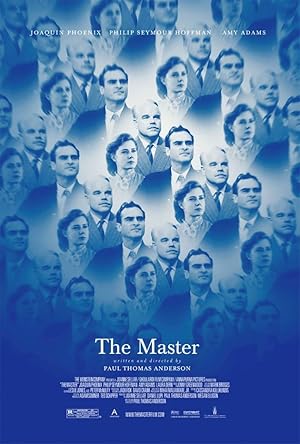
The Master
Following his discharge from the US Navy after WWII, Freddie Quell is having difficulties adjusting to non-military life partly due to his war experiences in the tropics. He has a violent temper. He is obsessed with sex, which is partly why he can't and won't commit to his teenaged girlfriend, Doris Solstad. And he is an alcoholic, drinking primarily concoctions he creates himself with dangerous ingredients. It is these factors in combination that lead to him being fired from one job after another, from department store portrait photographer to cabbage picker. Wandering one night in 1950 while drunk, he stumbles upon a yacht being used by Lancaster and Peggy Dodd, the yacht aboard which their daughter Elizabeth will get married. Feeling a connection to the stranger, Lancaster invites Freddie to stay aboard to work. In addition to that work, Lancaster indoctrinates him into his cult, named the Cause, which purports to do things as varied as cure serious maladies and create world peace. Peggy, Elizabeth and Elizabeth's husband Clark all subscribe to and support Lancaster's teachings. The only one of the Dodd family that doesn't is Lancaster and Peggy's son, Val Dodd, who believes his father is just making things up as he goes along. Because of being lost psychologically, Freddie is easy prey, he who is looking for something or someone to guide him to a higher plane. But as Freddie travels with the Dodd family as they spout the gospel, he and the Dodds may become at odds with each other if Freddie cannot or does not find from them and the Cause what he needs in life to survive emotionally.
The film struggled financially against its moderate budget of $32.0M, earning $28.3M globally (-12% loss).
Nominated for 3 Oscars. 75 wins & 187 nominations


Plot Structure
Story beats plotted across runtime


Narrative Arc
Emotional journey through the story's key moments
Story Circle
Blueprint 15-beat structure
Arcplot Score Breakdown
Weighted: Precision (70%) + Arc (15%) + Theme (15%)
The Master (2012) showcases deliberately positioned plot construction, characteristic of Paul Thomas Anderson's storytelling approach. This structural analysis examines how the film's 15-point plot structure maps to proven narrative frameworks across 2 hours and 17 minutes. With an Arcplot score of 6.8, the film balances conventional beats with creative variation.
Structural Analysis
The Status Quo at 1 minutes (1% through the runtime) establishes Freddie Quell lies alone on a beach during WWII, a broken and animalistic man mixing torpedo fuel into drinks, establishing his status as damaged, isolated, and self-destructive.. Of particular interest, this early placement immediately immerses viewers in the story world.
The inciting incident occurs at 16 minutes when After poisoning a fellow worker with his homemade alcohol (possibly killing him), Freddie flees in panic and terror, forcing him to abandon his itinerant existence and setting him adrift with nowhere to go.. At 12% through the film, this Disruption aligns precisely with traditional story structure. This beat shifts the emotional landscape, launching the protagonist into the central conflict.
The First Threshold at 33 minutes marks the transition into Act II, occurring at 24% of the runtime. This shows the protagonist's commitment to Freddie actively chooses to stay with Dodd and The Cause, accepting his role as Dodd's "protégé" and guinea pig. He commits to the journey of potential transformation, leaving behind his aimless drifting for devotion to the Master., moving from reaction to action.
At 70 minutes, the Midpoint arrives at 51% of the runtime—precisely centered, creating perfect narrative symmetry. Of particular interest, this crucial beat Dodd is arrested and both men are jailed. In adjacent cells, Freddie explodes in violent rage, destroying the toilet while Dodd remains calm. The false promise of transformation shatters - Freddie hasn't been cured, and the difference between them becomes starkly visible., fundamentally raising what's at risk. The emotional intensity shifts, dividing the narrative into clear before-and-after phases.
The Collapse moment at 102 minutes (75% through) represents the emotional nadir. Here, Freddie leaves The Cause and travels back to find Doris, his teenage love from before the war. He discovers she married someone else years ago, has children, and barely remembers him. His idealized past - the thing he thought he was broken over - is revealed as an illusion that never existed., demonstrates the protagonist at their lowest point. This beat's placement in the final quarter sets up the climactic reversal.
The Second Threshold at 110 minutes initiates the final act resolution at 80% of the runtime. Freddie chooses to visit Dodd one final time in England, not to rejoin The Cause, but to confront the truth of their relationship and say goodbye. He sees clearly now: Dodd cannot fix him, and Dodd needs Freddie as much as Freddie needed him., demonstrating the transformation achieved throughout the journey.
Emotional Journey
The Master's emotional architecture traces a deliberate progression across 15 carefully calibrated beats.
Narrative Framework
This structural analysis employs proven narrative structure principles that track dramatic progression. By mapping The Master against these established plot points, we can identify how Paul Thomas Anderson utilizes or subverts traditional narrative conventions. The plot point approach reveals not only adherence to structural principles but also creative choices that distinguish The Master within the drama genre.
Paul Thomas Anderson's Structural Approach
Among the 8 Paul Thomas Anderson films analyzed on Arcplot, the average structural score is 6.6, demonstrating varied approaches to story architecture. The Master represents one of the director's most structurally precise works. For comparative analysis, explore the complete Paul Thomas Anderson filmography.
Comparative Analysis
Additional drama films include After Thomas, South Pacific and Dirty Dancing: Havana Nights. For more Paul Thomas Anderson analyses, see Magnolia, Phantom Thread and Licorice Pizza.
Plot Points by Act
Act I
SetupStatus Quo
Freddie Quell lies alone on a beach during WWII, a broken and animalistic man mixing torpedo fuel into drinks, establishing his status as damaged, isolated, and self-destructive.
Theme
At the VA hospital, a doctor asks Freddie about his relationship with his mother, probing whether he can be "fixed" through processing - the central question of whether damaged souls can be cured or must accept their nature.
Worldbuilding
Post-war America, 1950. Freddie drifts through failed jobs as a department store photographer and migrant farm worker, compulsively mixing toxic alcohol concoctions, violent and unable to integrate into civilian life, haunted by memories of Doris, a girl he left behind.
Disruption
After poisoning a fellow worker with his homemade alcohol (possibly killing him), Freddie flees in panic and terror, forcing him to abandon his itinerant existence and setting him adrift with nowhere to go.
Resistance
Freddie stows away on a yacht hosting Lancaster Dodd's party. The morning after, Dodd discovers him and becomes fascinated rather than angry. Dodd introduces "The Cause," his philosophical movement, and begins informal "processing" sessions, testing whether Freddie can be helped.
Act II
ConfrontationFirst Threshold
Freddie actively chooses to stay with Dodd and The Cause, accepting his role as Dodd's "protégé" and guinea pig. He commits to the journey of potential transformation, leaving behind his aimless drifting for devotion to the Master.
Mirror World
Dodd's wife Peggy emerges as a force of control, privately manipulating Dodd while maintaining his authority. She represents the rigid structure and doctrine that contrasts with Freddie's chaos, embodying the question of whether control or acceptance is the path to peace.
Premise
Freddie undergoes intensive "processing" exercises with Dodd - walking between window and wall, answering rapid-fire questions without blinking. He becomes Dodd's enforcer and companion, traveling with The Cause, experiencing both the promise of cure and the reality that his violence and impulses remain unchanged.
Midpoint
Dodd is arrested and both men are jailed. In adjacent cells, Freddie explodes in violent rage, destroying the toilet while Dodd remains calm. The false promise of transformation shatters - Freddie hasn't been cured, and the difference between them becomes starkly visible.
Opposition
Tensions rise as Dodd's son and others in The Cause question his methods and Freddie's place. Dodd releases a new book with increasingly fantastical claims about past lives. A follower scientifically challenges Dodd at a party, and Freddie violently attacks him, showing The Cause's foundation is faith, not truth, and Freddie's violence serves to protect Dodd's delusion.
Collapse
Freddie leaves The Cause and travels back to find Doris, his teenage love from before the war. He discovers she married someone else years ago, has children, and barely remembers him. His idealized past - the thing he thought he was broken over - is revealed as an illusion that never existed.
Crisis
Freddie wanders alone in a movie theater, watching a film. Dodd calls him on the phone, singing to him, inviting him back to England. Freddie must decide: return to the false promise of cure, or accept his nature and move forward alone.
Act III
ResolutionSecond Threshold
Freddie chooses to visit Dodd one final time in England, not to rejoin The Cause, but to confront the truth of their relationship and say goodbye. He sees clearly now: Dodd cannot fix him, and Dodd needs Freddie as much as Freddie needed him.
Synthesis
In England, Freddie and Dodd share a final conversation. Dodd offers him one last chance: stay, or "be my enemy." Freddie recognizes the manipulation and control beneath the love. He sings Dodd the crude song "I'd Like to Get You on a Slow Boat to China," asserting his own crude nature. They say goodbye as equals.
Transformation
Freddie lies on a beach with a woman, mirroring the opening image. But now he's not alone in isolation - he's chosen connection on his own terms, accepting himself as he is rather than seeking to be cured or controlled. He rests his head on her, finally at peace with his nature.