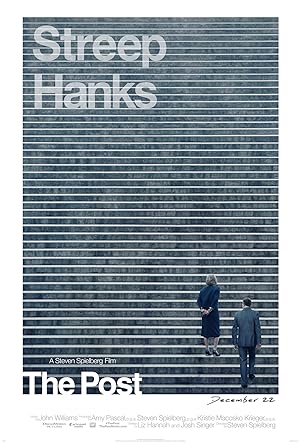
The Post
When American military analyst, Daniel Ellsberg, realizes to his disgust the depths of the US government's deceptions about the futility of the Vietnam War, he takes action by copying top-secret documents that would become the Pentagon Papers. Later, Washington Post owner, Kay Graham, is still adjusting to taking over her late husband's business when editor Ben Bradlee discovers the New York Times has scooped them with an explosive expose on those papers. Determined to compete, Post reporters find Ellsberg himself and a complete copy of those papers. However, the Post's plans to publish their findings are put in jeopardy with a Federal restraining order that could get them all indicted for Contempt. Now, Kay Graham must decide whether to back down for the safety of her paper or publish and fight for the Freedom of the Press. In doing so, Graham and her staff join a fight that would have America's democratic ideals in the balance.
Despite a mid-range budget of $50.0M, The Post became a financial success, earning $179.8M worldwide—a 260% return.
Nominated for 2 Oscars. 21 wins & 116 nominations


Plot Structure
Story beats plotted across runtime


Narrative Arc
Emotional journey through the story's key moments
Story Circle
Blueprint 15-beat structure
Arcplot Score Breakdown
Weighted: Precision (70%) + Arc (15%) + Theme (15%)
The Post (2017) demonstrates deliberately positioned plot construction, characteristic of Steven Spielberg's storytelling approach. This structural analysis examines how the film's 15-point plot structure maps to proven narrative frameworks across 1 hour and 56 minutes. With an Arcplot score of 4.6, the film takes an unconventional approach to traditional narrative frameworks.
Structural Analysis
The Status Quo at 1 minutes (1% through the runtime) establishes Vietnam 1966: Daniel Ellsberg accompanies troops into combat, then reports optimistically to Secretary McNamara, who privately admits the war is unwinnable. This establishes the fundamental lie at the heart of the story.. The analysis reveals that this early placement immediately immerses viewers in the story world.
The inciting incident occurs at 12 minutes when The New York Times publishes excerpts from the Pentagon Papers. Bradlee is devastated that the Times got the scoop, but this event sets everything in motion—the biggest story of the decade is now in play.. At 11% through the film, this Disruption aligns precisely with traditional story structure. This beat shifts the emotional landscape, launching the protagonist into the central conflict.
The First Threshold at 26 minutes marks the transition into Act II, occurring at 22% of the runtime. This demonstrates the protagonist's commitment to Ben Bagdikian tracks down Daniel Ellsberg and obtains copies of the Pentagon Papers for The Washington Post. The Post now possesses the classified documents—there is no going back., moving from reaction to action.
At 52 minutes, the Midpoint arrives at 45% of the runtime—arriving early, accelerating into Act IIb complications. Notably, this crucial beat The Post's lawyers advise against publishing, warning that printing classified documents could result in criminal prosecution and destroy the company. The stakes crystallize: this isn't just about journalism, it's about survival., fundamentally raising what's at risk. The emotional intensity shifts, dividing the narrative into clear before-and-after phases.
The Collapse moment at 78 minutes (67% through) represents the emotional nadir. Here, With the presses ready to roll, Kay must make the final call. Fritz Beebe and the board urge her not to publish. The weight of her late husband's legacy, the company's future, and potential imprisonment all converge in this moment of maximum pressure., illustrates the protagonist at their lowest point. This beat's placement in the final quarter sets up the climactic reversal.
The Second Threshold at 83 minutes initiates the final act resolution at 72% of the runtime. Kay declares, "Let's go. Let's publish." She has found her voice, choosing to serve the governed over the governors, press freedom over personal safety. The presses begin to roll., demonstrating the transformation achieved throughout the journey.
Emotional Journey
The Post's emotional architecture traces a deliberate progression across 15 carefully calibrated beats.
Narrative Framework
This structural analysis employs systematic plot point analysis that identifies crucial turning points. By mapping The Post against these established plot points, we can identify how Steven Spielberg utilizes or subverts traditional narrative conventions. The plot point approach reveals not only adherence to structural principles but also creative choices that distinguish The Post within the biography genre.
Steven Spielberg's Structural Approach
Among the 33 Steven Spielberg films analyzed on Arcplot, the average structural score is 5.8, showcasing experimental approaches to narrative form. The Post takes a more unconventional approach compared to the director's typical style. For comparative analysis, explore the complete Steven Spielberg filmography.
Comparative Analysis
Additional biography films include After Thomas, Taking Woodstock and The Fire Inside. For more Steven Spielberg analyses, see The Adventures of Tintin, Close Encounters of the Third Kind and War Horse.
Plot Points by Act
Act I
SetupStatus Quo
Vietnam 1966: Daniel Ellsberg accompanies troops into combat, then reports optimistically to Secretary McNamara, who privately admits the war is unwinnable. This establishes the fundamental lie at the heart of the story.
Theme
Kay Graham nervously prepares for a board meeting, surrounded by men who speak over her. The theme is established through her visible discomfort: women in power must fight to be heard, and institutions resist truth-telling.
Worldbuilding
We meet Kay Graham struggling with the IPO of The Washington Post, Ben Bradlee frustrated that the Post is considered second-tier to The New York Times, and the newsroom culture of 1971 America where newspapers compete for scoops and respect.
Disruption
The New York Times publishes excerpts from the Pentagon Papers. Bradlee is devastated that the Times got the scoop, but this event sets everything in motion—the biggest story of the decade is now in play.
Resistance
The Nixon administration obtains a federal injunction against the Times. Bradlee sees an opportunity and pushes to get the Pentagon Papers for the Post. Kay navigates the IPO process while the newsroom debates whether to pursue the dangerous story.
Act II
ConfrontationFirst Threshold
Ben Bagdikian tracks down Daniel Ellsberg and obtains copies of the Pentagon Papers for The Washington Post. The Post now possesses the classified documents—there is no going back.
Mirror World
Kay's relationship with her late husband's legacy and her friendship with Robert McNamara is revealed. She must choose between personal loyalty to powerful friends and her duty as a publisher—the thematic heart of her journey.
Premise
The newsroom springs into action. Reporters spread thousands of pages across Bradlee's home, racing against time to verify and organize the documents. The energy is electric as journalists do what they do best—pursue the truth.
Midpoint
The Post's lawyers advise against publishing, warning that printing classified documents could result in criminal prosecution and destroy the company. The stakes crystallize: this isn't just about journalism, it's about survival.
Opposition
Intense pressure mounts from all sides. Board members threaten to pull the IPO. Lawyers warn of prison. Nixon's administration looms as a threat. Kay is caught between her business advisors demanding caution and Bradlee demanding courage.
Collapse
With the presses ready to roll, Kay must make the final call. Fritz Beebe and the board urge her not to publish. The weight of her late husband's legacy, the company's future, and potential imprisonment all converge in this moment of maximum pressure.
Crisis
Kay stands alone with the phone, everyone waiting. She reflects on everything at stake—her family's newspaper, the employees who depend on her, her own freedom. The silence stretches as she wrestles with the most consequential decision of her life.
Act III
ResolutionSecond Threshold
Kay declares, "Let's go. Let's publish." She has found her voice, choosing to serve the governed over the governors, press freedom over personal safety. The presses begin to roll.
Synthesis
The Post publishes and the government seeks an injunction. The case goes to the Supreme Court. In a 6-3 decision, the Court rules in favor of the press. The First Amendment prevails, and Kay Graham emerges as a true leader.
Transformation
Kay walks down the Supreme Court steps through a crowd of admiring women. She has transformed from a hesitant inheritor of power to a decisive leader who changed history. The film ends with a security guard discovering the Watergate break-in—the next chapter begins.