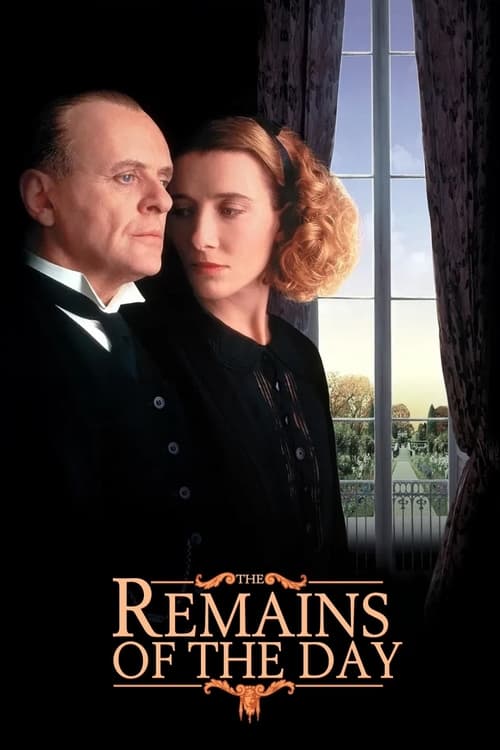
The Remains of the Day
A rule-bound head butler's world of manners and decorum in the household he maintains is tested by the arrival of a housekeeper who falls in love with him in post-WWI Britain. The possibility of romance and his master's cultivation of ties with the Nazi cause challenge his carefully maintained veneer of servitude.
Despite its small-scale budget of $11.5M, The Remains of the Day became a box office success, earning $23.2M worldwide—a 102% return.
Nominated for 8 Oscars. 17 wins & 42 nominations


Plot Structure
Story beats plotted across runtime


Narrative Arc
Emotional journey through the story's key moments
Story Circle
Blueprint 15-beat structure
Arcplot Score Breakdown
Weighted: Precision (70%) + Arc (15%) + Theme (15%)
The Remains of the Day (1993) reveals carefully calibrated story structure, characteristic of James Ivory's storytelling approach. This structural analysis examines how the film's 15-point plot structure maps to proven narrative frameworks across 2 hours and 14 minutes. With an Arcplot score of 6.9, the film balances conventional beats with creative variation.
Structural Analysis
The Status Quo at 1 minutes (1% through the runtime) establishes Stevens, now serving American Congressman Lewis at Darlington Hall in 1958, moves through the empty, sheet-covered rooms alone. The grandeur is faded, the staff reduced to one. His isolation and devotion to duty define his diminished world.. Structural examination shows that this early placement immediately immerses viewers in the story world.
The inciting incident occurs at 16 minutes when Stevens receives a letter from Miss Kenton, now Mrs. Benn, after twenty years. Her marriage appears troubled, and she hints at returning to service. This letter disrupts Stevens' carefully ordered existence and awakens buried feelings he has long suppressed.. At 12% through the film, this Disruption aligns precisely with traditional story structure. This beat shifts the emotional landscape, launching the protagonist into the central conflict.
The First Threshold at 34 minutes marks the transition into Act II, occurring at 25% of the runtime. This reveals the protagonist's commitment to Stevens sets out on his motoring journey to visit Miss Kenton. For the first time, he leaves Darlington Hall not on duty but on a personal errand—though he cannot admit this to himself. He crosses into unfamiliar territory, both geographically and emotionally., moving from reaction to action.
At 67 minutes, the Midpoint arrives at 50% of the runtime—precisely centered, creating perfect narrative symmetry. Notably, this crucial beat Stevens' father collapses and dies while Stevens continues serving at Lord Darlington's crucial political dinner. Miss Kenton finds Stevens and tells him his father is dying. Stevens' response—"I'm very busy right now"—and his return to serving guests while his father dies alone upstairs represents his tragic choice of duty over humanity. False victory in professionalism, true defeat in human connection., fundamentally raising what's at risk. The emotional intensity shifts, dividing the narrative into clear before-and-after phases.
The Collapse moment at 101 minutes (75% through) represents the emotional nadir. Here, The pivotal flashback: Miss Kenton tells Stevens she is engaged. She comes to his pantry that evening, and they share an agonizing scene where she nearly breaks through his defenses. She asks what he's reading, tries to take his book, and for one moment physical and emotional intimacy seems possible—but Stevens pulls away. She leaves, weeping. The chance for love dies., demonstrates the protagonist at their lowest point. This beat's placement in the final quarter sets up the climactic reversal.
The Second Threshold at 107 minutes initiates the final act resolution at 80% of the runtime. Stevens arrives at the seaside town where Miss Kenton lives. He finally acknowledges to himself—and will soon acknowledge to her—that his journey is not about staffing but about seeing her again. He prepares to meet her, crossing into the final act where truth must be spoken., demonstrating the transformation achieved throughout the journey.
Emotional Journey
The Remains of the Day's emotional architecture traces a deliberate progression across 15 carefully calibrated beats.
Narrative Framework
This structural analysis employs a 15-point narrative structure framework that maps key story moments. By mapping The Remains of the Day against these established plot points, we can identify how James Ivory utilizes or subverts traditional narrative conventions. The plot point approach reveals not only adherence to structural principles but also creative choices that distinguish The Remains of the Day within the drama genre.
James Ivory's Structural Approach
Among the 4 James Ivory films analyzed on Arcplot, the average structural score is 7.1, reflecting strong command of classical structure. The Remains of the Day takes a more unconventional approach compared to the director's typical style. For comparative analysis, explore the complete James Ivory filmography.
Comparative Analysis
Additional drama films include After Thomas, South Pacific and Dirty Dancing: Havana Nights. For more James Ivory analyses, see A Room with a View, Le Divorce and Howards End.
Plot Points by Act
Act I
SetupStatus Quo
Stevens, now serving American Congressman Lewis at Darlington Hall in 1958, moves through the empty, sheet-covered rooms alone. The grandeur is faded, the staff reduced to one. His isolation and devotion to duty define his diminished world.
Theme
Congressman Lewis tells Stevens he should take a motoring trip: "You ought to get out, see the country, meet people. A man can't be cooped up his whole life." This casual observation speaks to Stevens' emotional imprisonment and the life unlived.
Worldbuilding
The present-day world of 1958 is established alongside flashbacks to the 1930s golden era of Darlington Hall. We see Stevens' philosophy of butlering, his relationship with his aging father, and the arrival of Miss Kenton as the new housekeeper. The contrast between the grand past and diminished present frames the story.
Disruption
Stevens receives a letter from Miss Kenton, now Mrs. Benn, after twenty years. Her marriage appears troubled, and she hints at returning to service. This letter disrupts Stevens' carefully ordered existence and awakens buried feelings he has long suppressed.
Resistance
Stevens debates whether to visit Miss Kenton, rationalizing the trip as a staffing solution. Flashbacks reveal their early professional relationship—her warmth against his formality. His father's presence as under-butler shows Stevens the model of dignity through repression he has adopted.
Act II
ConfrontationFirst Threshold
Stevens sets out on his motoring journey to visit Miss Kenton. For the first time, he leaves Darlington Hall not on duty but on a personal errand—though he cannot admit this to himself. He crosses into unfamiliar territory, both geographically and emotionally.
Mirror World
Extended flashback to Stevens and Miss Kenton's deepening relationship at Darlington Hall. She brings flowers to his pantry, challenges his coldness, and tries to draw out his humanity. Their scenes together represent the emotional life—connection, warmth, even love—that Stevens systematically denies himself.
Premise
The dual narrative unfolds: Stevens' present journey through the English countryside, meeting ordinary people who challenge his rigid worldview, paralleled with flashbacks showing his relationship with Miss Kenton intensifying. We see Lord Darlington's political activities, the growing tension between duty and feeling, and Miss Kenton's increasing frustration with Stevens' emotional walls.
Midpoint
Stevens' father collapses and dies while Stevens continues serving at Lord Darlington's crucial political dinner. Miss Kenton finds Stevens and tells him his father is dying. Stevens' response—"I'm very busy right now"—and his return to serving guests while his father dies alone upstairs represents his tragic choice of duty over humanity. False victory in professionalism, true defeat in human connection.
Opposition
The consequences of Stevens' choices mount. Lord Darlington's Nazi appeasement is revealed as catastrophic misjudgment. Miss Kenton, hurt by Stevens' continued emotional rejection, accepts a marriage proposal from another man. Stevens' rigid loyalty to Darlington and his inability to express his feelings for Miss Kenton converge toward disaster. In the present, Stevens struggles to connect with people he meets on his journey.
Collapse
The pivotal flashback: Miss Kenton tells Stevens she is engaged. She comes to his pantry that evening, and they share an agonizing scene where she nearly breaks through his defenses. She asks what he's reading, tries to take his book, and for one moment physical and emotional intimacy seems possible—but Stevens pulls away. She leaves, weeping. The chance for love dies.
Crisis
Stevens processes the memory of losing Miss Kenton while continuing his journey. The present-day scenes show him alone in a guesthouse, surrounded by ordinary people living ordinary emotional lives. Lord Darlington's disgrace and death are revealed—the man Stevens sacrificed everything to serve has left nothing but shame. Stevens must confront what his life of service has actually meant.
Act III
ResolutionSecond Threshold
Stevens arrives at the seaside town where Miss Kenton lives. He finally acknowledges to himself—and will soon acknowledge to her—that his journey is not about staffing but about seeing her again. He prepares to meet her, crossing into the final act where truth must be spoken.
Synthesis
Stevens and Miss Kenton reunite at a tearoom. Their conversation is painfully restrained yet charged with decades of unspoken feeling. She admits her marriage has been difficult, that she sometimes wonders what life might have been. Stevens nearly speaks his heart but cannot. She reveals she is to be a grandmother—her life has moved on. They part at the bus stop in the rain, and Stevens finally admits, "My heart is breaking."
Transformation
Stevens returns to Darlington Hall. He releases a pigeon that has become trapped, then sets about learning the American custom of "banter" to better serve his new master. His transformation is tragic: he recognizes what he has lost but chooses to continue his life of service. The final image mirrors the first—Stevens alone at Darlington Hall—but now weighted with conscious awareness of his sacrifice.