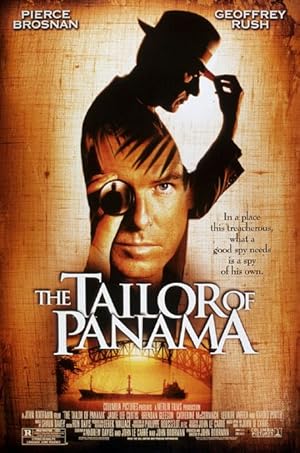
The Tailor of Panama
Women have been MI.6. agent Andy Osnard's weakness. As punishment for being caught sleeping with the wrong woman on his last posting in Spain, Andy is relegated to the global backwater of Panama as his next field assignment. Although nothing is happening there on the surface, Panama is still seen as having global importance due to the canal, with something always possible to rock the boat as seen by the recent history of the corrupt regime of Manuel Noriega. The advice of his superior is to co-opt one of the only few hundred British nationals living there to act as an informant for pay. Who Andy chooses is Harry Pendel, a men's suits tailor with Savile Row credentials through his now deceased business partner Arthur Braithwaite. This choice is because of Harry's client list, he the tailor to the elite and powerful, including the Panamanian president, who may treat him like the proverbial "bartender" or "hairdresser" confidante, and because his American wife, Louisa, works in a senior managerial position within the canal authority. But what may have swayed Andy's choice the most is that he knows the truth about Harry: that he not only does not have Savile Row credentials, but is an ex-con, Arthur Braithwaite was his Uncle Benny, also a criminal, and that despite his tailor shop doing good business, he is deep in debt from a farming venture gone wrong, none of this about which Louisa knows. As such, Harry has no choice but to cooperate, the payment from Andy which at least gets him out of his farm debt. As a side, Harry also has some connections to people who actively worked in the opposition against Noriega: Mickie Abraxas, who has turned to the bottle to cope, and Harry's store manager Marta, the right side of her face which shows the physical scars of that war, the scars at the hands of Noriega's men. With Andy placing more and more pressure on Harry to provide intel of some importance, Andy eventually learns through Harry that the Panamanian government is planning on selling the canal to the Chinese. This intel is exactly what Andy was looking for to set in motion a plan to reach his ultimate goal with this Panamanian posting.
Working with a moderate budget of $21.0M, the film achieved a modest success with $28.0M in global revenue (+33% profit margin).
1 win & 1 nomination


Plot Structure
Story beats plotted across runtime


Narrative Arc
Emotional journey through the story's key moments
Story Circle
Blueprint 15-beat structure
Arcplot Score Breakdown
Weighted: Precision (70%) + Arc (15%) + Theme (15%)
The Tailor of Panama (2001) exhibits meticulously timed narrative design, characteristic of John Boorman's storytelling approach. This structural analysis examines how the film's 15-point plot structure maps to proven narrative frameworks across 1 hour and 49 minutes. With an Arcplot score of 7.4, the film balances conventional beats with creative variation.
Characters
Cast & narrative archetypes

Harry Pendel
Andrew Osnard
Louisa Pendel
Mickie Abraxas
Francesca Deane
Luxmore
Main Cast & Characters
Harry Pendel
Played by Geoffrey Rush
A charming tailor in Panama with a fabricated past who becomes entangled in espionage through his elaborate lies and fantasies.
Andrew Osnard
Played by Pierce Brosnan
A disgraced British spy sent to Panama who manipulates the tailor into creating intelligence fiction for personal profit.
Louisa Pendel
Played by Jamie Lee Curtis
Harry's American wife who works for the Panama Canal Authority, unaware of her husband's deceptions and spy entanglements.
Mickie Abraxas
Played by Brendan Gleeson
Harry's idealistic former revolutionary friend who becomes an unwitting player in the fabricated spy narrative.
Francesca Deane
Played by Catherine McCormack
A beautiful and intelligent administrator at the Canal Authority who becomes romantically involved with Osnard.
Luxmore
Played by Harold Pinter
Osnard's cynical and manipulative MI6 handler in London who encourages the escalating deceptions.
Structural Analysis
The Status Quo at 1 minutes (1% through the runtime) establishes Harry Pendel operates his successful tailoring business in Panama, living a seemingly comfortable life with his wife Louisa and their children, though hints of his fabricated past linger beneath the surface.. The analysis reveals that this early placement immediately immerses viewers in the story world.
The inciting incident occurs at 14 minutes when Osnard pressures Harry into becoming an informant by discovering his criminal past (prison time for arson) and threatening to expose him to Louisa, who believes Harry inherited the tailoring business from a prestigious uncle.. At 12% through the film, this Disruption aligns precisely with traditional story structure. This beat shifts the emotional landscape, launching the protagonist into the central conflict.
The First Threshold at 27 minutes marks the transition into Act II, occurring at 25% of the runtime. This indicates the protagonist's commitment to Harry makes the active choice to fully engage in the deception, inventing a fictional resistance group called "The Silent Opposition" led by Mickie Abraxas, transforming from reluctant informant to active fabricator of intelligence., moving from reaction to action.
At 55 minutes, the Midpoint arrives at 50% of the runtime—precisely centered, creating perfect narrative symmetry. Significantly, this crucial beat London fully believes Harry's fabrications and begins planning real military action based on the false intelligence. What seemed like a harmless con for money becomes dangerously real, with stakes escalating beyond Harry's control., fundamentally raising what's at risk. The emotional intensity shifts, dividing the narrative into clear before-and-after phases.
The Collapse moment at 82 minutes (75% through) represents the emotional nadir. Here, Mickie Abraxas is killed, a direct consequence of Harry's lies and the attention they've drawn. Harry's best friend dies because of the fictional resistance movement Harry invented, representing the death of Harry's innocence and the ultimate price of his deception., reveals the protagonist at their lowest point. This beat's placement in the final quarter sets up the climactic reversal.
The Second Threshold at 88 minutes initiates the final act resolution at 80% of the runtime. Harry realizes he must expose the truth to prevent further catastrophe. He decides to reveal to the Americans that all the intelligence was fabricated, accepting the consequences of his actions rather than letting the lies continue to cause harm., demonstrating the transformation achieved throughout the journey.
Emotional Journey
The Tailor of Panama's emotional architecture traces a deliberate progression across 15 carefully calibrated beats.
Narrative Framework
This structural analysis employs systematic plot point analysis that identifies crucial turning points. By mapping The Tailor of Panama against these established plot points, we can identify how John Boorman utilizes or subverts traditional narrative conventions. The plot point approach reveals not only adherence to structural principles but also creative choices that distinguish The Tailor of Panama within the drama genre.
John Boorman's Structural Approach
Among the 5 John Boorman films analyzed on Arcplot, the average structural score is 7.1, reflecting strong command of classical structure. The Tailor of Panama represents one of the director's most structurally precise works. For comparative analysis, explore the complete John Boorman filmography.
Comparative Analysis
Additional drama films include After Thomas, South Pacific and Dirty Dancing: Havana Nights. For more John Boorman analyses, see Exorcist II: The Heretic, Beyond Rangoon and Deliverance.
Plot Points by Act
Act I
SetupStatus Quo
Harry Pendel operates his successful tailoring business in Panama, living a seemingly comfortable life with his wife Louisa and their children, though hints of his fabricated past linger beneath the surface.
Theme
Osnard remarks to Harry about the nature of lies and storytelling, suggesting that "everyone has something to hide" and that fiction can be more powerful than truth—establishing the film's exploration of deception and its consequences.
Worldbuilding
Introduction to Panama's political landscape, Harry's tailoring shop and clientele, his marriage to Louisa who works at the Canal Authority, his friendship with the idealistic Mickie Abraxas, and the arrival of disgraced MI6 agent Andrew Osnard who needs to manufacture intelligence to save his career.
Disruption
Osnard pressures Harry into becoming an informant by discovering his criminal past (prison time for arson) and threatening to expose him to Louisa, who believes Harry inherited the tailoring business from a prestigious uncle.
Resistance
Harry struggles with Osnard's demands, initially resisting but gradually realizing he has no choice. He begins to embellish stories about his friend Mickie and other clients, while Osnard explains how the intelligence game works and what London expects.
Act II
ConfrontationFirst Threshold
Harry makes the active choice to fully engage in the deception, inventing a fictional resistance group called "The Silent Opposition" led by Mickie Abraxas, transforming from reluctant informant to active fabricator of intelligence.
Mirror World
Harry's relationship with Louisa deepens as a subplot, representing the authentic life and truth he's betraying. Her integrity and honest work at the Canal Authority contrasts sharply with his expanding web of lies.
Premise
Harry elaborates increasingly complex fabrications about political conspiracies and arms deals. Osnard sends the false intelligence to London where it's taken seriously. Harry enjoys the money and excitement while his lies grow more elaborate, involving Chinese plans to take over the Panama Canal.
Midpoint
London fully believes Harry's fabrications and begins planning real military action based on the false intelligence. What seemed like a harmless con for money becomes dangerously real, with stakes escalating beyond Harry's control.
Opposition
The lies spiral out of control. Osnard pressures Harry for more intelligence. Mickie discovers he's being used and confronts Harry. Louisa begins to suspect something is wrong. The Americans and British start taking concrete action based on the fabricated intelligence, and Harry realizes he's created a monster.
Collapse
Mickie Abraxas is killed, a direct consequence of Harry's lies and the attention they've drawn. Harry's best friend dies because of the fictional resistance movement Harry invented, representing the death of Harry's innocence and the ultimate price of his deception.
Crisis
Harry is devastated by Mickie's death and consumed by guilt. He confesses everything to Louisa, destroying their marriage and the life he'd built. He faces the full weight of what his lies have cost and contemplates his complicity in the tragedy.
Act III
ResolutionSecond Threshold
Harry realizes he must expose the truth to prevent further catastrophe. He decides to reveal to the Americans that all the intelligence was fabricated, accepting the consequences of his actions rather than letting the lies continue to cause harm.
Synthesis
Harry attempts to undo the damage, revealing the truth about the fabrications. Osnard escapes with the money, unrepentant. The intelligence apparatus quietly buries the embarrassment. Harry must face the ruins of his life and relationships.
Transformation
Harry sits alone in his tailor shop, stripped of his illusions and his family, finally living in truth but having lost everything. The shop that represented his fabricated identity now stands as a monument to the cost of deception.