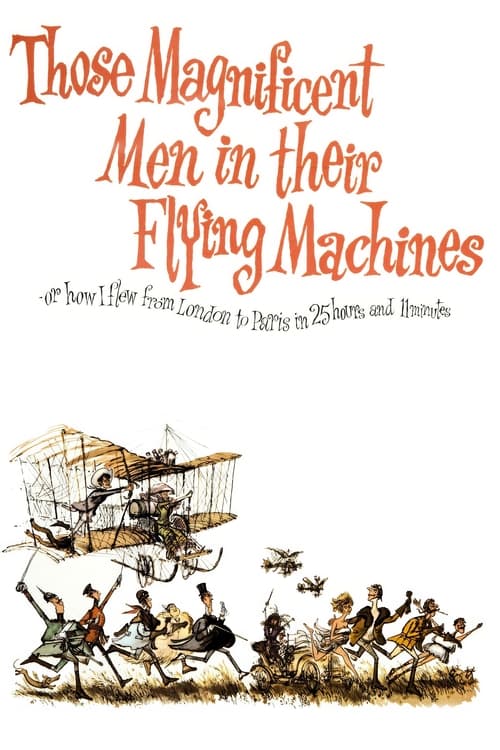
Those Magnificent Men in Their Flying Machines or How I Flew from London to Paris in 25 Hours 11 Minutes
In order to boost circulation of his newspaper, Lord Rawnsley announces an air race and offers £10,000 to the first person who can fly across the English Channel. But one of the participants, Percy, plots to sabotage his competitor's planes. Will Percy triumph?
Despite its tight budget of $5.6M, Those Magnificent Men in Their Flying Machines or How I Flew from London to Paris in 25 Hours 11 Minutes became a financial success, earning $29.9M worldwide—a 435% return. The film's compelling narrative resonated with audiences, confirming that strong storytelling can transcend budget limitations.
Nominated for 1 Oscar. 1 win & 8 nominations


Plot Structure
Story beats plotted across runtime


Narrative Arc
Emotional journey through the story's key moments
Story Circle
Blueprint 15-beat structure
Arcplot Score Breakdown
Weighted: Precision (70%) + Arc (15%) + Theme (15%)
Those Magnificent Men in Their Flying Machines or How I Flew from London to Paris in 25 Hours 11 Minutes (1965) showcases precise dramatic framework, characteristic of Ken Annakin's storytelling approach. This structural analysis examines how the film's 15-point plot structure maps to proven narrative frameworks across 2 hours and 18 minutes. With an Arcplot score of 7.1, the film balances conventional beats with creative variation.
Characters
Cast & narrative archetypes

Orvil Newton
Richard Mays
Patricia Rawnsley
Sir Percy Ware-Armitage
Colonel Manfred von Holstein
Count Emilio Ponticelli
Pierre Dubois
Yamamoto
Main Cast & Characters
Orvil Newton
Played by Stuart Whitman
American cowboy pilot with charm and confidence, competing for both the race and Patricia's affection.
Richard Mays
Played by James Fox
British Royal Navy officer and gentleman pilot, Patricia's initial suitor and honorable competitor.
Patricia Rawnsley
Played by Sarah Miles
Spirited suffragette and daughter of the newspaper magnate sponsoring the race, determined to prove women's equality.
Sir Percy Ware-Armitage
Played by Terry-Thomas
Eccentric and befuddled British aristocrat pilot prone to mishaps and comical incompetence.
Colonel Manfred von Holstein
Played by Gert Fröbe
Prussian military officer obsessed with German superiority and winning at any cost through sabotage.
Count Emilio Ponticelli
Played by Alberto Sordi
Dashing Italian pilot and romantic who claims numerous affairs, often distracted by women.
Pierre Dubois
Played by Jean-Pierre Cassel
French pilot with passionate temperament and theatrical personality, easily provoked and dramatic.
Yamamoto
Played by Yujiro Ishihara
Japanese pilot who remains calm and resourceful despite challenges and represents Eastern determination.
Structural Analysis
The Status Quo at 1 minutes (1% through the runtime) establishes Opening montage shows the history of early aviation attempts and failures, establishing a world of eccentric inventors and dangerous flying contraptions in 1910.. Notably, this early placement immediately immerses viewers in the story world.
The inciting incident occurs at 17 minutes when Lord Rawnsley announces the Great London-to-Paris Air Race with a £10,000 prize, drawing aviators from around the world. The challenge is issued and the race becomes official.. At 12% through the film, this Disruption aligns precisely with traditional story structure. This beat shifts the emotional landscape, launching the protagonist into the central conflict.
The First Threshold at 34 minutes marks the transition into Act II, occurring at 25% of the runtime. This illustrates the protagonist's commitment to The race officially begins. All pilots take off from London, committing to the dangerous journey to Paris. This marks the active choice to compete and risk everything., moving from reaction to action.
At 70 minutes, the Midpoint arrives at 50% of the runtime—precisely centered, creating perfect narrative symmetry. Significantly, this crucial beat Major setback: multiple pilots are grounded or eliminated through crashes and sabotage. Sir Percy's schemes intensify. Orvil's aircraft is damaged. The race that seemed adventurous now reveals its deadly serious stakes. False defeat: it appears the villains may win., fundamentally raising what's at risk. The emotional intensity shifts, dividing the narrative into clear before-and-after phases.
The Collapse moment at 103 minutes (74% through) represents the emotional nadir. Here, All seems lost: Sir Percy's final sabotage attempt nearly succeeds, multiple aircraft are destroyed, and pilots are grounded. Orvil's plane is severely damaged and appears unable to continue. The dream of honest competition seems dead., demonstrates the protagonist at their lowest point. This beat's placement in the final quarter sets up the climactic reversal.
The Second Threshold at 110 minutes initiates the final act resolution at 80% of the runtime. Orvil repairs his aircraft and decides to continue not for the prize but for the love of flying and Patricia. Other honest pilots band together, realizing the race is about advancing aviation, not just winning. Sir Percy is exposed. New understanding: it's about the journey and camaraderie, not victory., demonstrating the transformation achieved throughout the journey.
Emotional Journey
Those Magnificent Men in Their Flying Machines or How I Flew from London to Paris in 25 Hours 11 Minutes's emotional architecture traces a deliberate progression across 15 carefully calibrated beats.
Narrative Framework
This structural analysis employs proven narrative structure principles that track dramatic progression. By mapping Those Magnificent Men in Their Flying Machines or How I Flew from London to Paris in 25 Hours 11 Minutes against these established plot points, we can identify how Ken Annakin utilizes or subverts traditional narrative conventions. The plot point approach reveals not only adherence to structural principles but also creative choices that distinguish Those Magnificent Men in Their Flying Machines or How I Flew from London to Paris in 25 Hours 11 Minutes within the comedy genre.
Ken Annakin's Structural Approach
Among the 5 Ken Annakin films analyzed on Arcplot, the average structural score is 7.2, reflecting strong command of classical structure. Those Magnificent Men in Their Flying Machines or How I Flew from London to Paris in 25 Hours 11 Minutes takes a more unconventional approach compared to the director's typical style. For comparative analysis, explore the complete Ken Annakin filmography.
Comparative Analysis
Additional comedy films include The Bad Guys, Ella Enchanted and The Evening Star. For more Ken Annakin analyses, see Swiss Family Robinson, Battle of the Bulge and The Longest Day.
Plot Points by Act
Act I
SetupStatus Quo
Opening montage shows the history of early aviation attempts and failures, establishing a world of eccentric inventors and dangerous flying contraptions in 1910.
Theme
Lord Rawnsley declares that a great air race will prove British superiority and advance aviation, stating "The future belongs to those who dare." Theme: courage, competition, and progress through daring.
Worldbuilding
Introduction of the international cast of pilots and their various motivations: American Orvil Newton seeking adventure, German Colonel von Klugermann representing national pride, Italian Count Ponticelli as romantic, Frenchman Pierre Dubois as reckless, Japanese Yamamoto with honor, and British Fairfax seeking Patricia's hand. Patricia Rawnsley wants to fly herself but is forbidden by her father.
Disruption
Lord Rawnsley announces the Great London-to-Paris Air Race with a £10,000 prize, drawing aviators from around the world. The challenge is issued and the race becomes official.
Resistance
Pilots arrive and prepare for the race. Orvil Newton meets and begins courting Patricia. Various competitors test their aircraft and engage in rivalries. Sir Percy Ware-Armitage schemes to sabotage competitors. Patricia secretly learns to fly with Orvil's help, debating whether to defy her father.
Act II
ConfrontationFirst Threshold
The race officially begins. All pilots take off from London, committing to the dangerous journey to Paris. This marks the active choice to compete and risk everything.
Mirror World
Mid-flight, Orvil and Patricia's relationship deepens as romantic subplot. She represents the thematic ideal: someone who wants to fly for the love of flight itself, not glory or prizes. Their connection embodies the pure joy of aviation.
Premise
The promise of the premise: spectacular flying sequences, comedic mishaps, sabotage attempts, forced landings, aerial near-misses, and national stereotypes playing out. Various pilots face obstacles - crashes, mechanical failures, sabotage by Sir Percy, romantic entanglements, and the dangers of early aviation.
Midpoint
Major setback: multiple pilots are grounded or eliminated through crashes and sabotage. Sir Percy's schemes intensify. Orvil's aircraft is damaged. The race that seemed adventurous now reveals its deadly serious stakes. False defeat: it appears the villains may win.
Opposition
Pressure mounts as sabotage escalates. Sir Percy's schemes become more dangerous. Pilots must overcome increasing mechanical failures, bad weather, and exhaustion. Patricia's desire to fly openly conflicts with her father's expectations. The antagonistic forces close in on all competitors.
Collapse
All seems lost: Sir Percy's final sabotage attempt nearly succeeds, multiple aircraft are destroyed, and pilots are grounded. Orvil's plane is severely damaged and appears unable to continue. The dream of honest competition seems dead.
Crisis
Dark moment as pilots survey the damage and question whether to continue. The cost of the competition becomes clear. Patricia and Orvil face the reality that winning may not be worth losing each other or their lives.
Act III
ResolutionSecond Threshold
Orvil repairs his aircraft and decides to continue not for the prize but for the love of flying and Patricia. Other honest pilots band together, realizing the race is about advancing aviation, not just winning. Sir Percy is exposed. New understanding: it's about the journey and camaraderie, not victory.
Synthesis
Final push to Paris with multiple pilots racing neck-and-neck in spectacular aerial finale. Patricia takes to the air herself, defying convention. The various national rivals help each other rather than sabotage. Climactic aerial sequences showcase the beauty and danger of early flight. The race concludes with sportsmanship winning over nationalism.
Transformation
Closing image: pilots celebrate together in Paris regardless of who won. Patricia has earned respect as an aviator. Orvil and Patricia unite. The transformation shows aviation has brought nations together rather than divided them. The future of flight is assured through cooperation and shared passion.