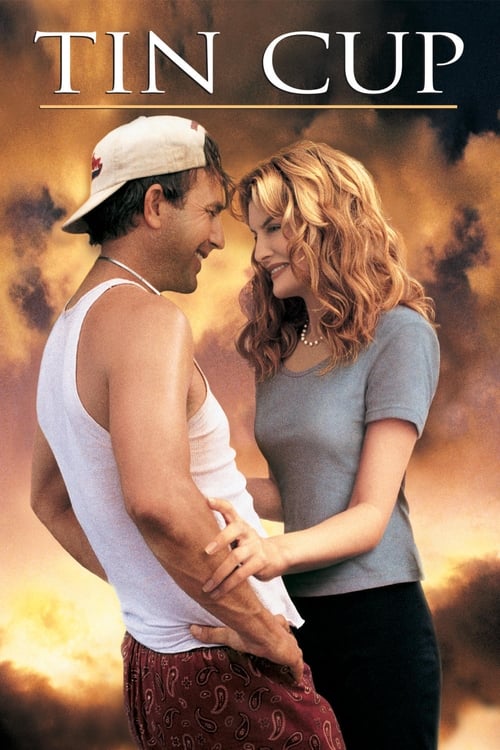
Tin Cup
A washed up golf pro working at a driving range tries to qualify for the US Open in order to win the heart of his succesful rival's girlfriend.
Working with a moderate budget of $45.0M, the film achieved a modest success with $53.9M in global revenue (+20% profit margin).


Plot Structure
Story beats plotted across runtime


Narrative Arc
Emotional journey through the story's key moments
Story Circle
Blueprint 15-beat structure
Arcplot Score Breakdown
Weighted: Precision (70%) + Arc (15%) + Theme (15%)
Tin Cup (1996) demonstrates precise story structure, characteristic of Ron Shelton's storytelling approach. This structural analysis examines how the film's 15-point plot structure maps to proven narrative frameworks across 2 hours and 15 minutes. With an Arcplot score of 7.1, the film balances conventional beats with creative variation.
Characters
Cast & narrative archetypes

Roy "Tin Cup" McAvoy
Dr. Molly Griswold
David Simms
Romeo Posar
Earl
Main Cast & Characters
Roy "Tin Cup" McAvoy
Played by Kevin Costner
A talented but self-destructive driving range pro who attempts to qualify for the U.S. Open to prove himself and win back his former girlfriend.
Dr. Molly Griswold
Played by Rene Russo
A psychiatrist and amateur golfer who becomes romantically involved with Roy while initially dating his rival David Simms.
David Simms
Played by Don Johnson
Roy's former college golf teammate turned successful PGA Tour pro, representing everything Roy could have been with discipline and compromise.
Romeo Posar
Played by Cheech Marin
Roy's loyal best friend and caddy, a philosophical former golfer who provides wisdom and unwavering support throughout Roy's journey.
Earl
Played by Dennis Burkley
Roy's elderly but sharp mentor who runs the driving range and offers tough-love guidance rooted in decades of golf experience.
Structural Analysis
The Status Quo at 2 minutes (1% through the runtime) establishes Roy "Tin Cup" McAvoy gives a golf lesson at his rundown West Texas driving range, living as a washed-up talent who never fulfilled his potential, drinking beer and hustling small-time bets with his caddy Romeo.. Significantly, this early placement immediately immerses viewers in the story world.
The inciting incident occurs at 16 minutes when Dr. Molly Griswold arrives at Roy's driving range for golf lessons. She's beautiful, intelligent, and dating David Simms. Roy is immediately attracted and sees her as both a romantic opportunity and a connection to his past rivalry.. At 12% through the film, this Disruption aligns precisely with traditional story structure. This beat shifts the emotional landscape, launching the protagonist into the central conflict.
The First Threshold at 33 minutes marks the transition into Act II, occurring at 25% of the runtime. This indicates the protagonist's commitment to Roy makes the decision to qualify for the U.S. Open to prove himself to Molly and show up David Simms. He chooses to leave his safe mediocrity and risk public failure by competing at the highest level again., moving from reaction to action.
At 68 minutes, the Midpoint arrives at 50% of the runtime—precisely centered, creating perfect narrative symmetry. The analysis reveals that this crucial beat Roy successfully makes the cut at the U.S. Open and is in contention. This is a false victory—he's achieving his goal, but his old demons (ego, recklessness, need to prove himself) haven't been conquered. The stakes are raised as real success becomes possible., fundamentally raising what's at risk. The emotional intensity shifts, dividing the narrative into clear before-and-after phases.
The Collapse moment at 100 minutes (74% through) represents the emotional nadir. Here, On the 72nd hole of the U.S. Open, needing par to tie and force a playoff, Roy faces a critical decision: lay up safely or go for the green over water. His defining moment arrives, and he must choose between safe mediocrity and glorious risk., shows the protagonist at their lowest point. This beat's placement in the final quarter sets up the climactic reversal.
The Second Threshold at 107 minutes initiates the final act resolution at 79% of the runtime. Roy realizes that defining the moment means being true to himself, not proving anything to Simms or winning Molly through victory. He chooses to go for the green—not out of ego, but out of authentic self-expression. This is who he is, win or lose., demonstrating the transformation achieved throughout the journey.
Emotional Journey
Tin Cup's emotional architecture traces a deliberate progression across 15 carefully calibrated beats.
Narrative Framework
This structural analysis employs proven narrative structure principles that track dramatic progression. By mapping Tin Cup against these established plot points, we can identify how Ron Shelton utilizes or subverts traditional narrative conventions. The plot point approach reveals not only adherence to structural principles but also creative choices that distinguish Tin Cup within the drama genre.
Ron Shelton's Structural Approach
Among the 7 Ron Shelton films analyzed on Arcplot, the average structural score is 7.3, reflecting strong command of classical structure. Tin Cup takes a more unconventional approach compared to the director's typical style. For comparative analysis, explore the complete Ron Shelton filmography.
Comparative Analysis
Additional drama films include After Thomas, South Pacific and Dirty Dancing: Havana Nights. For more Ron Shelton analyses, see White Men Can't Jump, Hollywood Homicide and Dark Blue.
Plot Points by Act
Act I
SetupStatus Quo
Roy "Tin Cup" McAvoy gives a golf lesson at his rundown West Texas driving range, living as a washed-up talent who never fulfilled his potential, drinking beer and hustling small-time bets with his caddy Romeo.
Theme
Romeo tells Roy, "When a defining moment comes along, you define the moment, or the moment defines you." This establishes the film's central question: will Roy choose safe mediocrity or risk everything for greatness?
Worldbuilding
We see Roy's life in Salome, Texas: his struggling driving range, his rivalry with former college teammate David Simms (now a PGA success), his loyal friend Romeo, and his pattern of self-sabotage. Roy lives off past glory and small hustles.
Disruption
Dr. Molly Griswold arrives at Roy's driving range for golf lessons. She's beautiful, intelligent, and dating David Simms. Roy is immediately attracted and sees her as both a romantic opportunity and a connection to his past rivalry.
Resistance
Roy pursues Molly while giving her golf lessons, using unconventional methods. He debates whether to stay in his comfortable failure or risk trying again. Molly becomes fascinated by Roy's talent and recklessness, creating tension with her stable relationship with Simms.
Act II
ConfrontationFirst Threshold
Roy makes the decision to qualify for the U.S. Open to prove himself to Molly and show up David Simms. He chooses to leave his safe mediocrity and risk public failure by competing at the highest level again.
Mirror World
Roy and Molly's relationship deepens as she agrees to help him psychologically prepare for competition. As a therapist, Molly represents the emotional growth Roy needs—she mirrors his journey from reckless ego to authentic courage.
Premise
The "fun and games" of Roy's comeback: qualifying for the U.S. Open through sectionals, reuniting with Romeo as his caddy, preparing for the tournament, and navigating his relationship with Molly while facing off against Simms. Roy proves he still has world-class talent.
Midpoint
Roy successfully makes the cut at the U.S. Open and is in contention. This is a false victory—he's achieving his goal, but his old demons (ego, recklessness, need to prove himself) haven't been conquered. The stakes are raised as real success becomes possible.
Opposition
Pressure mounts during the final rounds. Roy's reckless decision-making threatens to derail him. Simms plays it safe and stays in the lead. Molly struggles between supporting Roy's dream and fearing his self-destructive pattern. Roy's flaws intensify under championship pressure.
Collapse
On the 72nd hole of the U.S. Open, needing par to tie and force a playoff, Roy faces a critical decision: lay up safely or go for the green over water. His defining moment arrives, and he must choose between safe mediocrity and glorious risk.
Crisis
Roy processes the weight of his choice. Romeo and Molly both know what he'll do. This is his dark night—not of defeat, but of confronting who he truly is. Will he play it safe to tie Simms, or will he be himself regardless of consequence?
Act III
ResolutionSecond Threshold
Roy realizes that defining the moment means being true to himself, not proving anything to Simms or winning Molly through victory. He chooses to go for the green—not out of ego, but out of authentic self-expression. This is who he is, win or lose.
Synthesis
Roy executes his choice: he goes for the green repeatedly, hitting ball after ball into the water, refusing to lay up. He makes a 12 on the hole, destroying his chance to win but creating a legendary moment of authentic courage. Simms wins the tournament playing it safe.
Transformation
Back at the driving range, Molly chooses Roy over Simms. Roy didn't win the U.S. Open, but he won something greater—he defined his moment instead of letting it define him. He's the same reckless Roy, but now it's authentic courage rather than ego-driven self-sabotage.