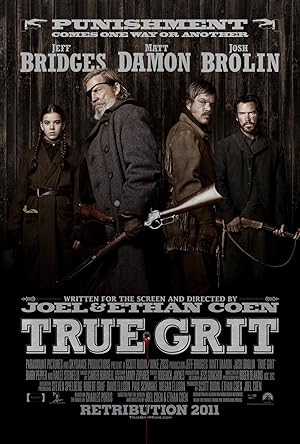
True Grit
Following the murder of her father by hired hand Tom Chaney, 14-year-old farm girl Mattie Ross sets out to capture the killer. To aid her, she hires the toughest U.S. marshal she can find, a man with "true grit," Reuben J. "Rooster" Cogburn. Mattie insists on accompanying Cogburn, whose drinking, sloth, and generally reprobate character do not augment her faith in him. Against his wishes, she joins him in his trek into the Indian Nations in search of Chaney. They are joined by Texas Ranger LaBoeuf, who wants Chaney for his own purposes. The unlikely trio find danger and surprises on the journey, and each has his or her "grit" tested.
Despite a mid-range budget of $38.0M, True Grit became a massive hit, earning $252.3M worldwide—a remarkable 564% return.
Nominated for 10 Oscars. 38 wins & 170 nominations


Plot Structure
Story beats plotted across runtime


Narrative Arc
Emotional journey through the story's key moments
Story Circle
Blueprint 15-beat structure
Arcplot Score Breakdown
Weighted: Precision (70%) + Arc (15%) + Theme (15%)
True Grit (2010) demonstrates precise narrative architecture, characteristic of Coen Brothers's storytelling approach. This structural analysis examines how the film's 15-point plot structure maps to proven narrative frameworks across 1 hour and 50 minutes. With an Arcplot score of 5.3, the film takes an unconventional approach to traditional narrative frameworks.
Characters
Cast & narrative archetypes

Mattie Ross
Rooster Cogburn
LaBoeuf
Tom Chaney
Lucky Ned Pepper
Main Cast & Characters
Mattie Ross
Played by Hailee Steinfeld
A determined 14-year-old girl who seeks justice for her father's murder by hiring a U.S. Marshal to track down the killer.
Rooster Cogburn
Played by Jeff Bridges
A hard-drinking, one-eyed U.S. Marshal with "true grit" who reluctantly agrees to help Mattie find her father's killer.
LaBoeuf
Played by Matt Damon
A Texas Ranger pursuing the same outlaw for different crimes, who joins forces with Mattie and Rooster despite initial friction.
Tom Chaney
Played by Josh Brolin
The cowardly killer who murdered Mattie's father and fled into Indian Territory.
Lucky Ned Pepper
Played by Barry Pepper
A ruthless outlaw gang leader who employs Tom Chaney and becomes the primary antagonist.
Structural Analysis
The Status Quo at 1 minutes (1% through the runtime) establishes Adult Mattie's voiceover describes her father's murder by Tom Chaney in Fort Smith, establishing the inciting tragedy and her worldview of accountability and justice.. Notably, this early placement immediately immerses viewers in the story world.
The inciting incident occurs at 12 minutes when Mattie watches a public hanging and witnesses Rooster Cogburn testify in court, revealing his ruthless methods. She decides he is the man to hunt Chaney, setting her mission in motion.. At 11% through the film, this Disruption aligns precisely with traditional story structure. This beat shifts the emotional landscape, launching the protagonist into the central conflict.
The First Threshold at 25 minutes marks the transition into Act II, occurring at 23% of the runtime. This shows the protagonist's commitment to Mattie crosses the river on horseback, defying Rooster and LaBoeuf who left without her. She swims Little Blackie across the freezing water, proving her grit and forcing them to accept her on the journey into Indian Territory., moving from reaction to action.
At 50 minutes, the Midpoint arrives at 45% of the runtime—arriving early, accelerating into Act IIb complications. Of particular interest, this crucial beat At the dugout cabin, Rooster kills two of Ned Pepper's men in a shootout. The dying outlaw reveals Chaney and Pepper will rendezvous nearby, but the violence and LaBoeuf's injury raise the stakes dramatically - they're now committed to a deadly confrontation., fundamentally raising what's at risk. The emotional intensity shifts, dividing the narrative into clear before-and-after phases.
The Collapse moment at 74 minutes (68% through) represents the emotional nadir. Here, Mattie is held hostage by Ned Pepper's gang. Chaney strikes her and threatens her life. Rooster is forced to negotiate for her release, seemingly powerless. Everything Mattie fought for appears lost as she faces death at the hands of her father's killer., shows the protagonist at their lowest point. This beat's placement in the final quarter sets up the climactic reversal.
The Second Threshold at 79 minutes initiates the final act resolution at 72% of the runtime. Rooster charges alone at the four outlaws across the meadow, reins in teeth, guns blazing in both hands, shouting "Fill your hand, you son of a bitch!" LaBoeuf returns at the critical moment to shoot Ned Pepper, and together they rout the gang., demonstrating the transformation achieved throughout the journey.
Emotional Journey
True Grit's emotional architecture traces a deliberate progression across 15 carefully calibrated beats.
Narrative Framework
This structural analysis employs a 15-point narrative structure framework that maps key story moments. By mapping True Grit against these established plot points, we can identify how Coen Brothers utilizes or subverts traditional narrative conventions. The plot point approach reveals not only adherence to structural principles but also creative choices that distinguish True Grit within the drama genre.
Coen Brothers's Structural Approach
Among the 11 Coen Brothers films analyzed on Arcplot, the average structural score is 5.1, showcasing experimental approaches to narrative form. True Grit represents one of the director's most structurally precise works. For comparative analysis, explore the complete Coen Brothers filmography.
Comparative Analysis
Additional drama films include After Thomas, South Pacific and Dirty Dancing: Havana Nights. For more Coen Brothers analyses, see The Ballad of Buster Scruggs, Inside Llewyn Davis and The Big Lebowski.
Plot Points by Act
Act I
SetupStatus Quo
Adult Mattie's voiceover describes her father's murder by Tom Chaney in Fort Smith, establishing the inciting tragedy and her worldview of accountability and justice.
Theme
The sheriff tells Mattie that Rooster Cogburn is a man of "true grit" when she asks who the toughest marshal is, establishing the thematic question of what true determination costs.
Worldbuilding
Mattie arrives in Fort Smith to claim her father's body. She demonstrates her formidable negotiating skills with the horse trader Stonehill, establishes her single-minded determination, and begins searching for a marshal to pursue Chaney into Indian Territory.
Disruption
Mattie watches a public hanging and witnesses Rooster Cogburn testify in court, revealing his ruthless methods. She decides he is the man to hunt Chaney, setting her mission in motion.
Resistance
Mattie negotiates with Rooster to hire him for $100. She meets LaBoeuf, a Texas Ranger also hunting Chaney. Rooster initially refuses to take her along, and LaBoeuf proposes a partnership that excludes her. Mattie insists on accompanying them to ensure Chaney hangs for her father's murder in Arkansas.
Act II
ConfrontationFirst Threshold
Mattie crosses the river on horseback, defying Rooster and LaBoeuf who left without her. She swims Little Blackie across the freezing water, proving her grit and forcing them to accept her on the journey into Indian Territory.
Mirror World
Rooster begins sharing stories of his past with Mattie as they ride together, revealing his losses and hard-won wisdom. Their unlikely bond forms as she sees the humanity beneath his gruff exterior - he becomes both mirror and mentor.
Premise
The trio rides through the wilderness tracking Chaney and Lucky Ned Pepper's gang. They interrogate outlaws, visit a remote trading post, and encounter two hanged men. LaBoeuf and Rooster clash over methods while Mattie observes the brutal realities of frontier justice.
Midpoint
At the dugout cabin, Rooster kills two of Ned Pepper's men in a shootout. The dying outlaw reveals Chaney and Pepper will rendezvous nearby, but the violence and LaBoeuf's injury raise the stakes dramatically - they're now committed to a deadly confrontation.
Opposition
LaBoeuf parts ways with the group after arguing with Rooster. Rooster and Mattie continue alone, with Rooster drinking heavily. They locate Ned Pepper's gang's location but Mattie is captured by Chaney when she encounters him at the river while the others sleep.
Collapse
Mattie is held hostage by Ned Pepper's gang. Chaney strikes her and threatens her life. Rooster is forced to negotiate for her release, seemingly powerless. Everything Mattie fought for appears lost as she faces death at the hands of her father's killer.
Crisis
Pepper agrees to release Mattie if Rooster leaves. Rooster retreats, appearing defeated. Mattie is left alone with Chaney as the gang prepares to ride out, her fate uncertain and her mission seemingly failed.
Act III
ResolutionSecond Threshold
Rooster charges alone at the four outlaws across the meadow, reins in teeth, guns blazing in both hands, shouting "Fill your hand, you son of a bitch!" LaBoeuf returns at the critical moment to shoot Ned Pepper, and together they rout the gang.
Synthesis
Mattie shoots Chaney, avenging her father, but the rifle's recoil knocks her into a snake pit where she is bitten. Rooster rides Little Blackie to exhaustion through the night to save her life, demonstrating his own true grit. The horse dies and Rooster carries Mattie to safety.
Transformation
Twenty-five years later, adult Mattie - now one-armed - visits the Wild West show to find Rooster, only to learn he died three days prior. She arranges for his body to be buried in her family plot, honoring the man who showed her what true grit costs.