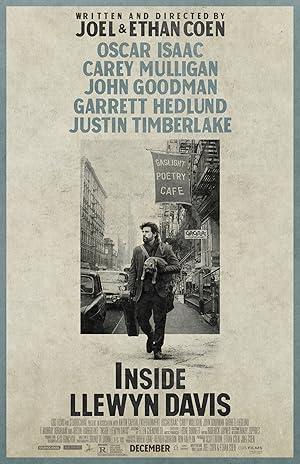
Inside Llewyn Davis
Follow a week in the life of a young folk singer as he navigates the Greenwich Village folk scene of 1961. Guitar in tow, huddled against the unforgiving New York winter, he is struggling to make it as a musician against seemingly insurmountable obstacles -- some of them of his own making.
Despite its small-scale budget of $11.0M, Inside Llewyn Davis became a financial success, earning $32.9M worldwide—a 199% return.
Nominated for 2 Oscars. 47 wins & 174 nominations


Plot Structure
Story beats plotted across runtime


Narrative Arc
Emotional journey through the story's key moments
Story Circle
Blueprint 15-beat structure
Arcplot Score Breakdown
Weighted: Precision (70%) + Arc (15%) + Theme (15%)
Inside Llewyn Davis (2013) showcases strategically placed dramatic framework, characteristic of Coen Brothers's storytelling approach. This structural analysis examines how the film's 15-point plot structure maps to proven narrative frameworks across 1 hour and 44 minutes. With an Arcplot score of 4.8, the film takes an unconventional approach to traditional narrative frameworks.
Characters
Cast & narrative archetypes

Llewyn Davis
Jean Berkey
Jim Berkey
Roland Turner
Bud Grossman
Al Cody
Main Cast & Characters
Llewyn Davis
Played by Oscar Isaac
A struggling folk singer in 1961 Greenwich Village, cycling through couches and gigs while resisting compromise and connection.
Jean Berkey
Played by Carey Mulligan
A folk singer and Llewyn's sometime lover, pregnant and furious with his irresponsibility and self-destructive patterns.
Jim Berkey
Played by Justin Timberlake
Jean's husband and musical partner, a kind and successful folk musician oblivious to his wife's affair with Llewyn.
Roland Turner
Played by John Goodman
A caustic jazz musician Llewyn travels with to Chicago, contemptuous of folk music and most human interaction.
Bud Grossman
Played by F. Murray Abraham
A Chicago club owner and music producer who evaluates Llewyn with cool professional detachment.
Al Cody
Played by Jeanine Serralles
Llewyn's former musical partner whose death haunts the narrative and represents lost possibility.
Structural Analysis
The Status Quo at 1 minutes (1% through the runtime) establishes Llewyn Davis performs "Hang Me, Oh Hang Me" at the Gaslight Cafe. He is a talented folk singer, alone on stage, performing with raw emotional depth. This establishes him as an artist struggling in the Greenwich Village folk scene of 1961, existing in a state of barely sustained survival.. Significantly, this early placement immediately immerses viewers in the story world.
The inciting incident occurs at 11 minutes when Jean Berkey reveals she's pregnant and the baby might be Llewyn's. She's furious with him, calls him a "fucking asshole," and demands he pay for an abortion. This external crisis disrupts his already precarious existence and forces him into action he can't afford.. At 11% through the film, this Disruption aligns precisely with traditional story structure. This beat shifts the emotional landscape, launching the protagonist into the central conflict.
The First Threshold at 23 minutes marks the transition into Act II, occurring at 22% of the runtime. This indicates the protagonist's commitment to Llewyn actively chooses to take the cat and travel to Chicago to audition for Bud Grossman, a major folk music manager. This is his decision to make one last push for success. He joins Roland Turner and Johnny Five for the road trip, entering a new world outside his familiar Greenwich Village circuit., moving from reaction to action.
At 46 minutes, the Midpoint arrives at 44% of the runtime—arriving early, accelerating into Act IIb complications. The analysis reveals that this crucial beat Llewyn auditions for Bud Grossman in Chicago, performing "The Death of Queen Jane." Grossman listens impassively and delivers the verdict: "I don't see a lot of money here." He suggests Llewyn join a trio. This is a false defeat—the journey was for nothing. Grossman's rejection mirrors Pappi's theme statement, confirming the industry doesn't value Llewyn's solo artistry., fundamentally raising what's at risk. The emotional intensity shifts, dividing the narrative into clear before-and-after phases.
The Collapse moment at 68 minutes (66% through) represents the emotional nadir. Here, Llewyn visits his father in a nursing home, trying to connect or find meaning. His father is unresponsive, possibly has dementia, and eventually urinates on himself. Llewyn breaks down. This contains the "whiff of death"—his father represents Llewyn's future: alone, forgotten, reduced to nothing. The scene is emotionally devastating and represents Llewyn's complete spiritual collapse., reveals the protagonist at their lowest point. This beat's placement in the final quarter sets up the climactic reversal.
The Second Threshold at 74 minutes initiates the final act resolution at 71% of the runtime. Llewyn returns to the Gaslight Cafe one last time before shipping out. He chooses to perform "Fare Thee Well" (his and Mike's song) as a farewell to music. This synthesis combines his past with Mike and his present failure—acknowledging both his artistic identity and his inability to sustain it. It's acceptance, not triumph., demonstrating the transformation achieved throughout the journey.
Emotional Journey
Inside Llewyn Davis's emotional architecture traces a deliberate progression across 15 carefully calibrated beats.
Narrative Framework
This structural analysis employs structural analysis methodology used to understand storytelling architecture. By mapping Inside Llewyn Davis against these established plot points, we can identify how Coen Brothers utilizes or subverts traditional narrative conventions. The plot point approach reveals not only adherence to structural principles but also creative choices that distinguish Inside Llewyn Davis within the drama genre.
Coen Brothers's Structural Approach
Among the 11 Coen Brothers films analyzed on Arcplot, the average structural score is 5.1, showcasing experimental approaches to narrative form. Inside Llewyn Davis takes a more unconventional approach compared to the director's typical style. For comparative analysis, explore the complete Coen Brothers filmography.
Comparative Analysis
Additional drama films include After Thomas, South Pacific and Dirty Dancing: Havana Nights. For more Coen Brothers analyses, see The Ballad of Buster Scruggs, The Big Lebowski and True Grit.
Plot Points by Act
Act I
SetupStatus Quo
Llewyn Davis performs "Hang Me, Oh Hang Me" at the Gaslight Cafe. He is a talented folk singer, alone on stage, performing with raw emotional depth. This establishes him as an artist struggling in the Greenwich Village folk scene of 1961, existing in a state of barely sustained survival.
Theme
Pappi Corsicato at the Gaslight tells Llewyn, "I don't see a lot of money here." This early line encapsulates the film's central tension: artistic purity versus commercial viability, and whether art that doesn't sell has value.
Worldbuilding
Llewyn's world is revealed: he sleeps on friends' couches (the Gorfeins), has no home, carries everything in a guitar case, and can't seem to get traction despite talent. His solo album "Inside Llewyn Davis" isn't selling. He learns his former musical partner Mike committed suicide by jumping off the George Washington Bridge. He's stuck couch-surfing, broke, and grieving.
Disruption
Jean Berkey reveals she's pregnant and the baby might be Llewyn's. She's furious with him, calls him a "fucking asshole," and demands he pay for an abortion. This external crisis disrupts his already precarious existence and forces him into action he can't afford.
Resistance
Llewyn scrambles for money and stability. He tracks down royalties from his album with Mike but learns he signed away rights for quick cash. He participates in a novelty recording session ("Please Mr. Kennedy") for immediate payment instead of royalties. He debates his choices, resists compromise, but circumstances push him toward desperation. He accidentally lets the Gorfeins' cat Ulysses escape.
Act II
ConfrontationFirst Threshold
Llewyn actively chooses to take the cat and travel to Chicago to audition for Bud Grossman, a major folk music manager. This is his decision to make one last push for success. He joins Roland Turner and Johnny Five for the road trip, entering a new world outside his familiar Greenwich Village circuit.
Mirror World
Roland Turner, the caustic jazz musician, serves as the thematic mirror. Roland represents artistic elitism and disdain for commercial folk music. He embodies uncompromising artistic vision but also isolation and bitterness—a potential future for Llewyn. Their relationship forces Llewyn to confront his own artistic identity.
Premise
The road trip to Chicago. Llewyn experiences the journey with Roland and Johnny Five, enduring Roland's contempt and philosophical lectures. The cat is lost and found repeatedly. This section delivers the premise promise: watching Llewyn navigate the folk music world, dealing with his artistic integrity versus survival. Darkly comic misadventures pile up.
Midpoint
Llewyn auditions for Bud Grossman in Chicago, performing "The Death of Queen Jane." Grossman listens impassively and delivers the verdict: "I don't see a lot of money here." He suggests Llewyn join a trio. This is a false defeat—the journey was for nothing. Grossman's rejection mirrors Pappi's theme statement, confirming the industry doesn't value Llewyn's solo artistry.
Opposition
Llewyn returns to New York defeated. Pressures mount: Jean is still angry, he has no money for the abortion, he loses the cat again (gets the wrong cat), and his friend's husband Professor Gorfein discovers his affair with Jean. He tries reconnecting with his sister but she's unsympathetic. His merchant marine card is unavailable (at sea). Every escape route closes. He considers rejoining the merchant marines to escape.
Collapse
Llewyn visits his father in a nursing home, trying to connect or find meaning. His father is unresponsive, possibly has dementia, and eventually urinates on himself. Llewyn breaks down. This contains the "whiff of death"—his father represents Llewyn's future: alone, forgotten, reduced to nothing. The scene is emotionally devastating and represents Llewyn's complete spiritual collapse.
Crisis
Llewyn sits in the darkness of his failure. He retrieves his merchant marine card and prepares to give up music entirely. He processes that he will never succeed, that his artistic dream is dead, and that he must return to his old life at sea. This is his dark night before a final decision.
Act III
ResolutionSecond Threshold
Llewyn returns to the Gaslight Cafe one last time before shipping out. He chooses to perform "Fare Thee Well" (his and Mike's song) as a farewell to music. This synthesis combines his past with Mike and his present failure—acknowledging both his artistic identity and his inability to sustain it. It's acceptance, not triumph.
Synthesis
The finale unfolds cyclically. After performing, Llewyn is confronted outside the club by a man (later revealed to be connected to Bud Grossman) who beats him in the alley. As Llewyn lies bleeding, Bob Dylan performs inside the Gaslight—the future of folk music that will pass Llewyn by. The film returns to its beginning: the cycle repeats. Llewyn is trapped in his pattern.
Transformation
Llewyn sits bleeding in the alley behind the Gaslight, alone in the dark. The film has come full circle—he is exactly where he started, perhaps worse. This is a negative arc: Llewyn has not transformed, he has not grown, he remains trapped by his uncompromising nature and inability to adapt. The closing image mirrors the opening but emphasizes his endless cycle of failure and isolation.