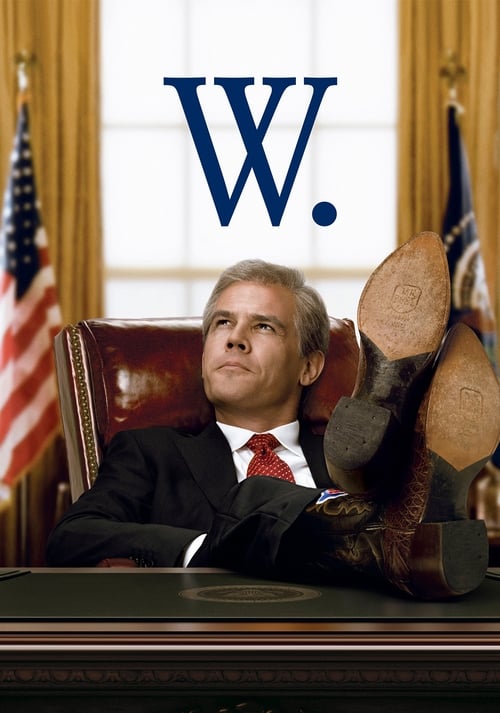
W.
The story of the eventful life of George W. Bush—his struggles and triumphs, how he found both his wife and his faith—and the critical days leading up to his decision to invade Iraq.
Working with a respectable budget of $25.1M, the film achieved a modest success with $29.5M in global revenue (+18% profit margin).
1 win & 8 nominations


Plot Structure
Story beats plotted across runtime


Narrative Arc
Emotional journey through the story's key moments
Story Circle
Blueprint 15-beat structure
Arcplot Score Breakdown
Weighted: Precision (70%) + Arc (15%) + Theme (15%)
W. (2008) demonstrates strategically placed dramatic framework, characteristic of Oliver Stone's storytelling approach. This structural analysis examines how the film's 15-point plot structure maps to proven narrative frameworks across 2 hours and 9 minutes. With an Arcplot score of 6.8, the film balances conventional beats with creative variation.
Structural Analysis
The Status Quo at 2 minutes (1% through the runtime) establishes President Bush alone in the Oval Office fielding questions from the press about weapons of mass destruction in Iraq, establishing his defensive posture and the administration's commitment to the war despite mounting criticism.. Structural examination shows that this early placement immediately immerses viewers in the story world.
The inciting incident occurs at 15 minutes when Bush's father George H.W. Bush confronts him about his failures and arrests, asking "What are you going to do with your life?" The moment crystallizes Bush's crisis of identity and his desperate need to prove himself worthy of the family name.. At 12% through the film, this Disruption aligns precisely with traditional story structure. This beat shifts the emotional landscape, launching the protagonist into the central conflict.
The First Threshold at 31 minutes marks the transition into Act II, occurring at 24% of the runtime. This shows the protagonist's commitment to Bush actively decides to run for Governor of Texas, declaring "I'm going to show my father." This is his irreversible choice to enter the political arena and pursue power on his own terms, launching him into the new world of leadership., moving from reaction to action.
At 63 minutes, the Midpoint arrives at 49% of the runtime—precisely centered, creating perfect narrative symmetry. Structural examination shows that this crucial beat Bush delivers his "Mission Accomplished" speech on the USS Abraham Lincoln, declaring major combat operations in Iraq over. A false victory—Bush appears triumphant but the audience knows the war is just beginning and will become his defining failure., fundamentally raising what's at risk. The emotional intensity shifts, dividing the narrative into clear before-and-after phases.
The Collapse moment at 95 minutes (73% through) represents the emotional nadir. Here, In a tense cabinet meeting, Bush faces the devastating truth: no weapons of mass destruction exist in Iraq. Colin Powell's departure symbolizes the death of credibility and measured counsel. Bush's entire justification for war crumbles, his legacy in ruins., demonstrates the protagonist at their lowest point. This beat's placement in the final quarter sets up the climactic reversal.
The Second Threshold at 102 minutes initiates the final act resolution at 79% of the runtime. Bush decides to double down on his convictions rather than admit error. He synthesizes his religious faith and political identity to justify staying the course. Not redemption through growth, but calcification—choosing certainty over doubt., demonstrating the transformation achieved throughout the journey.
Emotional Journey
W.'s emotional architecture traces a deliberate progression across 15 carefully calibrated beats.
Narrative Framework
This structural analysis employs proven narrative structure principles that track dramatic progression. By mapping W. against these established plot points, we can identify how Oliver Stone utilizes or subverts traditional narrative conventions. The plot point approach reveals not only adherence to structural principles but also creative choices that distinguish W. within the drama genre.
Oliver Stone's Structural Approach
Among the 15 Oliver Stone films analyzed on Arcplot, the average structural score is 7.1, reflecting strong command of classical structure. W. takes a more unconventional approach compared to the director's typical style. For comparative analysis, explore the complete Oliver Stone filmography.
Comparative Analysis
Additional drama films include After Thomas, South Pacific and Dirty Dancing: Havana Nights. For more Oliver Stone analyses, see Nixon, Any Given Sunday and Alexander.
Plot Points by Act
Act I
SetupStatus Quo
President Bush alone in the Oval Office fielding questions from the press about weapons of mass destruction in Iraq, establishing his defensive posture and the administration's commitment to the war despite mounting criticism.
Theme
Young Bush at Yale is told by a fellow student: "Some are born great, some achieve greatness, and some have greatness thrust upon them." The film's central question: Can someone inherit power without earning it, and what happens when ambition exceeds ability?
Worldbuilding
Intercut between present-day war cabinet meetings discussing Iraq strategy and flashbacks establishing young Bush as a directionless fraternity partier at Yale, overshadowed by his father's legacy, struggling with alcoholism and finding no clear path in life.
Disruption
Bush's father George H.W. Bush confronts him about his failures and arrests, asking "What are you going to do with your life?" The moment crystallizes Bush's crisis of identity and his desperate need to prove himself worthy of the family name.
Resistance
Bush meets Laura, finds religion through a Billy Graham encounter, quits drinking, and discovers his calling in politics. He debates entering the Texas gubernatorial race, initially uncertain but encouraged by Karl Rove and his political instincts.
Act II
ConfrontationFirst Threshold
Bush actively decides to run for Governor of Texas, declaring "I'm going to show my father." This is his irreversible choice to enter the political arena and pursue power on his own terms, launching him into the new world of leadership.
Mirror World
Bush's relationship with his father intensifies as a thematic counterpoint—the elder Bush represents establishment competence and measured diplomacy, while W. represents gut instinct and evangelical certainty. Their dynamic embodies the film's exploration of legacy versus earned authority.
Premise
Bush's rise from Governor to President, enjoying political success, assembling his war cabinet (Cheney, Rumsfeld, Powell, Rice), and the administration's growing fixation on Iraq and Saddam Hussein in the post-9/11 environment.
Midpoint
Bush delivers his "Mission Accomplished" speech on the USS Abraham Lincoln, declaring major combat operations in Iraq over. A false victory—Bush appears triumphant but the audience knows the war is just beginning and will become his defining failure.
Opposition
The Iraq situation deteriorates. No WMDs are found. Cabinet meetings grow contentious as Powell and others express doubts. Bush becomes increasingly isolated and defensive. His certitude hardens even as evidence contradicts the administration's rationale for war.
Collapse
In a tense cabinet meeting, Bush faces the devastating truth: no weapons of mass destruction exist in Iraq. Colin Powell's departure symbolizes the death of credibility and measured counsel. Bush's entire justification for war crumbles, his legacy in ruins.
Crisis
Bush retreats into himself, reflecting on his choices. Flashbacks intensify showing his lifelong struggle for his father's approval. He processes the gap between his self-image as a decisive leader and the reality of a disastrous war built on false premises.
Act III
ResolutionSecond Threshold
Bush decides to double down on his convictions rather than admit error. He synthesizes his religious faith and political identity to justify staying the course. Not redemption through growth, but calcification—choosing certainty over doubt.
Synthesis
Bush continues publicly defending the Iraq War while privately grappling with his legacy. The film's final sequences intercut between his presidential present and his baseball-loving past, showing a man trapped by his own choices and unable to escape his father's shadow.
Transformation
Bush stands alone in an empty baseball field, waiting for a ball that never comes—a metaphor for his unfulfilled dreams and isolation. Unlike the opening's defensive confidence, he now appears lost and small, having achieved power but not greatness, legacy defined by failure rather than triumph.