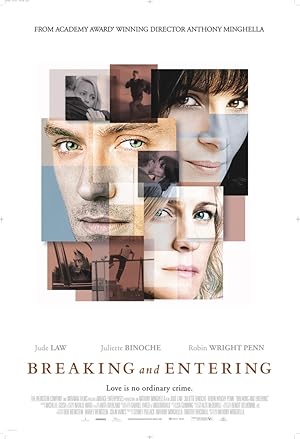
Breaking and Entering
A mother and her daughter, a mother and her son, and a man living with one and attracted to the other. Miro, a teen from Sarajevo, lives near King's Cross with his mother; he's nimble, able to run across roofs, so his uncle hires him to break into office skylights, so the uncle can boost computers. Twice they steal from Will's architectural firm, so Will stakes it out at night. He follows Miro home and returns the next day and meets Miro's mother, Amira. At home, Will's relationship with Liv is strained - he feels outside Liv and her daughter Bea's circle. The stakeout and Amira's vulnerability are attractive alternatives to being at home. The police, too, watch Miro.
The film earned $9.0M at the global box office.


Plot Structure
Story beats plotted across runtime


Narrative Arc
Emotional journey through the story's key moments
Story Circle
Blueprint 15-beat structure
Arcplot Score Breakdown
Weighted: Precision (70%) + Arc (15%) + Theme (15%)
Breaking and Entering (2006) exemplifies meticulously timed narrative design, characteristic of Anthony Minghella's storytelling approach. This structural analysis examines how the film's 15-point plot structure maps to proven narrative frameworks across 2 hours and 9 minutes. With an Arcplot score of 6.8, the film balances conventional beats with creative variation.
Structural Analysis
The Status Quo at 1 minutes (1% through the runtime) establishes Will drives through nighttime London, narrating his disconnection from Liv and Bea. His voiceover establishes emotional distance: "I'm living with someone I no longer understand.".. Significantly, this early placement immediately immerses viewers in the story world.
The inciting incident occurs at 15 minutes when The architecture office is broken into and robbed for the second time. Will witnesses the burglar Miro escaping across the rooftops, sparking his obsession to catch the thief.. At 12% through the film, this Disruption aligns precisely with traditional story structure. This beat shifts the emotional landscape, launching the protagonist into the central conflict.
The First Threshold at 32 minutes marks the transition into Act II, occurring at 25% of the runtime. This illustrates the protagonist's commitment to Will follows Miro home and discovers where he lives with his mother Amira. Rather than call police, Will makes the fateful choice to enter their world, beginning surveillance of the family., moving from reaction to action.
At 65 minutes, the Midpoint arrives at 50% of the runtime—precisely centered, creating perfect narrative symmetry. Notably, this crucial beat Will and Amira consummate their affair. For Will, this feels like genuine connection after years of emotional isolation. It's a false victory—he believes he can maintain both worlds without consequence., fundamentally raising what's at risk. The emotional intensity shifts, dividing the narrative into clear before-and-after phases.
The Collapse moment at 97 minutes (75% through) represents the emotional nadir. Here, Amira confronts Will with the truth: he used her. Simultaneously, Liv discovers the affair. Both women reject him. His constructed worlds—the comfortable life with Liv and the passionate escape with Amira—both shatter., illustrates the protagonist at their lowest point. This beat's placement in the final quarter sets up the climactic reversal.
The Second Threshold at 103 minutes initiates the final act resolution at 80% of the runtime. Will chooses to testify at Miro's hearing, openly admitting his affair with Amira and taking responsibility for his surveillance of the family. He stops hiding behind walls of his own construction., demonstrating the transformation achieved throughout the journey.
Emotional Journey
Breaking and Entering's emotional architecture traces a deliberate progression across 15 carefully calibrated beats.
Narrative Framework
This structural analysis employs a 15-point narrative structure framework that maps key story moments. By mapping Breaking and Entering against these established plot points, we can identify how Anthony Minghella utilizes or subverts traditional narrative conventions. The plot point approach reveals not only adherence to structural principles but also creative choices that distinguish Breaking and Entering within the crime genre.
Anthony Minghella's Structural Approach
Among the 4 Anthony Minghella films analyzed on Arcplot, the average structural score is 7.0, reflecting strong command of classical structure. Breaking and Entering takes a more unconventional approach compared to the director's typical style. For comparative analysis, explore the complete Anthony Minghella filmography.
Comparative Analysis
Additional crime films include The Bad Guys, Rustom and The Whole Ten Yards. For more Anthony Minghella analyses, see Cold Mountain, Truly Madly Deeply and The English Patient.
Plot Points by Act
Act I
SetupStatus Quo
Will drives through nighttime London, narrating his disconnection from Liv and Bea. His voiceover establishes emotional distance: "I'm living with someone I no longer understand."
Theme
Sandy, Will's business partner, observes about the King's Cross regeneration project: "We're breaking down walls, creating new spaces where people can connect." This reflects the film's central question about emotional boundaries.
Worldbuilding
Will's life is established: successful architect, strained relationship with Liv, difficulty connecting with her autistic daughter Bea. His new King's Cross office represents gentrification colliding with immigrant communities.
Disruption
The architecture office is broken into and robbed for the second time. Will witnesses the burglar Miro escaping across the rooftops, sparking his obsession to catch the thief.
Resistance
Will stakes out the office at night, waiting for the burglar to return. He confides in Sandy about his troubled home life. A prostitute named Oana becomes an unlikely confidante during his nighttime vigils.
Act II
ConfrontationFirst Threshold
Will follows Miro home and discovers where he lives with his mother Amira. Rather than call police, Will makes the fateful choice to enter their world, beginning surveillance of the family.
Mirror World
Will engineers a meeting with Amira at her seamstress shop. Their connection is immediate and profound. She represents everything missing in his life: emotional directness, resilience, and genuine human warmth.
Premise
Will pursues a secret relationship with Amira while maintaining his life with Liv. He helps Amira navigate immigration issues. The parallel between his emotional breaking-and-entering and Miro's literal crimes becomes clear.
Midpoint
Will and Amira consummate their affair. For Will, this feels like genuine connection after years of emotional isolation. It's a false victory—he believes he can maintain both worlds without consequence.
Opposition
The pressure mounts from all directions. Liv grows suspicious. Miro is arrested for burglary. Amira discovers Will originally approached her because of Miro, not genuine attraction. Will's deceptions begin collapsing.
Collapse
Amira confronts Will with the truth: he used her. Simultaneously, Liv discovers the affair. Both women reject him. His constructed worlds—the comfortable life with Liv and the passionate escape with Amira—both shatter.
Crisis
Will faces the wreckage of his choices. Miro faces deportation. Amira may lose everything. Will must decide whether to continue his pattern of emotional distance or finally take responsibility.
Act III
ResolutionSecond Threshold
Will chooses to testify at Miro's hearing, openly admitting his affair with Amira and taking responsibility for his surveillance of the family. He stops hiding behind walls of his own construction.
Synthesis
Will's testimony helps Miro's case. He has honest, painful conversations with both Liv and Amira. He commits to being present for Bea. The film doesn't offer easy reconciliation, but genuine acknowledgment.
Transformation
Will sits with Bea, finally present rather than distant. Unlike the opening where he narrated his disconnection, he now engages directly. The walls he built around himself have come down.