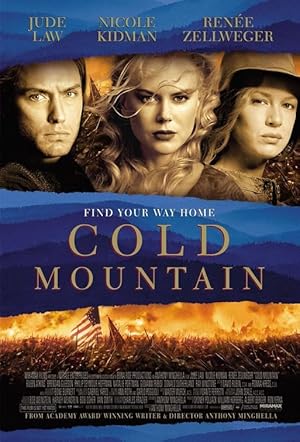
Cold Mountain
This Civil War saga addresses romance, friendship, and the ravages of war - both in the field and on the home front. Captures the horrors of war for both those fighting it, and for those left behind. This is a tale of hope, longing, redemption, second chances, and faith.
Despite a considerable budget of $79.0M, Cold Mountain became a solid performer, earning $173.0M worldwide—a 119% return.
1 Oscar. 20 wins & 101 nominations


Plot Structure
Story beats plotted across runtime


Narrative Arc
Emotional journey through the story's key moments
Story Circle
Blueprint 15-beat structure
Arcplot Score Breakdown
Weighted: Precision (70%) + Arc (15%) + Theme (15%)
Cold Mountain (2003) exhibits strategically placed story structure, characteristic of Anthony Minghella's storytelling approach. This structural analysis examines how the film's 15-point plot structure maps to proven narrative frameworks across 2 hours and 34 minutes. With an Arcplot score of 7.2, the film balances conventional beats with creative variation.
Characters
Cast & narrative archetypes

Inman
Ada Monroe
Ruby Thewes
Reverend Monroe
Teague
Stobrod Thewes
Sara
Veasey
Main Cast & Characters
Inman
Played by Jude Law
A Confederate soldier who deserts to return home to his love Ada during the Civil War
Ada Monroe
Played by Nicole Kidman
A refined minister's daughter who must learn to survive on her failing farm while waiting for Inman's return
Ruby Thewes
Played by Renée Zellweger
A tough, resourceful drifter who teaches Ada how to work the farm and survive
Reverend Monroe
Played by Donald Sutherland
Ada's father, a minister who brings her to Cold Mountain before his death
Teague
Played by Ray Winstone
A corrupt Home Guard captain who hunts deserters with brutal efficiency
Stobrod Thewes
Played by Brendan Gleeson
Ruby's estranged father, a lazy musician who abandoned her as a child
Sara
Played by Natalie Portman
A young widow struggling to survive alone with her baby while helping Inman on his journey
Veasey
Played by Philip Seymour Hoffman
A corrupt preacher Inman saves from execution who becomes his unreliable companion
Structural Analysis
The Status Quo at 1 minutes (1% through the runtime) establishes Inman and Ada meet at a church gathering in Cold Mountain, North Carolina. Their awkward but meaningful connection establishes the romantic foundation before war tears them apart.. Structural examination shows that this early placement immediately immerses viewers in the story world.
The inciting incident occurs at 19 minutes when The Battle of the Crater at Petersburg. Inman experiences the horrific violence of the Civil War. He is severely wounded in the neck, nearly dying. The war destroys the innocent world and separates him from Ada.. At 12% through the film, this Disruption aligns precisely with traditional story structure. This beat shifts the emotional landscape, launching the protagonist into the central conflict.
The First Threshold at 39 minutes marks the transition into Act II, occurring at 25% of the runtime. This reveals the protagonist's commitment to Inman receives Ada's letter expressing her enduring love and asking him to return to her. He makes the active choice to desert the Confederate Army and begin the dangerous journey home to Cold Mountain., moving from reaction to action.
At 77 minutes, the Midpoint arrives at 50% of the runtime—precisely centered, creating perfect narrative symmetry. Of particular interest, this crucial beat False defeat: Inman is captured by the Home Guard after Veasey's betrayal. He is lined up to be executed. Though he escapes when Sara intervenes, this marks the raising of stakes - the Home Guard is actively hunting deserters., fundamentally raising what's at risk. The emotional intensity shifts, dividing the narrative into clear before-and-after phases.
The Collapse moment at 116 minutes (75% through) represents the emotional nadir. Here, Inman is shot and severely wounded by the Home Guard. He nearly freezes to death in the snow, crawling for survival. This is his darkest moment - the "whiff of death" is literal as he faces mortality alone in the wilderness., demonstrates the protagonist at their lowest point. This beat's placement in the final quarter sets up the climactic reversal.
The Second Threshold at 124 minutes initiates the final act resolution at 80% of the runtime. Inman finally arrives at Cold Mountain and reunites with Ada. Their love is consummated. He has succeeded in his journey, combining the survival skills learned on the road with his original purpose - to return to the woman he loves., demonstrating the transformation achieved throughout the journey.
Emotional Journey
Cold Mountain's emotional architecture traces a deliberate progression across 15 carefully calibrated beats.
Narrative Framework
This structural analysis employs proven narrative structure principles that track dramatic progression. By mapping Cold Mountain against these established plot points, we can identify how Anthony Minghella utilizes or subverts traditional narrative conventions. The plot point approach reveals not only adherence to structural principles but also creative choices that distinguish Cold Mountain within the adventure genre.
Anthony Minghella's Structural Approach
Among the 4 Anthony Minghella films analyzed on Arcplot, the average structural score is 7.0, reflecting strong command of classical structure. Cold Mountain represents one of the director's most structurally precise works. For comparative analysis, explore the complete Anthony Minghella filmography.
Comparative Analysis
Additional adventure films include The Black Stallion, The Bad Guys and Puss in Boots. For more Anthony Minghella analyses, see Truly Madly Deeply, The English Patient and Breaking and Entering.
Plot Points by Act
Act I
SetupStatus Quo
Inman and Ada meet at a church gathering in Cold Mountain, North Carolina. Their awkward but meaningful connection establishes the romantic foundation before war tears them apart.
Theme
Reverend Monroe tells Ada: "What we have lost will be returned to us" - the film's central theme about endurance, faith, and the journey home through suffering.
Worldbuilding
Pre-war Charleston and Cold Mountain life. Ada and her father arrive from Charleston. Inman works as a carpenter. Their courtship develops through stolen glances and brief encounters. Establishes the idyllic world that will be shattered.
Disruption
The Battle of the Crater at Petersburg. Inman experiences the horrific violence of the Civil War. He is severely wounded in the neck, nearly dying. The war destroys the innocent world and separates him from Ada.
Resistance
Dual storylines begin: Inman recovers in a Confederate hospital, haunted by war trauma. Ada struggles alone at Black Cove Farm after her father's death, unable to manage the land. Both debate their futures - Inman whether to desert, Ada whether to leave Cold Mountain.
Act II
ConfrontationFirst Threshold
Inman receives Ada's letter expressing her enduring love and asking him to return to her. He makes the active choice to desert the Confederate Army and begin the dangerous journey home to Cold Mountain.
Mirror World
Ruby Thewes arrives at Black Cove Farm and offers to help Ada survive in exchange for room and board. This partnership represents the thematic counterpoint - practical survival skills and female resilience vs. refined helplessness.
Premise
The parallel journeys unfold. Inman encounters various characters on his odyssey home (Veasey, Sara, widow). Ada and Ruby transform the farm, with Ada learning to work the land and survive. Both protagonists are tested and changed by their respective journeys.
Midpoint
False defeat: Inman is captured by the Home Guard after Veasey's betrayal. He is lined up to be executed. Though he escapes when Sara intervenes, this marks the raising of stakes - the Home Guard is actively hunting deserters.
Opposition
Pressure intensifies on both fronts. Inman faces increasing danger from Home Guard Captain Teague. Ada and Ruby face threats from Federal soldiers. Winter approaches. The journey becomes harder, colder, and more desperate as enemies close in.
Collapse
Inman is shot and severely wounded by the Home Guard. He nearly freezes to death in the snow, crawling for survival. This is his darkest moment - the "whiff of death" is literal as he faces mortality alone in the wilderness.
Crisis
Inman is rescued and nursed back to health by a widow in the mountains. He processes his near-death experience and finds renewed determination to complete his journey home. The dark night of the soul transitions to resolve.
Act III
ResolutionSecond Threshold
Inman finally arrives at Cold Mountain and reunites with Ada. Their love is consummated. He has succeeded in his journey, combining the survival skills learned on the road with his original purpose - to return to the woman he loves.
Synthesis
Brief happiness is shattered when Teague and the Home Guard track Inman to the farm. Final confrontation in the snow. Inman kills Teague but is mortally wounded by Bosie. He dies in Ada's arms, having made it home but unable to stay.
Transformation
Years later: Ada has survived, raised Inman's daughter, and built a life at Black Cove with Ruby's extended family. The closing image shows Ada's daughter playing while she watches - life endures despite loss. The theme is fulfilled: what was lost (love, home, purpose) has been returned in transformed form.