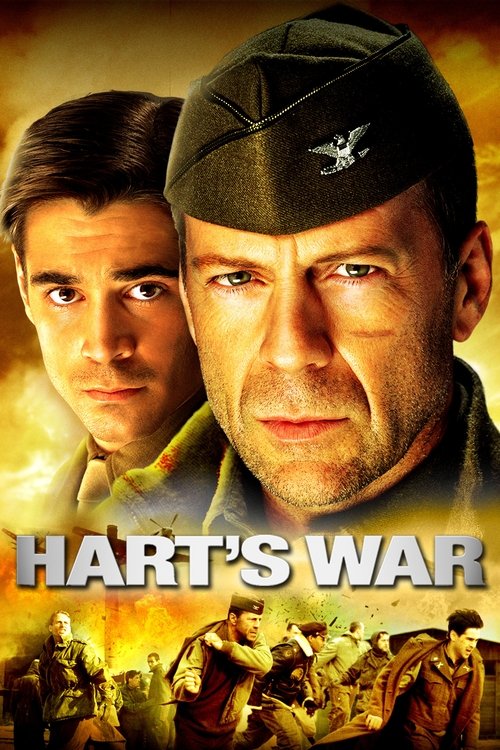
Hart's War
When Col. William McNamara is stripped of his freedom in a German POW camp, he's determined to keep on fighting even from behind enemy lines. Enlisting the help of a young lieutenant in a brilliant plot against his captors, McNamara risks everything on a mission to free his men and change the outcome of the war.
The film commercial failure against its respectable budget of $70.0M, earning $32.3M globally (-54% loss). While initial box office returns were modest, the film has gained appreciation for its unique voice within the drama genre.
1 win & 1 nomination


Plot Structure
Story beats plotted across runtime


Narrative Arc
Emotional journey through the story's key moments
Story Circle
Blueprint 15-beat structure
Arcplot Score Breakdown
Weighted: Precision (70%) + Arc (15%) + Theme (15%)
Hart's War (2002) exhibits precise narrative design, characteristic of Gregory Hoblit's storytelling approach. This structural analysis examines how the film's 15-point plot structure maps to proven narrative frameworks across 2 hours and 5 minutes. With an Arcplot score of 6.8, the film balances conventional beats with creative variation.
Structural Analysis
The Status Quo at 1 minutes (1% through the runtime) establishes Lt. Thomas Hart is shown as a privileged Yale law student turned officer, driving through the snowy Ardennes during the Battle of the Bulge. His status as a sheltered, untested soldier is established—a man who has yet to face true moral challenge.. Notably, this early placement immediately immerses viewers in the story world.
The inciting incident occurs at 15 minutes when Hart arrives at Stalag VI-A and is assigned to the enlisted barracks rather than officer quarters by McNamara—a subtle punishment. Two Black Tuskegee Airmen, Lt. Lincoln Scott and Lt. Archer, are also assigned to the enlisted barracks, disrupting the camp's racial dynamics.. At 12% through the film, this Disruption aligns precisely with traditional story structure. This beat shifts the emotional landscape, launching the protagonist into the central conflict.
The First Threshold at 31 minutes marks the transition into Act II, occurring at 25% of the runtime. This demonstrates the protagonist's commitment to Hart accepts the assignment to defend Lt. Scott in the court-martial, committing himself to seeking justice despite the hostility from racist prisoners and the impossibility of the situation. He crosses from passive observer to active participant in the fight for Scott's life., moving from reaction to action.
At 63 minutes, the Midpoint arrives at 50% of the runtime—precisely centered, creating perfect narrative symmetry. Notably, this crucial beat Hart discovers the trial is a diversion—McNamara is using it to cover an escape tunnel operation. The trial was never about justice; Scott is expendable. Hart realizes the entire defense may be a sham, and the commanding officer he trusted is manipulating everyone, including sacrificing Scott., fundamentally raising what's at risk. The emotional intensity shifts, dividing the narrative into clear before-and-after phases.
The Collapse moment at 94 minutes (75% through) represents the emotional nadir. Here, The escape plan is discovered by the Germans. The tunnel is found, the escapees are captured or killed, and the entire operation collapses. Scott faces execution for a murder he didn't commit. Everything Hart fought for seems lost—justice, the escape, his own redemption., indicates the protagonist at their lowest point. This beat's placement in the final quarter sets up the climactic reversal.
The Second Threshold at 100 minutes initiates the final act resolution at 80% of the runtime. Hart realizes he must expose the truth regardless of consequences. He chooses to reveal the real killer and fight for Scott's acquittal, synthesizing his legal training with the moral courage Scott embodied. He's ready to sacrifice his own standing for justice., demonstrating the transformation achieved throughout the journey.
Emotional Journey
Hart's War's emotional architecture traces a deliberate progression across 15 carefully calibrated beats.
Narrative Framework
This structural analysis employs structural analysis methodology used to understand storytelling architecture. By mapping Hart's War against these established plot points, we can identify how Gregory Hoblit utilizes or subverts traditional narrative conventions. The plot point approach reveals not only adherence to structural principles but also creative choices that distinguish Hart's War within the drama genre.
Gregory Hoblit's Structural Approach
Among the 6 Gregory Hoblit films analyzed on Arcplot, the average structural score is 7.1, reflecting strong command of classical structure. Hart's War takes a more unconventional approach compared to the director's typical style. For comparative analysis, explore the complete Gregory Hoblit filmography.
Comparative Analysis
Additional drama films include After Thomas, South Pacific and Dirty Dancing: Havana Nights. For more Gregory Hoblit analyses, see Fallen, Untraceable and Fracture.
Plot Points by Act
Act I
SetupStatus Quo
Lt. Thomas Hart is shown as a privileged Yale law student turned officer, driving through the snowy Ardennes during the Battle of the Bulge. His status as a sheltered, untested soldier is established—a man who has yet to face true moral challenge.
Theme
During Hart's brutal interrogation by the Germans, the Nazi officer challenges him about American values and whether Hart would sacrifice himself for principles. This plants the thematic question: what is true courage, and what are you willing to die for?
Worldbuilding
Hart is captured during the German offensive, endures torture and interrogation where he gives up information, and is transported to Stalag VI-A. We meet Col. McNamara, learn the camp hierarchy, and see the dehumanizing conditions of POW life.
Disruption
Hart arrives at Stalag VI-A and is assigned to the enlisted barracks rather than officer quarters by McNamara—a subtle punishment. Two Black Tuskegee Airmen, Lt. Lincoln Scott and Lt. Archer, are also assigned to the enlisted barracks, disrupting the camp's racial dynamics.
Resistance
Hart witnesses the racism directed at Scott and Archer by white prisoners. Archer is murdered after a confrontation with Bedford, a virulent racist. When Bedford is later found stabbed to death, Scott is accused of murder. Hart debates his role and McNamara assigns him to defend Scott in a court-martial.
Act II
ConfrontationFirst Threshold
Hart accepts the assignment to defend Lt. Scott in the court-martial, committing himself to seeking justice despite the hostility from racist prisoners and the impossibility of the situation. He crosses from passive observer to active participant in the fight for Scott's life.
Mirror World
Hart begins to know Lt. Lincoln Scott personally—learning of his excellence as a Tuskegee Airman, his dignity despite constant racism, and his refusal to compromise his principles. Scott becomes the mirror showing Hart what true courage looks like.
Premise
The court-martial proceeds within the POW camp, with German Col. Visser presiding. Hart investigates, interviews witnesses, and builds his defense while navigating racial hostility. The trial becomes a stage for examining American hypocrisy about equality while fighting fascism.
Midpoint
Hart discovers the trial is a diversion—McNamara is using it to cover an escape tunnel operation. The trial was never about justice; Scott is expendable. Hart realizes the entire defense may be a sham, and the commanding officer he trusted is manipulating everyone, including sacrificing Scott.
Opposition
Hart struggles with the knowledge that the trial is a cover. He continues defending Scott while uncovering evidence that another prisoner actually killed Bedford. The Germans grow suspicious. McNamara pressures Hart to maintain the charade. Hart's loyalty to justice conflicts with military duty.
Collapse
The escape plan is discovered by the Germans. The tunnel is found, the escapees are captured or killed, and the entire operation collapses. Scott faces execution for a murder he didn't commit. Everything Hart fought for seems lost—justice, the escape, his own redemption.
Crisis
Hart confronts the moral wasteland: Scott will be executed, the escape failed, and American officers sacrificed a Black man's life as a distraction. Hart must choose between silence (survival) and speaking the truth (risking everything). McNamara faces his own reckoning.
Act III
ResolutionSecond Threshold
Hart realizes he must expose the truth regardless of consequences. He chooses to reveal the real killer and fight for Scott's acquittal, synthesizing his legal training with the moral courage Scott embodied. He's ready to sacrifice his own standing for justice.
Synthesis
In the climax of the trial, Hart exposes the truth. But before justice can be served, McNamara makes the ultimate sacrifice—he falsely confesses to the murder to protect the men and the mission, knowing the Germans will execute him. McNamara is shot by firing squad, dying with dignity.
Transformation
Hart and Scott survive, transformed by what they witnessed. Hart—who began as a privileged man who broke under torture—has learned that true heroism means sacrifice for principle. Scott salutes McNamara's grave, and Hart carries forward the lesson of courage that transcends race and rank.