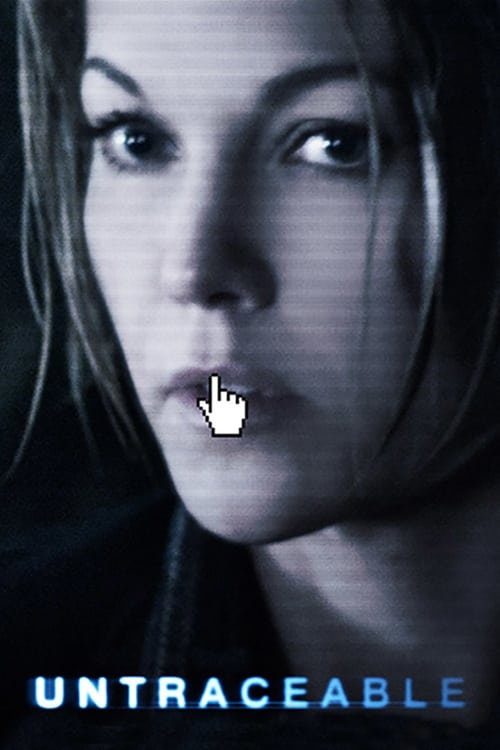
Untraceable
Special Agent Jennifer Marsh works in an elite division of the FBI dedicated to fighting cybercrime. She thinks she has seen it all, until a particularly sadistic criminal arises on the Internet. This tech-savvy killer posts live feeds of his crimes on his website; the more hits the site gets, the faster the victim dies. Marsh and her team must find the elusive killer before time runs out.
Working with a mid-range budget of $35.0M, the film achieved a steady performer with $52.7M in global revenue (+50% profit margin).


Plot Structure
Story beats plotted across runtime


Narrative Arc
Emotional journey through the story's key moments
Story Circle
Blueprint 15-beat structure
Arcplot Score Breakdown
Weighted: Precision (70%) + Arc (15%) + Theme (15%)
Untraceable (2008) exemplifies meticulously timed story structure, characteristic of Gregory Hoblit's storytelling approach. This structural analysis examines how the film's 15-point plot structure maps to proven narrative frameworks across 1 hour and 41 minutes. With an Arcplot score of 7.5, the film showcases strong structural fundamentals.
Structural Analysis
The Status Quo at 1 minutes (1% through the runtime) establishes FBI Agent Jennifer Marsh works in cybercrime from her home office in Portland, balancing her high-tech investigative work with single motherhood, living a controlled and compartmentalized life.. Significantly, this early placement immediately immerses viewers in the story world.
The inciting incident occurs at 13 minutes when Jennifer and Griffin discover KillWithMe.com, a website streaming live video of a kitten being killed, where the death rate accelerates based on the number of viewers - a disturbing new form of interactive murder.. At 13% through the film, this Disruption is delayed, allowing extended setup of the story world. This beat shifts the emotional landscape, launching the protagonist into the central conflict.
The First Threshold at 25 minutes marks the transition into Act II, occurring at 25% of the runtime. This illustrates the protagonist's commitment to The killer's first human victim dies on camera as millions watch. Jennifer fully commits to the case, accepting this is now a serial murder investigation that demands her complete engagement despite the risks., moving from reaction to action.
At 51 minutes, the Midpoint arrives at 50% of the runtime—precisely centered, creating perfect narrative symmetry. Significantly, this crucial beat Griffin Dowd, Jennifer's partner, is kidnapped by the killer and becomes the next victim on the website. The investigation becomes intensely personal - the killer is now targeting Jennifer's inner circle, raising stakes exponentially., fundamentally raising what's at risk. The emotional intensity shifts, dividing the narrative into clear before-and-after phases.
The Collapse moment at 76 minutes (75% through) represents the emotional nadir. Here, Detective Eric Box is kidnapped and appears as the next victim on the website. Jennifer realizes the killer has been surveilling her personally, knows her routines, and is systematically destroying everyone she works with and cares about., reveals the protagonist at their lowest point. This beat's placement in the final quarter sets up the climactic reversal.
The Second Threshold at 81 minutes initiates the final act resolution at 80% of the runtime. Jennifer synthesizes a breakthrough: analyzing the thermal signature in the video feed and cross-referencing property records, she identifies the killer's location. She combines her technical skills with Box's investigative instincts to pinpoint the exact address., demonstrating the transformation achieved throughout the journey.
Emotional Journey
Untraceable's emotional architecture traces a deliberate progression across 15 carefully calibrated beats.
Narrative Framework
This structural analysis employs a 15-point narrative structure framework that maps key story moments. By mapping Untraceable against these established plot points, we can identify how Gregory Hoblit utilizes or subverts traditional narrative conventions. The plot point approach reveals not only adherence to structural principles but also creative choices that distinguish Untraceable within the thriller genre.
Gregory Hoblit's Structural Approach
Among the 6 Gregory Hoblit films analyzed on Arcplot, the average structural score is 7.1, reflecting strong command of classical structure. Untraceable represents one of the director's most structurally precise works. For comparative analysis, explore the complete Gregory Hoblit filmography.
Comparative Analysis
Additional thriller films include The Warriors, Thunderball and Rustom. For more Gregory Hoblit analyses, see Fallen, Hart's War and Fracture.
Plot Points by Act
Act I
SetupStatus Quo
FBI Agent Jennifer Marsh works in cybercrime from her home office in Portland, balancing her high-tech investigative work with single motherhood, living a controlled and compartmentalized life.
Theme
During a team discussion about online predators, the idea emerges: "People would rather see something than look away" - establishing the theme about society's complicity in spectacle and violence.
Worldbuilding
Introduction to Jennifer's world: her cybercrime unit, partner Griffin Dowd, routine cases of credit card fraud and identity theft, her relationship with her daughter Annie, and the mundane but precise work of tracking digital criminals.
Disruption
Jennifer and Griffin discover KillWithMe.com, a website streaming live video of a kitten being killed, where the death rate accelerates based on the number of viewers - a disturbing new form of interactive murder.
Resistance
The team attempts to trace and shut down the untraceable website. Jennifer debates whether this is truly their jurisdiction. The killer escalates to a human victim. Jennifer resists making it personal but recognizes the unprecedented technical sophistication.
Act II
ConfrontationFirst Threshold
The killer's first human victim dies on camera as millions watch. Jennifer fully commits to the case, accepting this is now a serial murder investigation that demands her complete engagement despite the risks.
Mirror World
Detective Eric Box from Portland PD joins the investigation, bringing street-level detective work to complement Jennifer's cyber expertise. Their partnership represents the film's central relationship exploring trust and connection.
Premise
Jennifer and the team hunt the killer through digital forensics while bodies pile up in increasingly brutal ways. Each murder attracts more viewers, creating a feedback loop. Jennifer balances the investigation with protecting her daughter from the darkness of her work.
Midpoint
Griffin Dowd, Jennifer's partner, is kidnapped by the killer and becomes the next victim on the website. The investigation becomes intensely personal - the killer is now targeting Jennifer's inner circle, raising stakes exponentially.
Opposition
Jennifer watches helplessly as Griffin dies on camera. The killer taunts her directly. Media coverage explodes, driving more viewers to the site. Jennifer's emotional control fractures. The killer stays ahead of every technical trace, and Jennifer's own security is compromised.
Collapse
Detective Eric Box is kidnapped and appears as the next victim on the website. Jennifer realizes the killer has been surveilling her personally, knows her routines, and is systematically destroying everyone she works with and cares about.
Crisis
Jennifer faces her darkest moment watching Box being tortured online. She confronts her complicity - by investigating, she's driven traffic to the site. She nearly breaks down but must hold together to save Box and protect her daughter.
Act III
ResolutionSecond Threshold
Jennifer synthesizes a breakthrough: analyzing the thermal signature in the video feed and cross-referencing property records, she identifies the killer's location. She combines her technical skills with Box's investigative instincts to pinpoint the exact address.
Synthesis
Jennifer races to the killer's location and confronts Owen Reilly. She fights to save Box while the killer attempts to make her the final victim. Jennifer uses both her technical knowledge and physical determination to outsmart and overpower Reilly, ending the killing spree.
Transformation
Jennifer returns home to her daughter, having survived but transformed. She shuts her laptop, choosing presence over distance, connection over control - no longer hiding behind digital barriers but embracing the messy reality of human relationships and vulnerability.