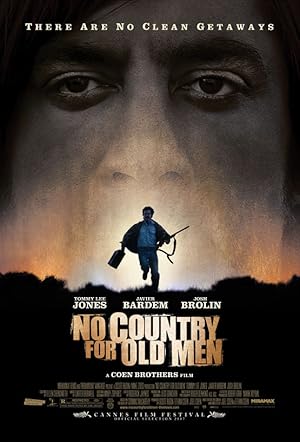
No Country for Old Men
In rural Texas, welder and hunter Llewelyn Moss (Josh Brolin) discovers the remains of several drug runners who have all killed each other in an exchange gone violently wrong. Rather than report the discovery to the police, Moss decides to simply take the two million dollars present for himself. This puts the psychopathic killer, Anton Chigurh (Javier Bardem), on his trail as he dispassionately murders nearly every rival, bystander and even employer in his pursuit of his quarry and the money. As Moss desperately attempts to keep one step ahead, the blood from this hunt begins to flow behind him with relentlessly growing intensity as Chigurh closes in. Meanwhile, the laconic Sheriff Ed Tom Bell (Tommy Lee Jones) blithely oversees the investigation even as he struggles to face the sheer enormity of the crimes he is attempting to thwart.
Despite a mid-range budget of $25.0M, No Country for Old Men became a box office phenomenon, earning $171.6M worldwide—a remarkable 587% return.
4 Oscars. 165 wins & 139 nominations
Roger Ebert
"The Coens have made a masterpiece about violence, fate, and the decay of American values, anchored by Bardem's chilling performance."Read Full Review


Plot Structure
Story beats plotted across runtime


Narrative Arc
Emotional journey through the story's key moments
Story Circle
Blueprint 15-beat structure
Arcplot Score Breakdown
Weighted: Precision (70%) + Arc (15%) + Theme (15%)
No Country for Old Men (2007) showcases meticulously timed narrative design, characteristic of Coen Brothers's storytelling approach. This structural analysis examines how the film's 15-point plot structure maps to proven narrative frameworks across 2 hours and 2 minutes. With an Arcplot score of 7.0, the film balances conventional beats with creative variation.
Characters
Cast & narrative archetypes

Llewelyn Moss
Anton Chigurh
Ed Tom Bell
Carla Jean Moss
Carson Wells
Main Cast & Characters
Llewelyn Moss
Played by Josh Brolin
A Vietnam veteran and welder who stumbles upon drug money and becomes the target of a relentless killer.
Anton Chigurh
Played by Javier Bardem
A psychopathic hitman who follows a strict personal code and uses a captive bolt pistol to kill his victims.
Ed Tom Bell
Played by Tommy Lee Jones
An aging sheriff who investigates the brutal murders and reflects on the changing, violent nature of the world.
Carla Jean Moss
Played by Kelly Macdonald
Llewelyn's loyal wife who becomes caught up in the deadly consequences of her husband's actions.
Carson Wells
Played by Woody Harrelson
A confident bounty hunter hired to track down Chigurh and recover the stolen money.
Structural Analysis
The Status Quo at 1 minutes (1% through the runtime) establishes Sheriff Ed Tom Bell's opening voiceover about the old-time sheriffs and how the modern world has become incomprehensible and violent. Establishes his weariness with a changing world he no longer understands.. Structural examination shows that this early placement immediately immerses viewers in the story world.
The inciting incident occurs at 15 minutes when Moss discovers the aftermath of a drug deal gone wrong in the desert: multiple bodies, trucks full of heroin, a wounded Mexican begging for water, and a satchel containing $2.4 million. The discovery disrupts his ordinary life.. At 12% through the film, this Disruption aligns precisely with traditional story structure. This beat shifts the emotional landscape, launching the protagonist into the central conflict.
The First Threshold at 27 minutes marks the transition into Act II, occurring at 22% of the runtime. This shows the protagonist's commitment to Moss sends his wife Carla Jean away and goes on the run with the money. He makes the active choice to keep the money and evade those who will come for it, fully entering the deadly new world of the chase., moving from reaction to action.
At 55 minutes, the Midpoint arrives at 45% of the runtime—arriving early, accelerating into Act IIb complications. Significantly, this crucial beat The hotel shootout between Moss and Chigurh. Both are wounded but Chigurh escapes. False victory: Moss thinks he's won, but Chigurh has demonstrated he cannot be stopped. The stakes raise—this is now a fight to the death. The fun and games are over., fundamentally raising what's at risk. The emotional intensity shifts, dividing the narrative into clear before-and-after phases.
The Collapse moment at 81 minutes (66% through) represents the emotional nadir. Here, Moss is killed off-screen by Mexican cartel members in a motel. The protagonist dies suddenly, unceremoniously, randomly—the ultimate "whiff of death." Everything Moss fought for is extinguished. His death is reported to Bell, who arrives too late yet again., reveals the protagonist at their lowest point. This beat's placement in the final quarter sets up the climactic reversal.
The Second Threshold at 88 minutes initiates the final act resolution at 72% of the runtime. Bell visits his uncle Ellis, who tells him the old-time sheriffs were just as overmatched by evil. Bell realizes "You can't stop what's coming" and decides to retire. He accepts the limits of what one man can do against fate and chaos., demonstrating the transformation achieved throughout the journey.
Emotional Journey
No Country for Old Men's emotional architecture traces a deliberate progression across 15 carefully calibrated beats.
Narrative Framework
This structural analysis employs structural analysis methodology used to understand storytelling architecture. By mapping No Country for Old Men against these established plot points, we can identify how Coen Brothers utilizes or subverts traditional narrative conventions. The plot point approach reveals not only adherence to structural principles but also creative choices that distinguish No Country for Old Men within the crime genre.
Coen Brothers's Structural Approach
Among the 11 Coen Brothers films analyzed on Arcplot, the average structural score is 5.1, showcasing experimental approaches to narrative form. No Country for Old Men represents one of the director's most structurally precise works. For comparative analysis, explore the complete Coen Brothers filmography.
Comparative Analysis
Additional crime films include The Bad Guys, Rustom and The Whole Ten Yards. For more Coen Brothers analyses, see The Ballad of Buster Scruggs, Inside Llewyn Davis and The Big Lebowski.
Plot Points by Act
Act I
SetupStatus Quo
Sheriff Ed Tom Bell's opening voiceover about the old-time sheriffs and how the modern world has become incomprehensible and violent. Establishes his weariness with a changing world he no longer understands.
Theme
Bell's voiceover about his father and the old-timers: "You can't stop what's coming." The theme of inevitability, fate, and the inability of good men to stop evil in a changing world.
Worldbuilding
Introduction of the three main characters in parallel: Chigurh's arrest and escape, establishing him as unstoppable evil; Llewelyn Moss hunting antelope in West Texas; Bell investigating crime scenes. The world is desolate, violent, and governed by fate.
Disruption
Moss discovers the aftermath of a drug deal gone wrong in the desert: multiple bodies, trucks full of heroin, a wounded Mexican begging for water, and a satchel containing $2.4 million. The discovery disrupts his ordinary life.
Resistance
Moss debates what to do with the money. He takes it home, hides it, lies awake consumed by guilt about the dying Mexican. Against his better judgment, he returns to the scene with water, triggering the pursuit when he's spotted by arriving cartel members.
Act II
ConfrontationFirst Threshold
Moss sends his wife Carla Jean away and goes on the run with the money. He makes the active choice to keep the money and evade those who will come for it, fully entering the deadly new world of the chase.
Mirror World
Sheriff Bell arrives at the scene, beginning his parallel investigation. Bell represents the moral law and old values, serving as thematic counterpoint to Chigurh's chaos and Moss's pragmatic survival. Bell will teach us what the story means.
Premise
The cat-and-mouse game we came to see: Moss evades cartel hitmen and Chigurh, who tracks him using a transponder hidden in the money. Moss proves resourceful and intelligent, treating his wounds, acquiring weapons, staying one step ahead. The promise of the premise delivers.
Midpoint
The hotel shootout between Moss and Chigurh. Both are wounded but Chigurh escapes. False victory: Moss thinks he's won, but Chigurh has demonstrated he cannot be stopped. The stakes raise—this is now a fight to the death. The fun and games are over.
Opposition
Chigurh continues closing in. Carson Wells, another hitman, finds Moss and warns him Chigurh will never stop and will kill Carla Jean. Moss refuses to give up the money. Chigurh kills Wells. Bell always arrives too late, unable to protect anyone. The walls close in.
Collapse
Moss is killed off-screen by Mexican cartel members in a motel. The protagonist dies suddenly, unceremoniously, randomly—the ultimate "whiff of death." Everything Moss fought for is extinguished. His death is reported to Bell, who arrives too late yet again.
Crisis
Bell processes the loss. He visits the crime scene, narrowly missing Chigurh who hides behind a door. Bell realizes he's out of his depth, that he cannot stop this evil. He confronts his own limitations and the darkness of the new world.
Act III
ResolutionSecond Threshold
Bell visits his uncle Ellis, who tells him the old-time sheriffs were just as overmatched by evil. Bell realizes "You can't stop what's coming" and decides to retire. He accepts the limits of what one man can do against fate and chaos.
Synthesis
Chigurh tracks down Carla Jean and kills her despite giving her a coin toss, showing his absolute adherence to his code. He's injured in a random car accident, escapes. Bell retires, leaving the chaos unresolved. The finale denies catharsis.
Transformation
Bell tells his wife about two dreams of his father. In the second, his father rides ahead carrying fire in a horn, going to prepare a place in the darkness. Bell says, "And then I woke up." He has accepted mortality, limitation, and that the old ways are gone.