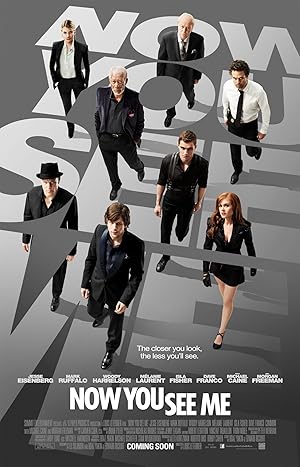
Now You See Me
Four magicians each answer a mysterious summons to an obscure address with secrets inside. A year later, they are the Four Horsemen, big time stage illusionists who climax their sold-out Las Vegas show with a bank apparently robbed for real. This puts F.B.I. Agents Dylan Rhodes and Interpol Agent Alma Dray on the case to find out how they did it. However, this mystery proves to be difficult to solve, even with the insights of professional illusion exposer Thaddeus Bradley. What follows is a bizarre investigation where nothing is what it seems to be, with illusions, dark secrets, and hidden agendas galore as all involved are reminded of a great truth in this puzzle: the closer you look, the less you see.
Despite a substantial budget of $75.0M, Now You See Me became a box office success, earning $351.7M worldwide—a 369% return.
1 win & 3 nominations


Plot Structure
Story beats plotted across runtime


Narrative Arc
Emotional journey through the story's key moments
Story Circle
Blueprint 15-beat structure
Arcplot Score Breakdown
Weighted: Precision (70%) + Arc (15%) + Theme (15%)
Now You See Me (2013) exemplifies strategically placed narrative architecture, characteristic of Louis Leterrier's storytelling approach. This structural analysis examines how the film's 15-point plot structure maps to proven narrative frameworks across 1 hour and 56 minutes. With an Arcplot score of 7.2, the film balances conventional beats with creative variation.
Characters
Cast & narrative archetypes

J. Daniel Atlas
Dylan Rhodes
Merritt McKinney
Henley Reeves
Jack Wilder
Thaddeus Bradley
Alma Dray
Arthur Tressler
Main Cast & Characters
J. Daniel Atlas
Played by Jesse Eisenberg
A cocky, ambitious street magician and mentalist who leads the Four Horsemen with his showmanship and intellectual superiority complex.
Dylan Rhodes
Played by Mark Ruffalo
An FBI agent assigned to investigate the Four Horsemen whose true motivations are far more complex than they appear.
Merritt McKinney
Played by Woody Harrelson
A former mentalist and hypnotist fallen on hard times who uses his psychological manipulation skills as part of the Four Horsemen.
Henley Reeves
Played by Isla Fisher
A skilled escape artist and former assistant to Atlas who joins the Four Horsemen seeking recognition for her own talents.
Jack Wilder
Played by Dave Franco
The youngest Horseman, a street hustler and sleight-of-hand expert who provides the team with pickpocketing and lock-picking skills.
Thaddeus Bradley
Played by Morgan Freeman
A former magician turned professional magic debunker who exposes tricks for profit and fame, serving as the Horsemen's primary public antagonist.
Alma Dray
Played by Melanie Laurent
An Interpol agent from France partnered with Dylan Rhodes, intelligent and perceptive with her own theories about the case.
Arthur Tressler
Played by Michael Caine
A wealthy insurance magnate and initial financier of the Four Horsemen who becomes a target of their elaborate revenge scheme.
Structural Analysis
The Status Quo at 2 minutes (1% through the runtime) establishes Four individual street magicians (J. Daniel Atlas, Merritt McKinney, Henley Reeves, Jack Wilder) perform separate acts showcasing their unique talents in their ordinary worlds before being recruited.. Structural examination shows that this early placement immediately immerses viewers in the story world.
The inciting incident occurs at 14 minutes when During their Las Vegas show, the Horsemen perform an impossible illusion: they seemingly teleport audience member Étienne Forcier to his Paris bank, rob the vault in real-time, and shower the Vegas audience with 3 million euros, launching an international investigation.. At 12% through the film, this Disruption aligns precisely with traditional story structure. This beat shifts the emotional landscape, launching the protagonist into the central conflict.
The First Threshold at 29 minutes marks the transition into Act II, occurring at 25% of the runtime. This illustrates the protagonist's commitment to Rhodes chooses to pursue the Horsemen despite lack of evidence and professional risk. The Horsemen announce their next performance in New Orleans, escalating the game. Rhodes and Alma commit to stopping the next heist., moving from reaction to action.
At 58 minutes, the Midpoint arrives at 50% of the runtime—precisely centered, creating perfect narrative symmetry. The analysis reveals that this crucial beat False defeat: The Horsemen escape an elaborate FBI trap through a spectacular car chase filled with illusions and misdirection. Rhodes realizes he's always one step behind - they anticipated every move. The game changes: Rhodes is being played., fundamentally raising what's at risk. The emotional intensity shifts, dividing the narrative into clear before-and-after phases.
The Collapse moment at 87 minutes (75% through) represents the emotional nadir. Here, All is lost: Cornered by FBI on Roosevelt Island during their final show, the Horsemen seemingly fail. Their money-drop trick is exposed as fake. They jump into the East River and apparently drown - the same death as Rhodes's father. The whiff of death is literal., indicates the protagonist at their lowest point. This beat's placement in the final quarter sets up the climactic reversal.
The Second Threshold at 93 minutes initiates the final act resolution at 80% of the runtime. The revelation: Rhodes discovers Bradley has the stolen money in his car - Bradley is arrested. Rhodes finds the Horsemen alive in the carousel building. He reveals himself as the fifth Horseman and member of The Eye who orchestrated everything to avenge his father., demonstrating the transformation achieved throughout the journey.
Emotional Journey
Now You See Me's emotional architecture traces a deliberate progression across 15 carefully calibrated beats.
Narrative Framework
This structural analysis employs a 15-point narrative structure framework that maps key story moments. By mapping Now You See Me against these established plot points, we can identify how Louis Leterrier utilizes or subverts traditional narrative conventions. The plot point approach reveals not only adherence to structural principles but also creative choices that distinguish Now You See Me within the crime genre.
Louis Leterrier's Structural Approach
Among the 7 Louis Leterrier films analyzed on Arcplot, the average structural score is 7.1, reflecting strong command of classical structure. Now You See Me represents one of the director's most structurally precise works. For comparative analysis, explore the complete Louis Leterrier filmography.
Comparative Analysis
Additional crime films include The Bad Guys, Rustom and The Whole Ten Yards. For more Louis Leterrier analyses, see The Incredible Hulk, Unleashed and Clash of the Titans.
Plot Points by Act
Act I
SetupStatus Quo
Four individual street magicians (J. Daniel Atlas, Merritt McKinney, Henley Reeves, Jack Wilder) perform separate acts showcasing their unique talents in their ordinary worlds before being recruited.
Theme
"The closer you look, the less you see" - the film's central theme of misdirection and perception vs. reality is established through Atlas's card trick philosophy and magic performances.
Worldbuilding
The four magicians each receive mysterious tarot cards leading them to a secret apartment in New York. One year later, they emerge as "The Four Horsemen," a famous magic act backed by insurance magnate Arthur Tressler, preparing for their Las Vegas debut.
Disruption
During their Las Vegas show, the Horsemen perform an impossible illusion: they seemingly teleport audience member Étienne Forcier to his Paris bank, rob the vault in real-time, and shower the Vegas audience with 3 million euros, launching an international investigation.
Resistance
FBI Agent Dylan Rhodes and Interpol Agent Alma Dray investigate the Horsemen. They interrogate the magicians without evidence, consult former magician Thaddeus Bradley who debunks illusions, and debate whether a crime actually occurred. The Horsemen are released due to lack of proof.
Act II
ConfrontationFirst Threshold
Rhodes chooses to pursue the Horsemen despite lack of evidence and professional risk. The Horsemen announce their next performance in New Orleans, escalating the game. Rhodes and Alma commit to stopping the next heist.
Mirror World
The partnership between Rhodes and Alma deepens as they investigate together. Thaddeus Bradley's backstory is revealed - he's a former magician who now makes millions exposing other magicians' tricks, representing the cynical opposite of the Horsemen's wonder.
Premise
The promise of the premise: elaborate cat-and-mouse between FBI and magicians. The New Orleans show where the Horsemen drain Arthur Tressler's bank account and expose his insurance fraud, distributing money to Hurricane Katrina victims. The Horsemen mention serving "The Eye," a legendary secret society of magicians.
Midpoint
False defeat: The Horsemen escape an elaborate FBI trap through a spectacular car chase filled with illusions and misdirection. Rhodes realizes he's always one step behind - they anticipated every move. The game changes: Rhodes is being played.
Opposition
Pressure intensifies: Rhodes discovers the case connects to his father, a magician who died in a failed safe escape trick. Betrayed Tressler teams with Bradley to expose the Horsemen. The final New York show approaches. Jack Wilder apparently dies in a confrontation. Internal tensions and external threats converge.
Collapse
All is lost: Cornered by FBI on Roosevelt Island during their final show, the Horsemen seemingly fail. Their money-drop trick is exposed as fake. They jump into the East River and apparently drown - the same death as Rhodes's father. The whiff of death is literal.
Crisis
Rhodes processes the apparent deaths - history repeating with his father. Bradley gloats to media, revealing the mechanics of the tricks. The case seems closed but hollow. Alma tries to console Rhodes. The victory feels empty.
Act III
ResolutionSecond Threshold
The revelation: Rhodes discovers Bradley has the stolen money in his car - Bradley is arrested. Rhodes finds the Horsemen alive in the carousel building. He reveals himself as the fifth Horseman and member of The Eye who orchestrated everything to avenge his father.
Synthesis
The finale and resolution: Rhodes explains the year-long con - Tressler funded the safe trick that killed his father, Bradley filmed it for profit. The entire investigation was theater. The Horsemen pass their test and are inducted into The Eye. Rhodes and Alma's relationship evolves with new understanding.
Transformation
Final image mirrors the opening: Rhodes performs an intimate card trick for Alma in Paris, revealing himself as a true magician. The FBI agent was the master illusionist all along. The student becomes the teacher, the hunter was the architect, completing the circle.