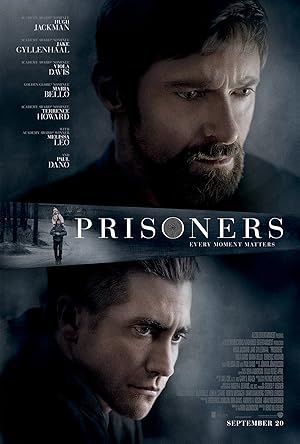
Prisoners
How far would you go to protect your family? Keller Dover is facing every parent's worst nightmare. His six-year-old daughter, Anna, is missing, together with her young friend, Joy, and as minutes turn to hours, panic sets in. The only lead is a dilapidated RV that had earlier been parked on their street. Heading the investigation, Detective Loki arrests its driver, Alex Jones, but a lack of evidence forces his release. As the police pursue multiple leads and pressure mounts, knowing his child's life is at stake the frantic Dover decides he has no choice but to take matters into his own hands. But just how far will this desperate father go to protect his family?
Despite a respectable budget of $46.0M, Prisoners became a commercial success, earning $122.1M worldwide—a 165% return.
Nominated for 1 Oscar. 10 wins & 38 nominations
Christy Lemire
"Villeneuve creates an atmosphere of dread that lingers long after the credits roll, anchored by powerhouse performances from Jackman and Gyllenhaal."Read Full Review


Plot Structure
Story beats plotted across runtime


Narrative Arc
Emotional journey through the story's key moments
Story Circle
Blueprint 15-beat structure
Arcplot Score Breakdown
Weighted: Precision (70%) + Arc (15%) + Theme (15%)
Prisoners (2013) demonstrates deliberately positioned narrative architecture, characteristic of Denis Villeneuve's storytelling approach. This structural analysis examines how the film's 15-point plot structure maps to proven narrative frameworks across 2 hours and 33 minutes. With an Arcplot score of 6.3, the film takes an unconventional approach to traditional narrative frameworks.
Characters
Cast & narrative archetypes

Keller Dover
Detective Loki
Alex Jones
Franklin Birch
Grace Dover
Nancy Birch
Holly Jones
Main Cast & Characters
Keller Dover
Played by Hugh Jackman
A desperate father who takes extreme measures to find his missing daughter, descending into moral darkness.
Detective Loki
Played by Jake Gyllenhaal
A meticulous detective with a perfect solve rate investigating the kidnapping case.
Alex Jones
Played by Paul Dano
A young man with the IQ of a 10-year-old who becomes Keller's primary suspect.
Franklin Birch
Played by Terrence Howard
Keller's neighbor and friend whose daughter also goes missing, struggles with Keller's methods.
Grace Dover
Played by Maria Bello
Keller's wife who copes with her daughter's disappearance through grief and faith.
Nancy Birch
Played by Viola Davis
Franklin's wife who becomes emotionally shattered by her daughter's disappearance.
Holly Jones
Played by Melissa Leo
Alex's aunt who cares for him, harboring dark secrets.
Structural Analysis
The Status Quo at 1 minutes (1% through the runtime) establishes Keller Dover and his son hunt a deer in the snowy Pennsylvania woods while reciting the Lord's Prayer, establishing Keller as a protective father who believes in faith, self-reliance, and being prepared for the worst.. Structural examination shows that this early placement immediately immerses viewers in the story world.
The inciting incident occurs at 16 minutes when Anna and Joy have vanished. The families search desperately, realizing the girls are missing. A suspicious RV that was parked on their street is gone. The ordinary world of Thanksgiving warmth is obliterated by every parent's worst nightmare.. At 11% through the film, this Disruption aligns precisely with traditional story structure. This beat shifts the emotional landscape, launching the protagonist into the central conflict.
The First Threshold at 34 minutes marks the transition into Act II, occurring at 22% of the runtime. This demonstrates the protagonist's commitment to When Alex is released due to lack of evidence, Keller makes the irreversible choice to take justice into his own hands. He kidnaps Alex and imprisons him in an abandoned apartment building, crossing a moral threshold from desperate father to torturer and vigilante., moving from reaction to action.
At 69 minutes, the Midpoint arrives at 45% of the runtime—arriving early, accelerating into Act IIb complications. Structural examination shows that this crucial beat Bob Taylor is captured and his house reveals boxes of bloody children's clothing and maze obsessions. This appears to be a major break - a false victory. But Taylor shoots himself during interrogation, and forensics reveals the blood was pig's blood, the clothes purchased. The real kidnapper remains free, and Keller's torture of Alex has yielded nothing., fundamentally raising what's at risk. The emotional intensity shifts, dividing the narrative into clear before-and-after phases.
The Collapse moment at 103 minutes (67% through) represents the emotional nadir. Here, Loki discovers Alex was kidnapped as a child and realizes the true pattern. He finds Keller at the hidden location torturing a near-dead Alex. Keller has become a monster, and the man he tortured was himself a victim. Everything Keller believed about Alex appears to have been wrong., reveals the protagonist at their lowest point. This beat's placement in the final quarter sets up the climactic reversal.
The Second Threshold at 110 minutes initiates the final act resolution at 72% of the runtime. Loki connects the maze symbols to Holly Jones, Alex's aunt who took him in after his parents died. Keller, visiting Holly to apologize, notices a detail that triggers his memory - realizing Holly is the kidnapper. The truth finally emerges, synthesizing all the scattered clues., demonstrating the transformation achieved throughout the journey.
Emotional Journey
Prisoners's emotional architecture traces a deliberate progression across 15 carefully calibrated beats.
Narrative Framework
This structural analysis employs systematic plot point analysis that identifies crucial turning points. By mapping Prisoners against these established plot points, we can identify how Denis Villeneuve utilizes or subverts traditional narrative conventions. The plot point approach reveals not only adherence to structural principles but also creative choices that distinguish Prisoners within the crime genre.
Denis Villeneuve's Structural Approach
Among the 7 Denis Villeneuve films analyzed on Arcplot, the average structural score is 5.9, showcasing experimental approaches to narrative form. Prisoners represents one of the director's most structurally precise works. For comparative analysis, explore the complete Denis Villeneuve filmography.
Comparative Analysis
Additional crime films include The Bad Guys, Rustom and The Whole Ten Yards. For more Denis Villeneuve analyses, see Sicario, Incendies and Arrival.
Plot Points by Act
Act I
SetupStatus Quo
Keller Dover and his son hunt a deer in the snowy Pennsylvania woods while reciting the Lord's Prayer, establishing Keller as a protective father who believes in faith, self-reliance, and being prepared for the worst.
Theme
Keller tells his son Ralph about his basement survivalist preparations, stating "Pray for the best, but prepare for the worst." This encapsulates the film's exploration of how far a man will go when his prayers go unanswered and preparation fails.
Worldbuilding
Thanksgiving Day brings two families together: the Dovers and the Birches. The parents drink and socialize while the children play. The Dovers' daughter Anna and the Birches' daughter Joy ask permission to walk to the Dover house, establishing the warm family bonds and community that will be shattered.
Disruption
Anna and Joy have vanished. The families search desperately, realizing the girls are missing. A suspicious RV that was parked on their street is gone. The ordinary world of Thanksgiving warmth is obliterated by every parent's worst nightmare.
Resistance
Detective Loki takes the case and tracks down the RV, driven by Alex Jones, a mentally impaired young man. Despite intense interrogation, no evidence connects Alex to the crime and he must be released. Keller confronts Alex in the parking lot, and Alex whispers something about the children that the police dismiss but Keller cannot ignore.
Act II
ConfrontationFirst Threshold
When Alex is released due to lack of evidence, Keller makes the irreversible choice to take justice into his own hands. He kidnaps Alex and imprisons him in an abandoned apartment building, crossing a moral threshold from desperate father to torturer and vigilante.
Mirror World
Detective Loki becomes the moral mirror to Keller's descent. While Keller tortures Alex in secret, Loki methodically pursues leads through proper channels - investigating a priest who had a corpse in his basement and following evidence. Loki represents the system Keller has abandoned.
Premise
Keller's brutal interrogation of Alex escalates while Loki pursues conventional investigation. Keller brings Franklin Birch into his vigilante mission, compromising another father's soul. Meanwhile, Loki discovers a suspect, Bob Taylor, who has maze drawings matching ones found at the crime scene.
Midpoint
Bob Taylor is captured and his house reveals boxes of bloody children's clothing and maze obsessions. This appears to be a major break - a false victory. But Taylor shoots himself during interrogation, and forensics reveals the blood was pig's blood, the clothes purchased. The real kidnapper remains free, and Keller's torture of Alex has yielded nothing.
Opposition
Keller's torture becomes more extreme and desperate as no answers come. His wife Grace collapses into a medicated haze. Loki discovers Taylor was a former kidnapping victim himself and investigates connections to maze symbols. Keller's brutality isolates him from everyone, including Franklin who can no longer participate.
Collapse
Loki discovers Alex was kidnapped as a child and realizes the true pattern. He finds Keller at the hidden location torturing a near-dead Alex. Keller has become a monster, and the man he tortured was himself a victim. Everything Keller believed about Alex appears to have been wrong.
Crisis
Keller flees from Loki, his crimes exposed. Alex is hospitalized. The investigation shifts as Loki re-examines everything. Keller, now a wanted man, realizes his torture may have destroyed their only lead and damned his soul for nothing.
Act III
ResolutionSecond Threshold
Loki connects the maze symbols to Holly Jones, Alex's aunt who took him in after his parents died. Keller, visiting Holly to apologize, notices a detail that triggers his memory - realizing Holly is the kidnapper. The truth finally emerges, synthesizing all the scattered clues.
Synthesis
Holly drugs Keller and reveals she and her late husband kidnapped children as a "war against God" after losing their son to cancer. She imprisoned him in a pit. Loki races to Holly's house, finds Joy drugged but alive, and shoots Holly as she attempts to kill the children. Anna is discovered in a hidden car pit. Loki rushes Anna to the hospital.
Transformation
As police clear the scene, Loki pauses. In the silence, he hears a faint whistle - Keller's emergency whistle from the film's opening. Keller lies trapped in the pit where Holly imprisoned him, his fate mirroring Alex's. Whether Loki will find him remains ambiguous - a father who became a monster may die in the same darkness he created.